

Syllabus: GS2/Governance
Context
- The National Social Assistance Programme serves as a key pillar of India’s social security system, providing essential support to citizens in need.
National Social Assistance Programme (NSAP)
- Introduced: On 15 August 1995.
- It is a fully funded Centrally Sponsored Scheme that extends financial support to individuals living below poverty line (BPL).
- Implemented by the Ministry of Rural Development.
- Operation: It operates across both rural and urban areas.
- Pensions Covered: NSAP covers old age pension, widow pension, disability pension, family benefit, and food security.
The NSAP at present comprises five sub-schemes as its components:
- Indira Gandhi National Old Age Pension Scheme (IGNOAPS): Financial assistance to elderly citizens aged 60 years.
- Those between 60 and 79 years of age receive Rs.200 per month, while those aged 80 years and above are provided Rs.500 per month.
- Indira Gandhi National Widow Pension Scheme (IGNWPS): Widows aged between 40 and 79 years.
- Pension of Rs.300 per month and for those aged 80 years and above, the amount is Rs.500 per month.
- Indira Gandhi National Disability Pension Scheme (IGNDPS): Scheme caters to individuals aged between 18 and 79 years who have severe or multiple disabilities and belong to families living below the poverty line.
- The beneficiaries are eligible for central assistance of Rs.300 per month and who are 80 years and above receive Rs.500 per month.
- National Family Benefit Scheme (NFBS): A household living below the poverty line becomes eligible for lump sum financial assistance in the unfortunate event of the death of its primary breadwinner between 18 and 59 years of age.
- The family receives Rs.20,000 as support to help them cope with the immediate financial difficulties arising from the loss.
- Annapurna Scheme: 10kg of food grains per month are provided free of cost to those senior citizens who, though eligible under IGNOAPS, are not receiving old age pension.
Implementation:
- Selection: Gram Panchayats and Municipalities play an active role in identifying eligible beneficiaries under the different NSAP schemes.
- Disbursement: Benefits are provided through DBT mode (94%) i.e beneficiary’s bank or post office savings accounts, or via postal money orders.
- Monitoring: States and Union Territories have the flexibility to implement the schemes through any State Government department, but each must appoint a Nodal Secretary at the State level to oversee implementation and coordinate with relevant departments.
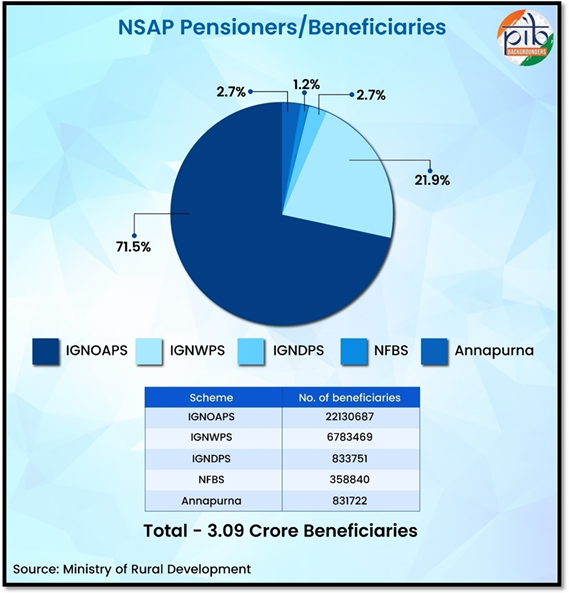
Beneficiaries Under Each Scheme:
Conclusion
- By integrating Aadhaar-based authentication and promoting direct benefit transfers, NSAP has improved transparency, reduced fraud, and strengthened the delivery of welfare to millions of beneficiaries.
- Collectively, these measures offer critical financial relief and contribute to a more inclusive and equitable social safety net across the country.
Source: PIB
Previous article
SC Orders Removal of Stray Dogs From Public Places
Next article
National Legal Services Day
