


150 Years of Vande Mataram
Syllabus: GS1/History/GS2/Polity and Governance
In News
- India commemorates the 150th anniversary of its National Song, Vande Mataram, a powerful symbol of unity, sacrifice, and patriotism.
Historical Background
- Composed by Bankim Chandra Chatterjee, ‘Vande Mataram’ was first published in the literary journal Bangadarshan on 7 November 1875.
- Later, Bankim Chandra Chatterjee incorporated the hymn in his immortal novel ‘Anandamath’ which was published in 1882.
- First sung by Rabindranath Tagore at the 1896 Congress session, it gained prominence during the 1905 Swadeshi and anti-partition movements, with initiatives like the Bande Mataram Sampradaya in Calcutta and massive processions in Barisal.
- In 1907, Madam Bhikaji Cama raised the tricolour flag for the first-time outside India in Stuttgart, Berlin. The words Vande Mataram were written on the flag.
National Status
- On 24 January 1950, Dr. Rajendra Prasad, addressing the Constituent Assembly, affirmed the unanimous decision to adopt Rabindranath Tagore’s Jana Gana Mana as India’s National Anthem and Bankim Chandra Chatterjee’s Vande Mataram as the National Song, granting both equal status.
| Bankim Chandra Chatterjee (1838–1894) – Bankim Chandra Chatterjee (1838–1894), the author of Vande Mataram, was one of the most prominent figures of 19th-century Bengal. – He holds a pivotal role in the intellectual and literary history of Bengal during the nineteenth century. – As a distinguished novelist, poet, and essayist, his contributions significantly influenced the development of modern Bengali prose and the articulation of an emerging Indian nationalism. – His notable works, including Anandamath (1882), Durgeshnandini (1865), Kapalkundala (1866), and Devi Chaudhurani (1884), reflect the social, cultural, and moral concerns of a colonised society striving for self-identity. |
Source :PIB
BRAIN Initiative Cell Atlas Network (BICAN)
Syllabus: GS2/ Health
In News
- Scientists working under the U.S. NIH’s BRAIN Initiative Cell Atlas Network (BICAN) have developed the first draft of comprehensive atlases charting the development of the human.
Key Highlights
- A large-scale cellular atlas of the human brain built using advanced single-cell sequencing and spatial transcriptomics technologies.
- The atlas charts cell types, gene expression patterns, and developmental pathways in the brain across various ages, including fetal, infant, adolescent, adult, and aged brains.
Benefit
- This will help in understanding how brain cells develop, mature, and interact, providing insight into neurological and psychiatric diseases like Alzheimer’s, autism, and schizophrenia.
About the BRAIN Initiative
- It was launched in 2013 by the U.S. National Institutes of Health (NIH) to revolutionize understanding of the human brain’s structure and function by mapping every cell and its connections.
Source: TH
Christmas Island
Syllabus: GS1/ Places In News
In News
- Google plans to build a large artificial intelligence data centre on Australia’s remote Indian Ocean outpost of Christmas Island after signing a cloud deal with the Department of Defence.
About Christmas Island
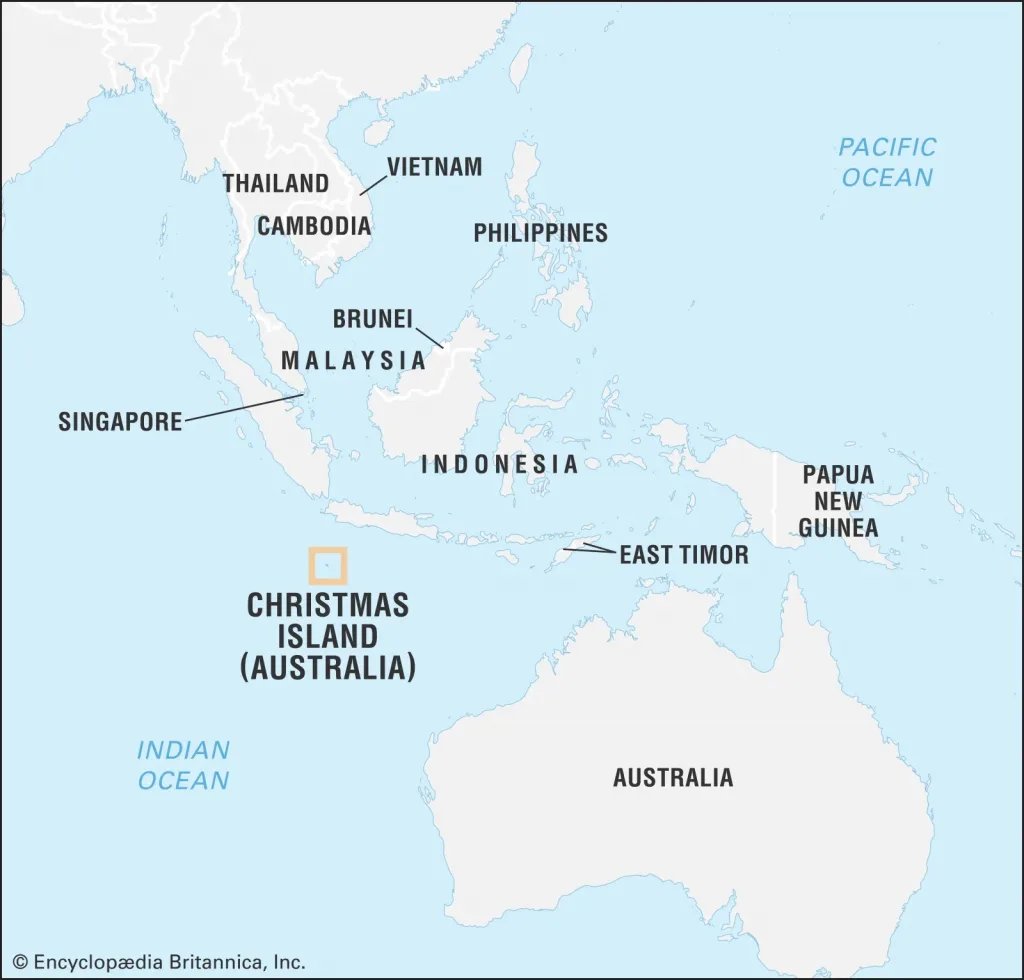
- Location: Christmas Island is an Australian external territory located in the Indian Ocean, about 350 km south of Java (Indonesia) and nearly 1,550 km northwest of Australia’s mainland.
- Historical Background: Discovered on Christmas Day in 1643 by Captain William Mynors of the British East India Company — hence the name Christmas Island.
- Strategic Significance: Lies close to key maritime chokepoints like Sunda Strait, Lombok Strait, and Malacca Strait, making it vital for Quadrilateral cooperation (Quad) and Indo-Pacific maritime strategy.
Source: TH
Quantum Gravity
Syllabus: GS3/Science and Technology
Context
- A new theoretical study suggests that tiny black holes, called “black hole morsels”, could help probe quantum gravity.
About
- Quantum Gravity: It is an attempt to reconcile two theories of physics:quantum mechanics, which tells us how physics works on very small scales — and gravity (general relativity), which tells us how physics works on large scales.
- Quantum gravity remains unsolved – we know how to describe quantum mechanics and gravity separately, but not together.
- Hawking Radiation: When applying quantum theory near a black hole, physicist Stephen Hawking found that black holes can emit radiation — a purely quantum-gravity effect.
- This is one of the few known hints that quantum mechanics and gravity do interact.
- Black Hole Morsels: Black Hole Morsels are a theoretical concept — tiny, short-lived black holes that could form during extreme cosmic events like black hole mergers.
- They are proposed as possible tools to study quantum gravity.
- These morsels would emit strong, short-lived bursts of high-energy radiation (Hawking radiation) that could, in principle, be detected by existing gamma-ray telescopes.
Significance
- If detected, such radiation would provide direct experimental evidence about the quantum nature of space, time, and gravity.
- Quantum gravity can help us understand the physics within black holes and the moments right after the birth of the universe.
- It can also aid us in understanding quantum entanglement, condensed matter physics and quantum information.
Source: TH
China’s Aircraft Carrier Fujian
Syllabus: GS3/Defence
In News
- China has commissioned its first indigenously designed aircraft carrier, Fujian.
Aircraft carrier Fujian
- It is China’s third aircraft carrier and the first to be indigenously designed, named after the province opposite Taiwan.
- Unlike its Russian-designed predecessors, Liaoning and Shandong, it features a flat deck and electromagnetic catapults, enabling it to launch heavier and more advanced aircraft.
- Sea trials have included the J-35 stealth fighter, KJ-600 early-warning aircraft, and a variant of the J-15, marking a significant upgrade in China’s naval aviation capabilities.
Source: TH
HAL inks $1-billion deal with GE Aerospace
Syllabus: GS3/Defence
Context
- India has signed a $1 billion deal with America’s General Electric for the procurement of 113 jet engines to power the indigenous Tejas Mark 1-A fighters under Tejas light combat aircraft programme.
About
- The GE-F404 engines will be delivered to the defence PSU Hindustan Aeronautics (HAL) between 2027 and 2032.
- However, the delivery of 99 such engines ordered in 2021 is still pending.
- IAF is looking at inducting the warplanes as the number of its fighter squadrons has gone down to 31 from officially sanctioned strength of 42.
- The LCA Mk-1As will replace the IAF’s MiG-21 fighter jets.
| Tejas Mk-1A – Light Combat Aircraft (LCA) Tejas is a 4.5 generation, all weather and multi-role fighter aircraft. – The aircraft is designed to be a multi-role aircraft capable of taking up offensive air support, close combat and ground attack roles at ease. – LCA Mk1A is the most advanced version of the LCA Tejas. – It is equipped with AESA Radar, EW suite consisting of radar warning and self-protection jamming, Digital Map Generator (DMG), Smart Multi-function Displays (SMFD), Combined Interrogator and Transponder (CIT), Advanced Radio Altimeter and other advances features. |
Source: TH
Rhesus Macaque
Syllabus: GS3/Environment
In News
- The National Board of Wildlife has reinstated Schedule II protection for the Rhesus Macaque, strengthening legal safeguards against its hunting, trade, and mistreatment.
Rhesus Macaque(Macaca mulatta)
- It is a diurnal, omnivorous primate that alternates between tree-dwelling and ground movement.
- It inhabits diverse ecosystems, including various forest types, mangroves, scrublands, rainforests, and areas near human settlements.
- It is found throughout most of southern Asia, in eastern Afghanistan, Bangladesh, Bhutan, China and India.
- It is listed as Least Concern.
- It is listed on CITES Appendix II.
Source :IE
Previous article
GST Collections & Performances of States
Next article
India Withdraws from Ayni Airbase
