


Syllabus: GS2/International Relations; Global Grouping
Context
- Multilateralism remains essential to global cooperation amid ongoing geopolitical tensions, climate crises, and rising nationalism.
| United Nations General Assembly (UNGA) – It was established in 1945 as one of the six principal organs of the United Nations (UN). It serves as the only body within the UN where all 193 member states have equal representation, each holding one vote. – It meets annually in New York (Headquarter), for its General Debate — a high-profile event where world leaders address global challenges and outline their national priorities. – It plays a vital role in shaping global norms and fostering consensus on pressing issues, while its resolutions are non-binding. 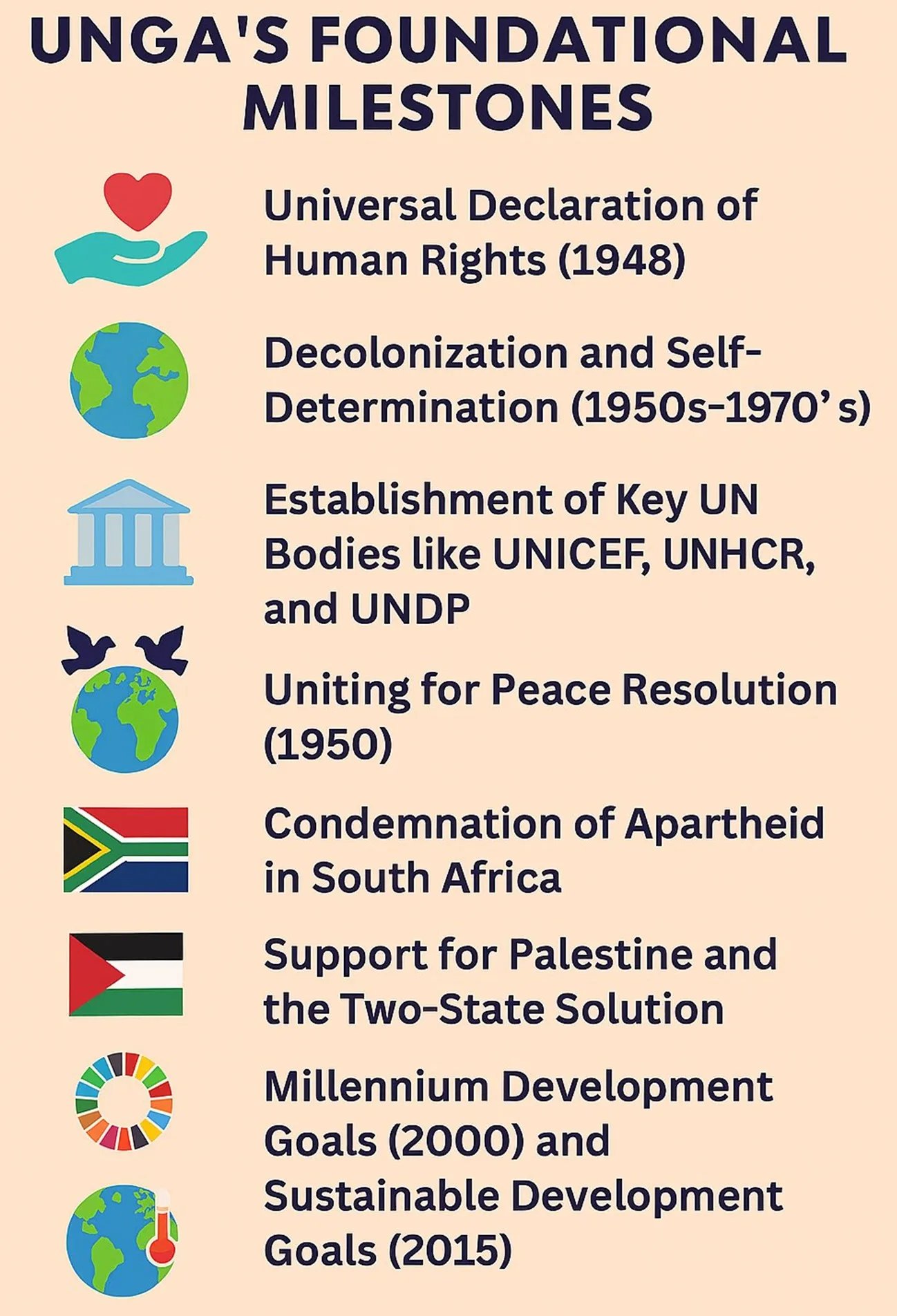 Key Functions Supporting Multilateralism – It provides a unique forum for multilateral negotiation across the full spectrum of international issues. – It plays a central role in standard-setting and codification of international law. – It convenes high-level thematic debates to address emerging global challenges, such as climate change, digital governance, and pandemic preparedness. |
Crisis of Multilateralism
- Erosion of US Commitment: Once the principal architect and patron of the UN system, the US has increasingly distanced itself from multilateral engagement.
- Washington has withdrawn from key UN bodies, including the Human Rights Council and UNESCO.
- Funding cuts — amounting to nearly 80% reduction in certain UN programmes — have weakened global operations.
- Vetoes on Gaza-related resolutions and restrictive visa policies reflect a retreat from traditional diplomatic leadership.
- Global Crisis: Situation: The world faces multiple overlapping crises like wars in Ukraine and Sudan show little sign of resolution; climate change intensifies; inequality widens; and technological change outpaces governance.
- The UN Secretary-General has warned of a ‘global crisis’ where geopolitical divides prevent collective action.
- The very notion of multilateralism — solving ‘problems without passports’ as Kofi Annan once described — appears under siege.
- Power Rivalries and Fragmentation: The US–China rivalry has deepened global divides, with both powers preferring bilateral or ‘mini-lateral’ arrangements.
- Russia’s invasion of Ukraine and Israel’s defiance in Gaza have exposed the limits of international enforcement.
- Even within Europe, nationalism challenges traditional consensus-building.
- Philosophical Crisis: Beyond institutions, the crisis is also one of legitimacy.
- Sociologist David Goodhart’s distinction between the ‘anywheres’ (global citizens) and the ‘somewheres’ (rooted in local identity) captures this divide.
- Populist movements — from Brexit to Trumpism — reflect disillusionment with global elites and distant institutions.
Multilateralism: Ideal vs. Reality
- At its heart, multilateralism rests on sovereign equality, mutual respect, and the rule of law. Yet the UN’s design embeds structural inequality:
- The Security Council’s veto power privileges five nations.
- General Assembly resolutions are often non-binding.
- Bureaucratic inertia and geopolitical rivalry undermine its credibility.
- The Universal Declaration of Human Rights, Sustainable Development Goals, and Paris Climate Agreement all emerged through multilateral cooperation.
- UN peacekeeping, humanitarian relief, and treaty-making efforts continue to matter — even if their influence appears diminished.
Reform, Renewal, and Relevance
- UN80 Initiative: It aims to streamline mandates, reduce waste, and rebuild trust. Reform is no longer optional; it is existential.
- Without institutional renewal, the UN risks fading into irrelevance.
- Rebuilding Legitimacy: The next phase of multilateralism must connect with citizens, not just diplomats.
- It needs to show that global cooperation produces tangible benefits — jobs, stability, and dignity — rather than abstract declarations.
- Models and Cautionary Tales: Countries like Japan and Hungary, with their nationalist or isolationist tendencies, may appear insulated from global turbulence.
- But these models risk long-term marginalisation, underscoring the need for balance — a principled yet pragmatic multilateralism.
- Revitalization and Reform: Recognizing the need to adapt, the UNGA has initiated efforts to revitalize its working methods and enhance its effectiveness. The Revitalization Agenda emphasizes:
- Greater transparency and accountability.
- Strengthening the role of the President of the General Assembly.
- Enhancing the Assembly’s ability to respond swiftly to global crises.
Road Ahead: Leadership and Shared Responsibility
- The renewal of multilateralism demands distributed leadership — not only from the US and China, but also from emerging powers and civil society.
- India, for example, has the potential to shape a fairer, more inclusive order through leadership in sustainable development, technology governance, and global equity.
- As Dag Hammarskjöld famously said, the UN was ‘not created to take mankind to heaven, but to save humanity from hell’.
- It remains the only platform where all nations, however unequal, can confront common threats together.
| Daily Mains Practice Question [Q] In light of the 80th anniversary of the United Nations General Assembly (UNGA), what extent do current global challenges affirm or contradict the relevance of multilateral institutions like the United Nations (UN)? |
Previous article
We Need a Law to Protect Domestic Workers
