

Syllabus: GS2/International Relation
Context
- Recently, US President Donald Trump unveiled a 20-point peace proposal, dubbed as ‘Comprehensive Plan to End the Gaza Conflict’ aimed at ending the protracted war between Israel and Hamas in Gaza.
| About Gaza Conflict – Gaza, a narrow coastal strip in West Asia, often referred to as the Middle East. 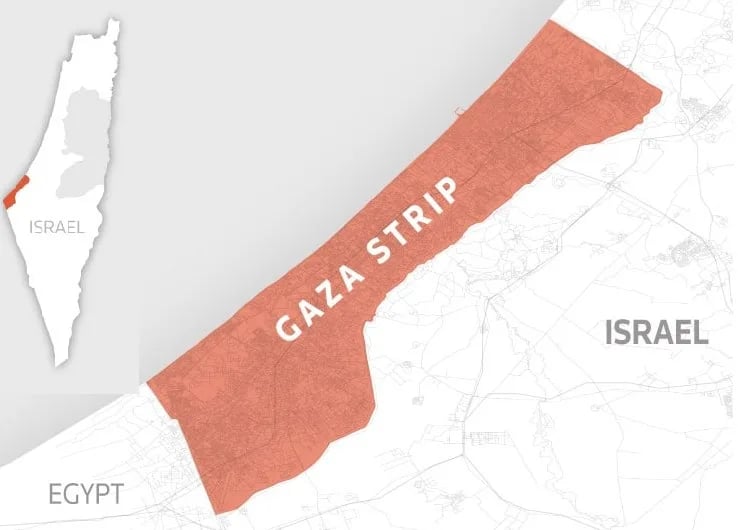 1. It was once a thriving mosaic of Arab, Turkish, Persian, and Jewish cultures. – The Sykes-Picot Agreement (1916) and the Balfour Declaration by Britain (1917) laid the groundwork for territorial fragmentation and Zionist settlement in Palestine. – Gaza became a focal point of resistance following Israel’s establishment in 1948 and subsequent wars, and has witnessed multiple wars with thousands of casualties and widespread destruction. – The current crisis escalated on October 7, 2023, when Hamas, the Palestinian militant group governing Gaza, launched a surprise attack on Israel, killing over 1,200 people and taking 250 hostages. 1. It has drawn in actors like Hezbollah (Lebanon), Iran, and the US, turning Gaza into a geopolitical battleground. |
Core Elements of the Gaza Peace Plan Announced By Trump
- Hamas Disarmament and Amnesty: The Plan demands disarmament and surrender of Hamas and relinquish control of Gaza.
- Members pledging peaceful coexistence will be granted amnesty, while those wishing to leave Gaza will receive safe passage to countries such as Jordan, Egypt, Qatar, or Iran.
- International Stabilization Force (ISF): A temporary International Stabilization Force (ISF), supported by the US, Arab partners, Jordan, and Egypt, will replace Israeli troops in Gaza.
- The ISF aims to secure borders, prevent arms smuggling, and train vetted Palestinian police. The Israel Defense Forces (IDF) will gradually withdraw, maintaining only a ‘security perimeter presence’ until full stability is ensured.
- Transitional Governance: Governance of Gaza will shift to a technocratic, apolitical Palestinian committee, supervised by an international ‘Board of Peace’ led by Trump itself.
- Humanitarian Relief and Reconstruction: The plan allows unrestricted humanitarian aid, focusing on infrastructure rehabilitation, hospitals, food supply chains, and road clearance.
- Aid will be delivered via the UN and Red Crescent without interference.
- Hostage-Prisoner Exchange: All hostages must be returned within 72 hours of Israel’s acceptance.
- In exchange, Israel will release 250 life-term prisoners and 1,700 Gazans detained post-October 7, including all women and children.
- Remains of hostages will be exchanged at a ratio of 1 Israeli to 15 Palestinians.
- Regional and International Guarantees: Eight countries — Qatar, Jordan, UAE, Indonesia, Pakistan, Turkey, Saudi Arabia, and Egypt — have welcomed the plan.
- China and Russia expressed support.
- Guarantees will be provided to ensure Gaza remains free from future militant threats.
Challenges to Implementing Trump’s Gaza Peace Plan
- Hamas’s Reluctance to Disarm and Cede Power: Hamas’s deep-rooted presence, ideological stance and role in armed resistance in the region are seen as the most formidable hurdle.
- Regional Opposition to Forced Resettlement: Trump’s suggestion that Palestinians could be relocated outside Gaza was swiftly rejected by key regional players like Egypt, Jordan, and Saudi Arabia.
- These nations emphasized the right of Palestinians to remain in Gaza, opposing any form of displacement.
- Security and Sovereignty Concerns: The proposed plan for International Stabilization Force (ISF) until Gaza is deemed safe could be interpreted as a de facto Israeli occupation, undermining Palestinian sovereignty and fueling distrust.
- Clarity and Operational Details: The plan lacks timelines, maps, and enforcement mechanisms, raising doubts about its feasibility.
- Trump did not take questions during the announcement, leaving many aspects of the plan ambiguous.
Political Implications of Trump’s Gaza Peace Plan
- Israel’s Political Calculus: The plan demands Hamas’s complete disarmament and exclusion from Gaza’s future governance, a stance that could deepen internal Israeli debates over long-term strategy.
- Palestinian Governance Shift: Gaza would be governed by an apolitical Palestinian committee under international oversight, sidelining both Hamas and the Palestinian Authority until reforms are complete.
- The plan hints at a ‘credible pathway to Palestinian self-determination’, a politically sensitive proposition that could reignite debates over a two-state solution.
- Regional Diplomacy and Realignment: Egypt, Jordan, and Qatar are expected to facilitate Hamas’s safe exit and support reconstruction, signaling a shift toward more active Arab mediation.
- The plan implicitly sidelines Iran, which backs Hamas, potentially altering the balance of influence in West Asia.
- For Trump: The plan could boost Trump’s legacy and ambitions for a Nobel Peace Prize, reminiscent of the Oslo Accords, if successful.
- However, it carries a business dimension, with opportunities for large-scale reconstruction projects in Gaza.
Implications on India
- Diplomatic Alignment and Global Standing: India welcomed the plan, calling it a ‘viable pathway to long-term and sustainable peace’ in West Asia.
- India’s endorsement reflects its balanced diplomacy—maintaining ties with both Israel and Arab nations like Iran, Saudi Arabia, and Egypt.
- Strategic and Security Interests: The plan’s emphasis on counterterrorism and deradicalization aligns with India’s own security concerns, especially regarding cross-border extremism.
- Israel noted that the plan reflects shared values between India and Israel, including the fight against terrorism.
- Economic and Infrastructure Opportunities: India’s expertise in infrastructure development could play a key role in Gaza’s reconstruction.
- Peace in West Asia would boost India’s ambitions for the India-Middle East-Europe Economic Corridor, facilitating trade and connectivity.
- Regional Stability and Diaspora Welfare: West Asia hosts over 9 million Indians, making regional stability crucial for their safety and economic well-being.
- The region supplies about 80% of India’s oil, so peace could stabilize energy prices and ensure uninterrupted supply chains.
- However, Pakistan’s prominent role in the Gaza plan raises concerns for India.
| Daily Mains Practice Question [Q] Evaluate the key components of the recent Gaza Peace Plan and discuss the potential political, humanitarian, and regional implications of its implementation. |
