


Syllabus: GS3/Defence and Security
Context
- India is reimagining its military doctrine, structure, and technology to build a future-ready force, from cyber warfare to space-based operations driven by artificial intelligence, automation, drones, and precision-guided weaponry.
About Indian Armed Forces
- These comprise three professional uniformed services (Army, Navy, and Air Force), tasked with defending India’s sovereignty, securing its borders, and supporting peacekeeping and humanitarian missions globally.
- Each service is headed by a Chief of Staff, reporting to the Chief of Defence Staff (CDS) and the Ministry of Defence.
Why India Needs A Future Ready Military?
- Lack of Jointness and Integrated Command: Despite repeated calls for jointness among the Army, Navy, and Air Force, integration remains limited:
- Service silos persist, slowing down coordinated operations.
- The move toward integrated theatre commands is still in early stages, unlike China’s fully operational model.
- Slow Pace of Structural Reforms: Administrative and operational reviews lack urgency. Theatrisation remains undefined in the Indian context, risking misalignment with strategic needs, and implementation is uneven.
- Technology Lag and Adaptability: Modern warfare now spans cyber, space, and AI-driven domains, but India’s military is still catching up:
- Unmanned Aerial Vehicles (UAVs), hypersonic missiles, and satellite-based surveillance are reshaping battlefields.
- The pace of tech adoption is slower than the rate of innovation, creating vulnerabilities.
- Surprise elements in warfare — like cyberattacks and AI decision-making — require rapid adaptability, which current systems struggle to deliver.
- Doctrinal Gaps and Operational Readiness: Doctrines haven’t translated into real-world synergy. Modular combat units (e.g., ‘Rudra’ and ‘Bhairav’) are promising but not widely deployed.
- Indigenous Innovation vs. Global Standards: India’s push for Atmanirbhar Bharat in defense manufacturing is commendable, but:
- Indigenous systems are still being scaled for export and deployment.
- Defense R&D needs faster cycles and deeper collaboration with private industry.
- Global interoperability remains limited, affecting joint exercises and strategic partnerships.
- Strategic Vision and Leadership: Defense leadership acknowledges the need to define the battlefield, not just respond to it. But:
- Strategic planning must evolve beyond traditional metrics like troop strength and weapon stockpiles.
- Future wars will be shaped by technology, intelligence, economy, and diplomacy—requiring a holistic approach.
Efforts & Initiatives: Building a Future-Ready Indian Military
- Jointness and Integrated Theatre Commands:
- Combined Commanders’ Conference 2025 emphasized ‘Year of Reforms – Transformation for the Future’.
- Push for Integrated Theatre Commands to unify Army, Navy, and Air Force operations under a single command structure.
- New Inter-Services Organisations (Command, Control and Discipline) Rules, 2025 empower joint commanders with cross-service authority.
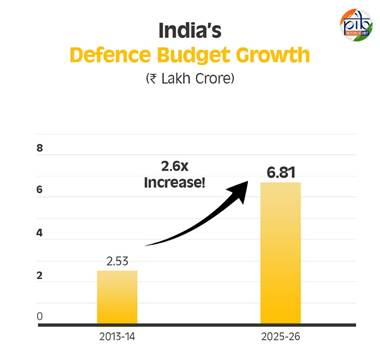
- Atmanirbharta (Self-Reliance) and Indigenous Innovation: Indigenous platforms like Tejas fighter jets, BrahMos missiles, Akash air defense systems, and advanced UAVs are now operational and export-ready.
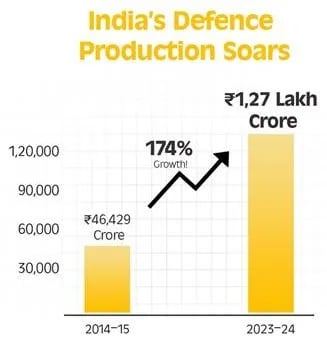
- Defense production hit a record ₹1.27 trillion in FY2024, up 174% from FY2015.
- Strategic partnerships with global firms (e.g., Boeing, Dassault, Rafael) are boosting local manufacturing and technology transfer.
- Next-Gen Combat Exercises and Multi-Domain Readiness: Debut of ASHNI platoons, integrating advanced tech with traditional combat skills for decisive advantage.
- Exercise Yudh Kaushal 3.0 in Arunachal Pradesh showcased high-altitude warfare capabilities, drone surveillance, precision strikes, and synchronized battlefield tactics.
- Embracing Emerging Technologies: Focus on AI, cyber warfare, space-based operations, and electronic warfare.
- Tri-service agencies for cyber, space, and special operations established under Integrated Defence Staff.
- Structural and Administrative Reforms: Holistic review of operational readiness, logistics, and personnel policies.
- Creation of National IHR Authorities to coordinate health emergencies and integrate military response with civilian systems.
- Doctrinal and Technological Evolution: The Joint Doctrine of the Indian Armed Forces (2017) and the Army’s Land Warfare Doctrine (2018) laid the groundwork for synergy.
- Recent initiatives like Ran Samvad (the first tri-service seminar on warfighting) stressed the rise of hybrid warriors—officers who blend military acumen with technological and information skills.
- New Structures and Battle Formations: MQ-9B drones now provide persistent ISR and precision strike capabilities across services.
- The Navy’s Rafale-M order strengthens maritime strike and air defence.
- Army’s AI-enabled Akashteer integrates with the Air Force’s IACCS for advanced air defence coordination.
- Building a Modern Force: The Army’s Integrated Battle Groups (Rudra) are designed to mobilise within 12–48 hours with combined arms elements, drones, and loitering munitions.
- At the strategic level, the Pralay quasi-ballistic missile enhances land-based theatre fires.
- The Navy is pursuing a 15-year roadmap for balanced growth in air, subsurface, and unmanned domains.
Way Forward: Integration, Education, and Civil-Military Fusion
- Stable Jointness: Theatre commands with phased mandates and iterative authority.
- Advanced Professional Military Education (PME) and Military Readiness: Training technologist-commanders who can operate in hybrid, multi-domain environments.
- Civil-Military Fusion: Collaboration with DRDO, defence PSUs, private industry, and academia for rapid prototyping, coding, and testing.
- Adaptive Cycles: Industrial and military ecosystems that retire outdated systems quickly and retain only effective solutions.
| Daily Mains Practice Question [Q] Discuss the key reforms and strategic initiatives undertaken by the Indian Armed Forces to build a future-ready military. What are the major challenges that could hinder the successful implementation of these efforts? |
Previous article
Gaza Peace Plan and its Implications for India
