

Syllabus: GS3/ S&T
Context
- Researchers at the Institute for Plasma Research (IPR) in Gandhinagar have laid out a roadmap for India to achieve fusion power.
About
- The researchers envisage developing India’s first fusion electricity generator, called the Steady-state Superconducting Tokamak-Bharat (SST-Bharat), with a power output 5x the input.
- It will be a fusion-fission hybrid reactor with 100 MW of the total 130 MW provided by fission. The estimated construction cost is Rs 25,000 crore.
- By 2060, the team aims to commission a 250 MW demonstration reactor with an output-to-input ratio (Q) of 20.
What is Nuclear Energy?
- Nuclear energy is the energy released during nuclear reactions, either through fission (splitting of atomic nuclei) or fusion (merging of atomic nuclei).
- In nuclear fission, heavy atomic nuclei, such as those of uranium or plutonium, are split into lighter nuclei, releasing a large amount of energy.
- This process is utilized in nuclear power plants to generate electricity.
Process of Nuclear fusion
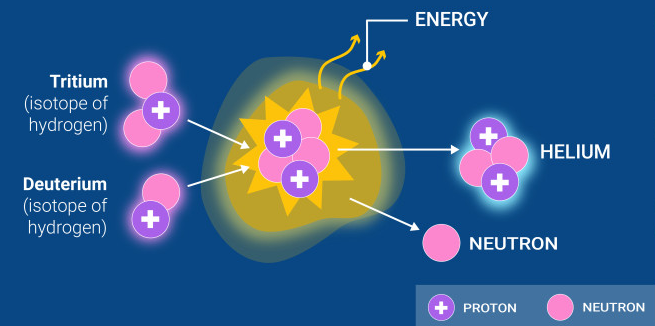
- It is a process in which two light atomic nuclei combine to form a heavier nucleus, releasing a significant amount of energy in the process.
- This process is the same as what powers stars, including our sun.
- The most common fusion reaction involves the isotopes of hydrogen: deuterium and tritium.
- When these isotopes fuse, they form helium and release a neutron, along with a large amount of energy.
Significance of Fusion energy
- Clean source of energy: Nuclear fusion, like nuclear fission, does not emit carbon dioxide or other greenhouse gases into the atmosphere.
- High energy efficiency: Fusion can generate nearly four times more energy per kilogram of fuel than fission and almost four million times more energy than burning coal or oil, making it far more efficient than conventional energy sources.
- Safer to Use: Future fusion reactors are also intrinsically safe and are not expected to produce high activity or long-lived nuclear waste.
- Furthermore, as the fusion process is difficult to start and maintain, there is no risk of a runaway reaction and meltdown.
- Abundant and accessible fuel supply: Fusion fuel is plentiful and widely available.
- Deuterium can be extracted inexpensively from seawater.
- Tritium can be generated from the interaction of fusion-produced neutrons with naturally abundant lithium.
What are the Challenges?
- Extreme conditions requirement: Thermonuclear fusion requires extremely high temperatures and pressures, typically in the range of millions of degrees Celsius, to overcome the electrostatic repulsion between nuclei.
- Sustaining the reaction: Once initiated, the reaction must be self-sustaining (burning plasma).
- Current laboratory experiments achieve fusion only for a few seconds, making it difficult to sustain such extreme conditions for prolonged periods.
- Competition with other energy sources: Fusion will need to compete with nuclear fission, solar, and wind energy, all of which are currently more cost-effective and scalable.
- Funding limitations in India: India’s fusion research budget remains modest compared to the US, EU, and China.
Current Progress with Fusion Energy
- Indian Scenario: SST-1 (Institute for Plasma Research – IPR): This superconducting tokamak has achieved plasma confinement for approximately 650 milliseconds.
- SST-Bharat is envisioned as the next step beyond SST-1, aiming to move from experimental research to actual electricity generation.
- Global progress benchmarks include:
- France’s WEST tokamak set a world record by sustaining a stable hydrogen plasma for over 22 minutes in February 2025.
- China’s EAST Tokamak: China maintained plasma at a temperature of 100 million°C for 1,066 seconds in the Experimental Advanced Superconducting Tokamak (EAST), demonstrating remarkable progress in sustaining high-temperature plasma.
- ITER (International Thermonuclear Experimental Reactor): ITER aims to achieve a Q of 10, meaning it will produce ten times the energy it consumes, a critical step towards demonstrating the feasibility of fusion power.
Way Ahead
- Fusion research should be pursued not only to ensure long-term energy security but also to drive strategic technological advancements, including superconducting materials, high-temperature engineering, and plasma modelling.
- The 2060 target reflects a cautious but deliberate approach, allowing India to gradually develop the necessary expertise, infrastructure, and technologies to eventually achieve practical and sustainable fusion energy.
Source: TH
Previous article
Impact of U.S. Tariffs on Jewellery Sector
