

Syllabus: GS3/ Economy
Context
- The Union Cabinet chaired by PM Modi approved a Rs.1,500 crore Incentive Scheme to develop recycling capacity in the country for the separation and production of critical minerals from secondary sources.
What are Critical Minerals?
- These are minerals that are essential for economic development and national security.
- The lack of availability of these minerals or the concentration of extraction or processing in a few geographical locations could potentially lead to “supply chain vulnerabilities and even disruption of supplies”.
List of Critical Minerals
- Different countries have their own unique lists of critical minerals based on their specific circumstances and priorities.
- A total of 30 minerals were found to be most critical for India, out of which two are critical as fertilizer minerals: Antimony, Beryllium, Bismuth, Cobalt, Copper, Gallium, Germanium, Graphite, Hafnium, Indium, Lithium, Molybdenum, Niobium, Nickel, PGE, Phosphorous, Potash, REE, Rhenium, Silicon, Strontium, Tantalum, Tellurium, Tin, Titanium, Tungsten, Vanadium, Zirconium, Selenium and Cadmium.
Applications of Critical Minerals
- Clean technologies initiatives such as zero-emission vehicles, wind turbines, solar panels etc.
- Critical minerals such as Cadmium, Cobalt, Gallium, Indium, Selenium and Vanadium and have uses in batteries, semiconductors, solar panels, etc.
- Electric vehicles (EVs): Lithium, nickel, and cobalt are key materials used in lithium-ion batteries.
- Advanced manufacturing inputs and materials such as defense applications, permanent magnets, ceramics.
- Minerals like Beryllium, Titanium, Tungsten, Tantalum, etc. have usage in new technologies, electronics and defense equipment.
- Platinum Group Metals (PGMs) are used in medical devices, cancer treatment drugs, and dental materials.
About the Scheme to Develop Recycling Capacity
- This scheme is part of the National Critical Mineral Mission (NCMM).
- The Scheme will have a tenure of six years from FY 2025-26 to FY 2030-31.
- The eligible feedstock is Electronic-waste, Lithium Ion Battery (LIB) scrap, and scrap other than e-waste & LIB scrap e.g. catalytic converters in end-of-life vehicles.
- Expected beneficiaries will be both large, established recyclers, as well as small, new recyclers (including start-ups), for whom one-third of the scheme outlay has been earmarked.
- The Scheme will be applicable to investments in new units as well as expansion of capacity / modernization and diversification of existing units.
- The incentives under the Scheme will comprise;
- 20% Capex subsidy on plant & machinery, equipment and associated utilities for starting production within specified timeframe, beyond which reduced subsidy applicable; and
- Opex subsidy: Linked to incremental sales beyond FY 2025–26 base year, with 40% disbursed in year 2 and 60% in year 5.
- Ceilings: ₹50 crore per entity for large players (₹10 crore cap on Opex); ₹25 crore for small entities (₹5 crore cap on Opex).
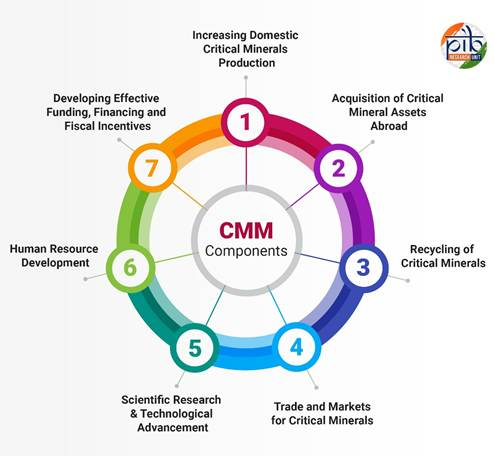
Need for the Critical Mineral Recycling
- Waste generation: India’s e-waste generation is poised to surge, driven by rapid growth in solar and wind energy infrastructure and EV adoption.
- The PV module waste will increase from 100 kilotons in FY23 to 340 kilotons by 2030. Additionally, 500 kt of EV batteries are expected to reach recycling units in the coming years.
- Scarce reserves: Manufacturing renewable energy technologies and transition to electric vehicles would require increasing quantities of minerals, including copper, manganese, zinc, and indium.
- India possesses rare earth deposits, particularly in Rajasthan and coastal regions, but mining, processing, and refining technologies remain underdeveloped.
- Chinese Dominance in the Supply Chain: China controls 60–70% of global rare earth production and 85–90% of refining, giving it near-monopoly from extraction to high-performance magnets.
- The recent export curbs on key rare earths highlighted India’s vulnerability and the need to build domestic recycling capacity.
- Environmental concerns, regulatory hurdles, and lack of advanced separation and refining capacity further restrict exploitation of primary sources.
Challenges in Critical Mineral Recycling
- Technology gaps: Limited domestic expertise in advanced recycling processes for rare earths and lithium.
- Environmental risks: Safe handling of toxic waste and emissions from recycling units remain concerns.
- Regulatory hurdles: Delays in approvals and lack of streamlined norms hinder quick adoption.
- Infrastructure deficits: Limited specialized recycling units and inadequate collection networks.
Suggestions
- Strengthen R&D and technology transfer for efficient mineral extraction from waste.
- Promote PPPs and start-up participation to expand recycling ecosystems.
- Build integrated collection and processing networks for e-waste and battery scrap.
- Ensure strict environmental safeguards to avoid secondary pollution.
- Skill development programmes to create a trained workforce in recycling and waste management.
Source: PIB
