


Pradhan Mantri Jan Dhan Yojana (PMJDY)
Syllabus: GS3/ Economy
Context
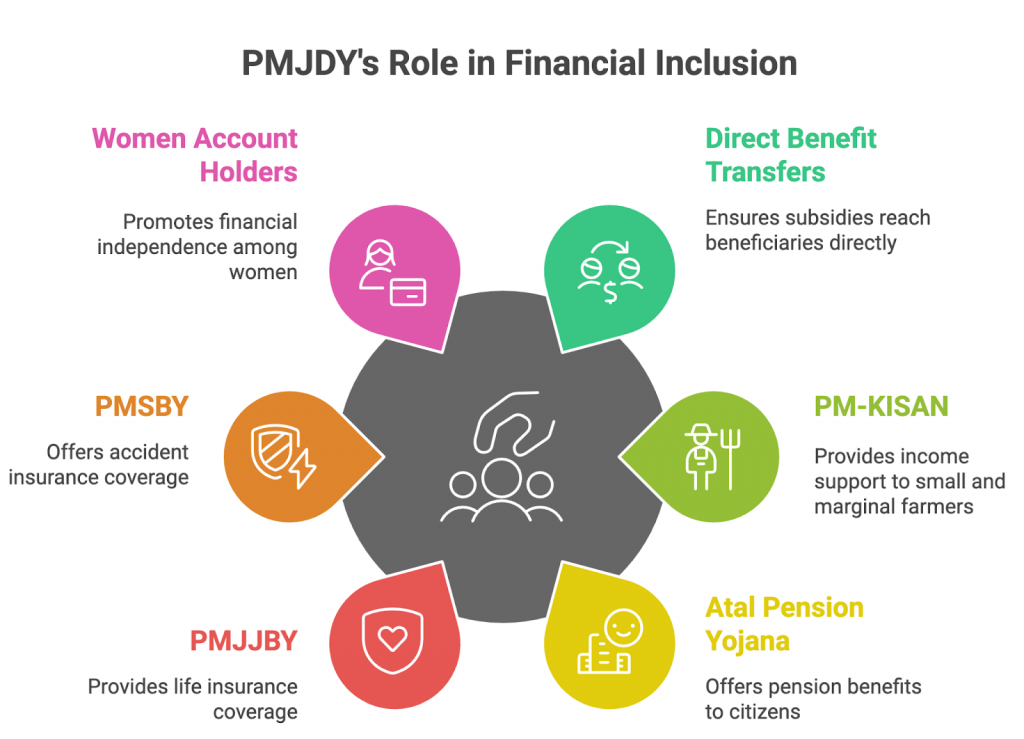
- The PM highlighted the effectiveness of Pradhan Mantri Jan Dhan Yojana (PMJDY) in transforming financial services for India’s poorest over the past 11 years.
About PMJDY
- Launched on August 28, 2014, the PMJDY has become one of the world’s largest financial inclusion initiatives.
- The scheme was aimed at providing every household with a bank account and bringing marginalized and rural communities into the formal banking system.
- As of March 2024, more than 52.6 crore accounts have been opened under the scheme, with a total balance of ₹2.63 lakh crore.
- The scheme offers several benefits including zero-balance accounts, RuPay debit cards, accidental and life insurance, and overdraft facilities.
Source: DD News
National Means-Cum-Merit Scholarship Scheme
Syllabus: GS2/Government Initiatives
Context
- An awareness session on the National Means-Cum-Merit Scholarship Scheme (NMMSS) was recently conducted in Meerut, Uttar Pradesh.
About the Scheme
- Launched in 2008 by the Ministry of Education, the NMMSS is a Centrally Sponsored Scheme aimed at encouraging meritorious students from economically weaker sections to continue their education from Class IX to Class XII.
- Eligibility & Benefits:
- The scheme awards fresh scholarships in Class IX, with renewals in Classes X, XI, and XII based on promotion and securing at least 60% marks.
- It is exclusively for students of government and government-aided schools, excluding Kendriya Vidyalayas, Jawahar Navodaya Vidyalayas, and other residential institutions.
- The annual scholarship amount is ₹12,000, disbursed via Direct Benefit Transfer (DBT) to Aadhaar-seeded bank accounts of students or their parents.
- The parental income must not exceed ₹3.5 lakh per annum from all sources.
Source: DD News
Ayush Ministry and FSSAI Releases List of ‘Ayurveda Aahara’ Food Preparations
Syllabus: GS2/Health
In News
- The Food Safety and Standards Authority of India (FSSAI), in collaboration with the Ministry of Ayush, has introduced a comprehensive list of Ayurvedic food preparations called “Ayurveda Aahara”.
| Do you know? – Ayurveda is India’s ancient medical science dating back over 5,000 years . – It is considered an upveda of the Atharva Veda and is mentioned in the Rigveda. – The term combines “Ayu” (life) and “Veda” (science), meaning it is the science of life, focusing on promoting health and curing diseases. – Ayurveda emphasizes the connection between mind, body, and nature, aiming to preserve wellness and treat illness. |
“Ayurveda Aahara”
- It was launched under the Food Safety and Standards (Ayurveda Aahara) Regulations, 2022.
- It integrates traditional Ayurvedic dietary wisdom into modern regulations, ensuring authenticity based on classical texts and providing clarity for food businesses and consumers.
- The list promotes natural, seasonal, and therapeutic ingredients to support health and wellness.

Importance
- Ayurveda Aahara reflects India’s rich food culture, rooted in one of the world’s oldest holistic health systems. These products emphasize natural ingredients, seasonal suitability, and therapeutic herbs to foster balance and wellness.
Source :PIB
India-Japan Textile Trade and Investment Collaboration
Syllabus: GS3/ Economy
Context
- India is inviting Japanese textile giants to invest in its flagship PM‑MITRA Parks, offering incentives through PLI and leveraging the India–Japan Comprehensive Economic Partnership Agreement (CEPA).
India–Japan Textile Trade
- India’s total textile and apparel export to Japan in 2024 is $354 Million and Japan’s total textile and apparel import from world is $ 30,873 Million.
- India has signed India-Japan CEPA in 2011 to reduce tariff and non-tariff barriers, simplify procedures and address structural issues to make Indian Exporters more competitive in partner markets.
Government Initiatives to Promote Textile Sector
- PM Mega Integrated Textile Regions and Apparel (PM MITRA) Parks Scheme: Its objective is to develop 7 mega integrated textile parks across India in Tamil Nadu, Telangana, Gujarat, Karnataka, Maharashtra, Madhya Pradesh, and Uttar Pradesh.
- It aims to create a modern, integrated, world class plug and play textile infrastructure.
- Foreign direct investment (FDI): Japanese investment aligns well with India’s goals under the “Make in India for the World” and “China‑plus‑one” manufacturing strategies.
- Production Linked Incentive (PLI) Scheme: The Scheme for Textiles was approved to promote production of Man-Made Fibre (MMF) Apparel, MMF Fabrics and products of Technical Textiles in the country to enable the textile sector to achieve size and scale and to become competitive.
Source: PIB
District Flood Severity Index
Syllabus: GS3/ Disaster Management
Context
- Researchers from IIT Delhi and IIT Gandhinagar have developed a District Flood Severity Index (DFSI) to comprehensively assess the severity of floods across Indian districts.
District Flood Severity Index (DFSI)
- DFSI is a data-driven tool designed to assess and categorize flood severity at the district level, India’s primary administrative unit for planning and disaster management.
- The index is used to identify districts most at risk and guide resource allocation for mitigation and response.
- Key Parameters Considered:
- Mean duration (in days) of all flooding events in a district.
- Percentage of district area historically affected by floods.
- Total deaths and number of people injured due to floods.
- Population size of the district.
- Data Used: Sourced mainly from the Indian Meteorological Department (IMD), which has been collecting flood-related data since 1967.
- Custom 40-year spatial datasets developed at IIT Delhi.
Key Insights from the DFSI
- Thiruvananthapuram District: Recorded highest number of flood events.
- However, it is absent from the top 30 most severely affected districts, indicating lower severity per DFSI criteria.
- Top Districts in Flood Severity: Patna ranks one on DFSI.
- Districts in Assam (Dhemaji, Kamrup, Nagaon) and along the Indo-Gangetic Plain dominate the top rankings.
Source: TH
Necropolitics
Syllabus: Miscellaneous
In News
- Necropolitics is highlighting how states expose marginalised groups to violence and neglect, normalising their suffering.
Concept of necropolitics
- It explores how political power determines whose lives are protected and whose deaths are normalized or even orchestrated.
- It was coined by Cameroonian scholar Achille Mbembe .
- It was built on Michel Foucault’s idea of biopolitics — which manages life through institutions and public health .
- It focuses on the governance of death, exposing how certain populations, such as refugees, the poor, racialized groups, and queer communities, are systematically abandoned or targeted.
Features
- Necropolitics functions through key mechanisms that devalue certain lives:
- State terror suppresses dissent via surveillance, violence, or imprisonment.
- Collaboration with militias or criminal groups blurs lines between state and non-state violence.
- Enmity becomes central to governance, legitimizing killing.
- War and terror turn into self-sustaining economies.
- Targeted exploitation displaces vulnerable communities.
- Death is inflicted through torture, starvation, drone strikes, and more.
- These actions are justified through ideologies like nationalism, religion, or utilitarianism.
Instances
- Achille Mbembe highlights how colonial legacies, state terror, and neoliberal regimes create “death worlds,” where people live in conditions so degraded they become the “living dead.”
- Examples range from Kashmir’s normalized violence and COVID-19 migrant crisis to Gaza’s devastation and sterilisation drives against marginalised women.
- Necropolitics thrives not only in war zones but in everyday bureaucratic violence, revealing a system where death is not accidental but administratively managed.
Source :TH
Amazon Rainforest
Syllabus: GS3/Environment
Context
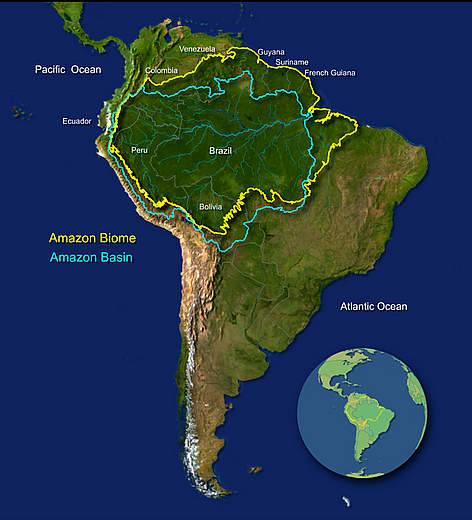
- Over 25% of the Amazon rainforest has already been degraded due to deforestation, fires, and mining, putting immense pressure on its biodiversity and ecological stability.
About
- The Amazon rainforest, often called the lungs of the Earth, is home to about 10% of all known plant and animal species — and countless others that haven’t even been discovered yet.
- The Amazon spans 8 countries and one overseas territory: Brazil, Bolivia, Colombia, Ecuador, Guyana, Peru, Suriname, Venezuela, and French Guiana (a French overseas territory).
- It stores around 250–300 billion tonnes of carbon, equivalent to 15–20 years of global greenhouse gas emissions, and generates rainfall that supports some of the world’s largest cities and most vital agricultural regions.
- It is home to over 47 million people, including 2.2 million Indigenous and traditional communities, whose cultures and livelihoods are deeply tied to the forest.
Source: DTE
Previous article
Role of Small Ruminants in Economy and Nutritional Security
Next article
80 Years of Hiroshima
