

Syllabus: GS2/Education/Governance
Context
- Minutes of meetings held by the Ministry of Education (MoE) with 33 States and UTs show that student enrolment dipped in 23 states.
About
- The drop first came to light late last year in the UDISE+ report for 2023-24, which pointed to a sharp fall of around 1.5 crore in overall school enrolment (government and private) compared to the 2018-19 to 2021-22 average.
- PM-POSHAN minutes show the trend continuing into 2024-25, triggering fresh concern in the government.
- At least eight witnessed declines exceeding 100,000: led by Uttar Pradesh (21.83 lakh), Bihar (6.14 lakh), Rajasthan (5.63 lakh) and West Bengal (4.01 lakh).
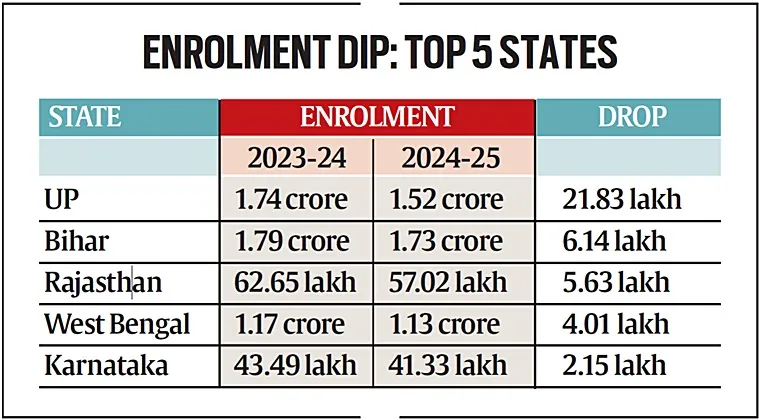
- Compared to 2023-24, Karnataka saw its enrollment fall by around 2 lakh; Assam by 1.68 lakh, Tamil Nadu by 1.65 lakh and Delhi by 1.05 lakh.
- The PM-POSHAN meetings flagged low scheme coverage: In Delhi, the number of students availing midday meals fell by 97,000 in 2024-25 versus 2023-24.
- In Uttar Pradesh, meal coverage dropped by 5.41 lakh students, by 3.27 lakh in Rajasthan and 8.04 lakh in West Bengal.
- Some States reported students bringing their own tiffin.
Possible Reasons for the Decline
- The first is a change in data-collection methodology—from school-wise reporting (just total numbers) to student-wise reporting, this ongoing “data cleansing” may have removed “ghost” entries.
- Several States have suggested enrolment may be moving from government to private schools in the post-Covid years, reversing pandemic-era trends.
Implications
- Nutritional Risk: Lower participation could impact child health and learning outcomes.
- Administrative Gaps: Transition to Aadhaar-based data is essential but may cause temporary disruption.
- Policy Reflection: Need to re-evaluate strategies to maintain enrolment and ensure scheme utilization.
MoE’s Response
- The ministry has expressed “deep concern” and asked states to investigate causes and submit reports by June 30.
- It emphasized on improving the meal coverage and quality assurance for concerns of some students reportedly bringing their own food.
| PM-POSHAN – PM-POSHAN — Pradhan Mantri Poshan Shakti Nirman, formerly known as the midday-meal scheme, is a centrally sponsored Scheme under the Ministry of Education. 1. It operates on a 60:40 funding model between the Centre and the states. – Provides hot cooked meals to 11.20 crore students in Balvatika and classes 1 to 8. – Covers 10.36 lakh govt. & govt.-aided schools. – Under the scheme, material cost is provided for procurement of ingredients such as pulses, vegetables, oil, spices and condiments, and fuel required for cooking the meals. 1. The Centre also supplies around 2.6 million metric tonnes of food grains annually through the Food Corporation of India (FCI), covering 100% of the cost. – Besides addressing child nutrition, a cooked meal in school is known to boost attendance, learning outcomes and attention spans. |
Source: IE
Previous article
India’s Northeast – Kolkata Link via Myanmar
Next article
AI and the Rise of the Hourglass Organisation
