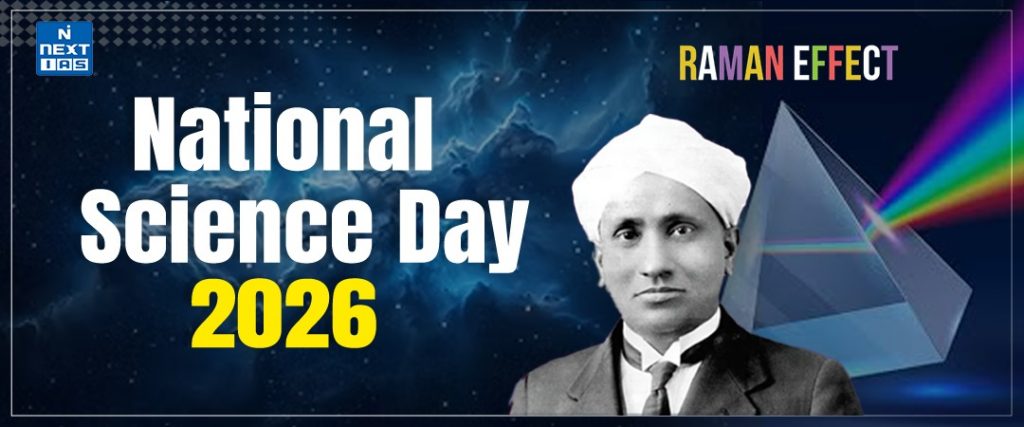
National Science Day in India is celebrated annually on February 28th to commemorate Sir C.V. Raman’s discovery of the ‘Raman Effect’ in 1928, a breakthrough that earned him the Nobel Prize and significantly advanced spectroscopy.
The day promotes scientific awareness, encourages innovation, and highlights India’s scientific achievements through nationwide activities like lectures, exhibitions, and competitions, which use an annual theme to advance national scientific development, starting with the current year theme of youth empowerment for global leadership.
As India commemorates the achievements of our scientific community on this special day, this article presents a detailed account of National Science Day, including its history, significance, and more.
Key Facts about National Science Day
| Date | 28 February |
| Origin | Started in 1987 to commemorate the discovery of the “Raman Effect” by renowned Indian scientist Sir C.V. Raman. |
| Objective | To create awareness about the importance of science in everyday life and to inculcate scientific temper among the general public. |
Theme for National Science Day 2026: Women in Science Catalyzing Viksit Bharat
The theme changes annually, and is decided by the Department of Science and Technology, Government of India. The theme for National Science Day 2026 is “Women in Science: Catalysing Viksit Bharat”.
Each year, the Department of Science and Technology declares a theme for National Science Day Celebrations that highlights a crucial aspect of India’s scientific endeavor and its social implications. These themes reflect the versatile role that science plays in addressing contemporary challenges.
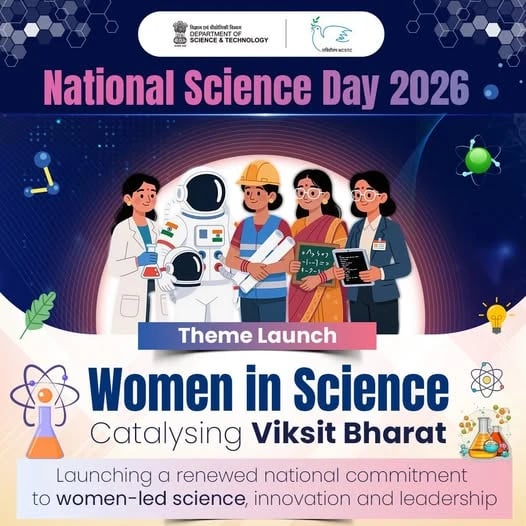
- The 2026 theme “Women in Science” demonstrates how women scientists for India Viksit Bharat 2047 developed the country’s vision for a developed nation. The theme shows how female scientists create innovative solutions for AI and biotechnology and climate change and sustainable development fields. The initiative supports national goals by Viksit Bharat which aims to develop gender-inclusive STEM programs that solve healthcare and clean energy and environmental security problems.
- The celebrations feature science exhibitions that showcase women achievers and lectures and quizzes which include the NCSTC online event scheduled for February 21-22 and lab visits to ISRO and CSIR and student projects. The activities motivate young people especially girls to enter scientific fields which develop their scientific mindset and ability to solve practical problems.
- The theme demonstrates how space and biotech pioneers advanced national progress by establishing science as an essential national progress force. The events across educational institutions from schools to colleges to institutes present activities which stimulate curiosity and drive innovation while achieving equal development according to Raman’s principle of resource-efficient creativity.
History of National Science Day in India
The history of National Science Day in India dates back to the late 1920s. The chronology of its origins and evolution in India is explained below.
1928: The Discovery of Raman Effect
- On 28 February 1928, an Indian physicist Sir C. V. Raman made the remarkable discovery of the phenomenon of scattering of light in inelastic collisions with molecules of matter.
- This discovery later came to be named after its discoverer as the “Raman Effect”.
1930: Sir C.V. Raman won the Nobel Prize
- The discovery of the Raman Effect revolutionized our understanding of light-matter interactions and left transformative impacts on various branches of science. Recognizing its importance, Sir C.V. Raman was honored with the Nobel Prize in Physics in 1930.
- With an Indian scientist becoming the first Asian to receive the Nobel Prize in any branch of science, it was a significant milestone for Indian science. Along with vindicating India’s scientific prowess, it placed India on the global scientific map.
1986: Proposal from the NCSTC
- In 1986, the National Council for Science and Technology Communication (NCSTC) proposed to the Government of India to designate the date of discovery of Raman Effect i.e. February 28 as National Science Day.
- The idea behind NCSTC’s proposal was to celebrate the pathbreaking discovery of Raman Effect as well as encourage scientific thinking and awareness among the Indian population.
- In 1986 itself, the Government accepted NCSTS’s proposal and formally declared 28 February as National Science Day to be celebrated annually in India.
1987: The First National Science Day
- The first official celebration of National Science Day in India was held on 28 February 1987. Since then, it has become a pivotal event in the academic and scientific communities across India, promoting science and scientific temper among the general populace.
Events and Celebrations
The celebration of National Science Day in India is marked by a range of official and public events across the country. Government bodies, educational institutions, scientific institutions, etc organize various programs across the country to celebrate the National Day of Science.
Here is an overview of some common types of events that take place as part of National Science Day celebrations in India:
- Conferment of National Awards for Science & Technology Communication to recognize outstanding efforts in popularizing science among the masses and motivating young minds towards scientific pursuits.
- Radio and television programs, aimed at promoting scientific ideas and thinking.
- Organization of science exhibitions, interactive workshops, lectures, etc by educational institutions.
- Research institutions organize exhibitions of their works, showcasing the latest advancements and achievements in various scientific fields.
- Non-Governmental Organisations and Community Groups also host events, making science accessible to a broader audience.
Objectives of the Celebration
Though the day mainly commemorates a historic scientific discovery by an Indian scientist, the celebrations of National Day of Science revolve around multiple objectives. Some of the prominent objectives of National Science Day celebrations can be seen as follows:
- Spreading the message of the importance of science and its application in daily life.
- To encourage the youth to engage in scientific activities and consider careers in science and technology
- Inculcating scientific temper and fostering a culture of innovation among the general public.
Why does the day hold significance?
In a rapidly changing world where scientific and technological advancements are reshaping societies, the annual celebration of National Day of Science holds immense significance for several reasons as listed below:
- Encourages our Scientists: A national celebration commemorating the discovery of Raman Effect is akin to honoring the whole scientific community of our nation. This encourages them to foster their scientific endeavors.
- Promotes Awareness about Science: Outreach programs organized as part of National Day of Science celebrations help broaden public understanding of various scientific concepts and recent advancements.
- Promotes Scientific Temper: Various lectures, debates, quizzes, and exhibitions held on this day educate people about the latest scientific advancements and inculcate scientific temper and rational thinking in them. Thus, it helps implement a Fundamental Duty enshrined in Article 51A of the Indian Constitution.
- Sparks Curiosity in Young Minds: Engaging activities like exhibitions, workshops, and science fairs expose children to science in a fun and interactive way, instilling a passion for it.
- Highlights Advancements in Indian Science: National Science Day serves as a showcase for the latest achievements and initiatives in various scientific fields across India. This fosters national pride and inspires future generations to pursue scientific careers.
- Encourages International Collaboration: By celebrating science nationally, India demonstrates its commitment to scientific progress and opens doors for collaborations with international scientific communities.
- Strengthens Scientific Foundation: By inspiring future generations to contribute to scientific progress and address global challenges through science, it strengthens the scientific foundation of our nation.
Much more than just a commemoration of the historic scientific discovery of Raman Effect, the significance of National Science Day celebration lies in reflecting India’s ongoing journey to becoming a global scientific superpower. By honoring the past, celebrating the present, and envisioning the future, it plays a crucial role in shaping India’s scientific progress. It is a day that reaffirms the nation’s collective aspiration to explore and innovate for a better tomorrow where science and technology are harnessed to create a more equitable, sustainable, and prosperous world for all.
Related Concepts
What is Raman Effect?
Raman Effect, in a nutshell, refers to the change in the wavelength of light that occurs when a light beam is scattered and deflected by molecules of matter.
When a monochromatic beam of light traverses a dust-free, transparent sample of any substance, its light photons undergo inelastic collisions with the molecules of the substance. These collisions make a part of the incident light scatter in directions other than that of the incident beam. Based on the energy exchange during the light-molecule interaction, the scattered light consists of one of the following types of light waves:
- Rayleigh Lines: Most of the light bounce back unchanged. Thus, a large portion of the scattered light has the wavelength same as that of the incident light. This is called Rayleigh Scattering.
- Stokes Raman Lines: A small part of the scattered light loses energy to the molecules of the substance, bouncing back with a lower energy. Thus, it has a wavelength higher than that of the incident light. This is known as Stokes Raman Scattering.
- Anti-Stokes Raman Lines: Very rarely, some portion of the scattered light gains energy from the interacted molecule, bouncing back with a higher energy. Thus, it has a wavelength shorter than that of the incident light. This is called Anti-Stokes Raman Scattering.
Thus, Stokes Raman Lines and Anti-Stoke Raman Lines have wavelengths different from that of the incident light. This phenomenon of the change in wavelength of some part of the scattered light is called Raman Effect.
Applications of Raman Effect
Raman Effect is utilized in Raman Spectroscopy, a method employed for determining and examining the chemical composition of substances.
The basis of this technique is that the amount and nature of changes caused in the wavelength of the scattered light is unique to each molecule and provides information about its vibrational and rotational energy states. By analyzing this change, scientists can identify the molecule and study its structure, composition, and other properties.
Frequently Asked Questions (FAQs)
Why do we Celebrate National Science Day?
National Science Day in India is celebrated to commemorate the discovery of the Raman Effect by Sir C.V. Raman on February 28, 1928. Along with this, the celebration also aims to foster a scientific temper among the populace.
When was the First National Science Day Celebrated?
The first National Science Day was celebrated in India on February 28, 1987. The Government of India designated this day as National Science Day in 1986, upon the recommendation of the National Council for Science and Technology Communication (NCSTC), to commemorate the anniversary of the Raman Effect’s discovery by Sir C.V. Raman in 1928.