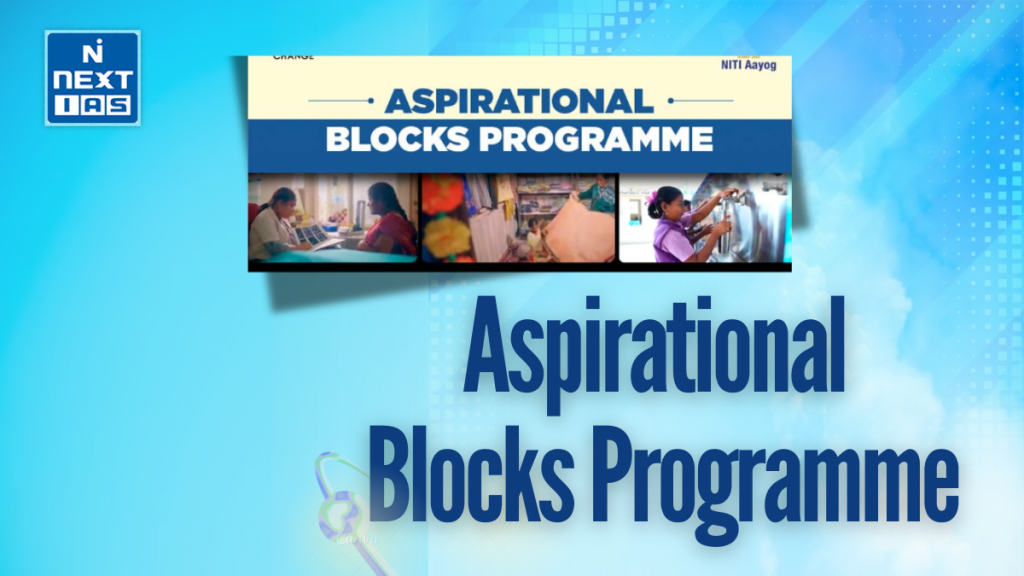
The Government of India constituted a program called the Aspirational Blocks Programme or ABP, launched on January 7, 2023. It involves improving the overall quality of life of 500 Blocks spread across 27 States and 4 Union Territories. The aspiration of this program is to improve the service delivery for the betterment of socio-economic and development parameters in health and nutrition; education; agriculture and allied sciences; basic infrastructure; and social development.
About the Aspirational Blocks Programme
- An enhanced planning and implementation effort, capacity building, system building for efficient and sustainable service delivery for fast development of identified Blocks (sub-district units), is being carried out with the NITI Aayog; national, state, and UT governments; and district administration, with the support of partners.
- The ABP is an exercise to allow the states and administrators to design their strategies for implementation based on local geography, social context, and any opportunities and challenges they see.
- Block officers are considered to be ‘Leaders of Change’ and empowered through training for the kind of skills and competencies that they can use to affect transformative change in their Blocks.
- The WHO Country Office for India (WHO India) in close collaboration with 10 states has identified 52 aspirational Blocks, including all 27 aspirational Blocks of Rajasthan, for direct Block support for the improvement of seven key health indicators.
- The states are Assam, Chhattisgarh, Jharkhand, Karnataka, Maharashtra, Madhya Pradesh, Odisha, Punjab, Rajasthan, and Uttar Pradesh.

Features of the Aspirational Blocks Programme
The Aspirational Blocks Programme (ABP) is a government initiative conceived to hasten development in India’s most disadvantaged blocks by focusing on governance and service delivery and thereby uplifting these regions. Some of its key features are:
- Holistic Development Approach – ABP looks at several sectors including health, education, agriculture, financial inclusion, and infrastructure, providing holistic development to underdeveloped blocks.
- Data-Driven Monitoring – The programme uses a real-time data-driven approach to monitor progress, identify gaps, and put in place measures for correction efficiently.
- Concentration on KPIs – Acting on the basis of set KPIs across sectors of major significance, it attempts to lead to measurement and improvement of each block’s performance with answers that can be effectively measured through real actions.
- Collaborative Governance – It brings central, state, and local governments together in governance issues, fostering voting governance, where administration is empowered locally.
- Encouraging a Competitive Spirit – It ranks blocks on the basis of performance, and the ABP encourages fierce competition among blocks, hence motivating their officials to mend governance and service delivery.
- Convergence of Government Schemes: It ensures better coordination of various government schemes and resources to maximize impact and avoid duplication of efforts.
- Community Participation: The local community, NGOs, and other stakeholders are actively involved in development planning and implementation, thereby fostering local development.
- Capacity Building with Skill Development: ABP imparts skill development to officials and the local workforce, thereby ensuring long-term capacity building for lasting improvement.
Significance of the Aspirational Blocks Programme
- Targeted Development– ABP focuses on the most backward blocks–those that lack essential services in areas such as healthcare, education, and infrastructure–so that these lagging areas come into their own in balanced regional development.
- Reduction of Socio-Economic Disparities- By improving the crucial indicators in health, education, agriculture, and financial inclusion levels, the ABP assists marginal groups in being uplifted and reducing levels of inequalities of the access to basic services.
- Data-Based Governance- The programme uses real-time data for monitoring progress and making evidence-based policy decisions so that accountability and transparency become the hallmark of developmental efforts.
- Increased Local Governance-ABP-weakened institutions through empowering the local administration and beseeching participatory governance-should, therefore, strengthen it in its capacity for planning and service delivery.
- Convergence of Government Schemes- ABP creates synergy between different government schemes, stopping wastages and overlapping of efforts and schemes, thus ensuring a coordinated and efficient approach to development.
- Creating Competitive Spirit- The blocks are, based on their performance, ranked under the programme, thereby leading to competition amongst local governments and ensuring better service delivery.
- Boosting Economic Opportunities – By improving infrastructure, promoting skill development, and enhancing financial inclusion, ABP creates employment opportunities, driving economic growth at the grassroots level.

Lacunae of the Aspirational Blocks Programme
- Limited Financial Resources – The programme primarily relies on convergence of existing schemes rather than committed funding, which may result in inadequate funding for certain crucial interventions.
- Data and Monitoring Issues – ABP being a data-driven programme, discrepancies in data collection, absence of real-time data updation, and challenges in monitoring progress in the field-level affect critical decision making and transparency.
- Implementation Challenges – Many blocks experience administrative inefficiency, implementation constraints because of unavailability of trained human resources, and bureaucratic delays that slow down the actual implementation of planned interventions.
- Insufficient Local Participation – Although a lot is said about community participation in the planning and execution, awareness and involvement at the grassroots level are still minimal and adversely affect the ability of the programme to help actual beneficiaries.
- Lack of Customization – The programme works on an overarching framework, and given that local socio-economic conditions vary widely, a one-size-fits-all methodology will not serve their purpose effectively.
- Dependence on Existing Schemes – Since ABP mostly integrates with government schemes that are already ongoing, if these schemes show signs of being inefficient in implementation or if they are poorly implemented, then the anticipated improvements in aspirational blocks may not materialize.
- Short-Term Focus – The programme emphasizes measurable short-term outcomes, but long-term sustainability strategies, such as capacity building and infrastructure development, need more attention.
- Political and Administrative Interference – Political influence and frequent administrative changes can disrupt continuity, affecting the programme’s effectiveness in delivering sustained development.
The Aspirational Blocks Programme (ABP) for UPSC CSE Prelims
- Launched by NITI Aayog and the Government of India in 2023.
- Objective- Service delivery and governance improvement in the least developed 500 blocks of India.
- Focus Areas- Health & nutrition, education, agriculture, water resources, financial inclusion, skill development, and infrastructure.
- Data-Driven Approach- KPIs are used to track real-time progress.
- Ranking System- Ranking of blocks based on performance induces competition.
- Implementation- Central-State-District-level coordination.
- Convergence of Schemes- Converging existing Government schemes for better delivery.
- Community Participation- Encourages NGOs, private sectors, and local governance to take part.
- Capacity Building- Training and improvement of officials for service delivery.
Way Forward
Strengthening data-fueled governance, community participation, seamless implementation of government schemes, and public-private partnerships could be the way ahead in the Aspirational Blocks Programme (ABP). It is Continuous Monitoring, Capacity Building, and Technology Integration that will enable sustenance of development and bridging development disparities in the deprived blocks of India.
Conclusion
The Aspirational Blocks Programme (ABP) works toward accelerating the development of India’s most backward blocks through data-driven governance with interventions in sectors and in the local community. In fostering competition, optimizing resources, and enhancing local capacities, the ABP reduces regional disparities, ensuring inclusive development and sustained progress for the marginalized communities across the country.