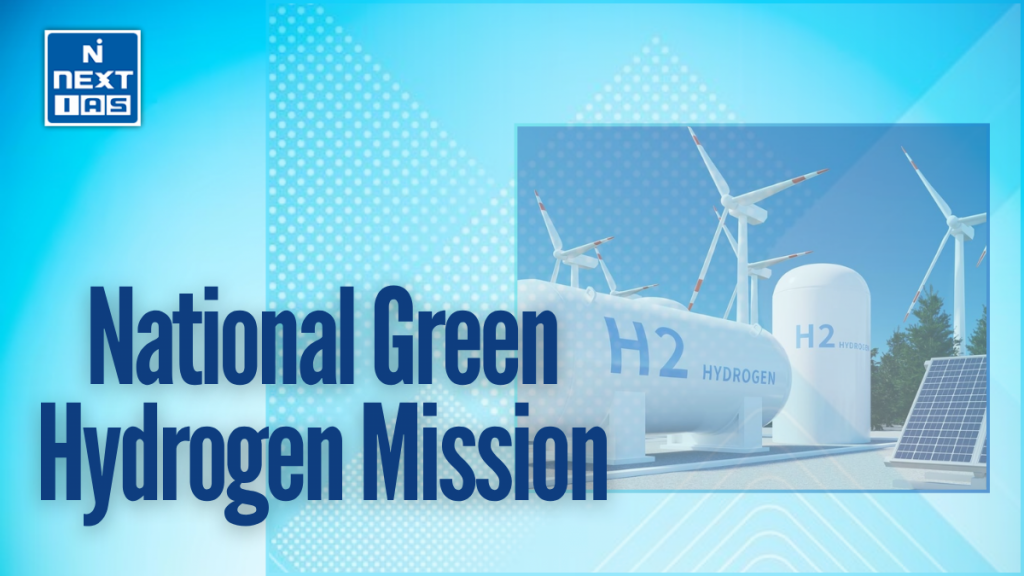
The Indian government in January 2023 launched the National Green Hydrogen Mission, envisaged to develop India into a worldwide green hydrogen production, usage, and export hub. Applying a budget of ₹19,744 crore, the mission aims at lowering carbon emissions, thereby increasing energy security and promoting clean energy innovations for sustained economic growth.
About the National Green Hydrogen Mission
- By utilizing renewable energy, producing such Green Hydrogen contributes towards low carbon economic pathways and self-reliance.
- Green Hydrogen will act in conjunction with the application of locally available renewable energy resources across regions, sectors, and seasons, feeding into multiple streams for use either as energy or industrial feedstock.
- It directly replaces fossil fuel-based feedstocks in petroleum refining, fertilizer manufacturing, steelmaking, etc.

- Long-haul trucks and ships running on hydrogen fuel can, therefore, decarbonize the mobility sector. Particularly, Green Hydrogen is an excellent option as a medium for energy storage with which energy needs of isolated regions, including islands, can be met with sustainable solutions.
- That set of unique potentials and advantages seem to have held back the replacement of fossil fuel and fossil fuel-based feedstock with Green Hydrogen or its derivatives, owing to unattractive cost economics, unresolved harmonized standards and regulations, supply-side challenges, and the heavy costs of enabling infrastructure.
- Hence, recent trends and analysis show that Green Hydrogen is likely to become cost-competitive in industrial applications, mobility, and other sectors in a matter of time, due to technology advancement, drop in renewable energy and electrolyser cost, and strong national measures in some of the major economies. The Green Hydrogen pathway can indeed prove to be the key for India to realize its aspirations towards building a low-carbon and self-reliant economy.
- The National Green Hydrogen Mission aims at scaling production and use of Green Hydrogen in multiple sectors and is associated with global trends in technology, applications, policy, and regulation.
Features of the National Green Hydrogen Mission
- Production Targets: Mission looks to set 5 million metric tonnes (MMT) green hydrogen production capacity per annum by 2030, which should be further expanded with demand.
- Finance: An allocation of ₹19,744 crore has been made in order to promote production incentive schemes, R&D, and infra facilities.
- Strategic Hydrogen Hubs: From the point of view of industrial production and for export, the mission aims to establish hydrogen hubs across India for large-scale production, storage, and distribution.
- Electrolyzer and Renewable Energy Expansion: It promotes, in support of hydrogen production, the manufacture of electrolyzer as well as the expansion of renewable energy capacity, most notably solar and wind.
- Industry Application: Green hydrogen is to be used in place of fossil fuels in refining, fertilizer, steel production, and heavy transport industries.
- Export Possibility: The mission considers promoting India to become one of the export destinations of green hydrogen, thus realizing its utmost economic gains.
- Research and Development: Great importance is placed upon technological improvement, cost curtailment, and efficiency improvement in hydrogen production and storage.
- Employment and Sustainability: The initiative shall create more than 600,000 jobs and will reduce carbon dioxide emissions by 50 million metric tonnes per annum. Also, it is anticipated to reduce our dependency on imported fossil fuels.

Objective of the National Green Hydrogen Mission
Develop India as a Global Hub
- Establish India as a producer, consumer, and exporter of green hydrogen and its derivatives.
Enhance Energy Security & Reduce Import Dependence
- Reduce emission of toxic gases so as to use clean energy at highest probability by restricting import of fossil fuels.
- Strengthen India’s energy independence and contribute to decarbonization.
Decarbonization of Key Sectors
- Help the industries of steel, refining, ammonia, and mobility to achieve carbon footprint reduction by using fossil fuels substituted with green hydrogen.
Promote Research, Development & Innovation (R&D & I)
- Engage in promotion and development of new and novel techniques or processes of green hydrogen production, storage, transportation, and utilization.
Create Demand & Market for Green Hydrogen
- Forge demand for green hydrogen in industries and transport to enable its large-scale adoption.
Infrastructure Development
- Establish a strong supply chain including manufacturing of electrolyzers, storage of hydrogen, and refueling stations.
Employment & Economic Growth
- Support job creation and industrial development through green hydrogen projects and investments.
Achieve Net Zero & Climate Goals
- Contribute to India’s commitment to achieving net-zero emissions by 2070 and meeting its Nationally Determined Contributions (NDCs) under the Paris Agreement.

Significance of the National Green Hydrogen Mission
- With the goal of establishing India in the global arena of green hydrogen production and consumption, the National Green Hydrogen Mission was designed as a truly transformative initiative by the Indian government.
- With around ₹19,744 crore worth of funding, it is crucial to the transformation of India into a low-carbon economy and achieving net-zero emissions by the year 2070.
- An important point lies in that the mission would discourage the use of fossil fuel, which would enhance energy security.
- Being import-centric for crude oil and natural gases, India is well placed for green hydrogen as the clean alternative in these difficult-to-abate sectors such as steel, cement, and chemical, as well as others such as transport and power generation.
- The National Green Hydrogen Mission also decarbonizes the industrial sectors to some extent, which will hugely cut down GHG emissions.
- Green hydrogen production shall be more environmentally friendly and cost-effective in India with the abundant renewable energy potential it boasts of via solar and wind power.
- Research, innovation, and manufacturing in the green hydrogen domain are expected to create jobs and stimulate economic growth due to the National Green Hydrogen Mission.
- It aligns with India’s commitment to climate action and strengthens its leadership in renewable energy and sustainable development.
Lacunae of the National Green Hydrogen Mission
- High Production Costs: Green hydrogen produced through electrolysis remains costly, mainly due to the high cost of renewable energy and electrolyzers. Without a substantial reduction in costs, it will have difficulty competing with fossil fuel-based hydrogen.
- Infrastructure Deficiency: India has no storage, transportation, and formative infrastructure for hydrogen. A nationwide hydrogen supply chain would require substantial investment and technological advances.
- Dependence on Renewable Energy Expansion: This mission has significant dependence on renewables in green hydrogen production. However, renewable energy capacity in India needs to expand significantly to meet demand, posing a question of resource strain.
- Concern for Water Scarcity: Electrolysis employs a mass amount of water, putting the process into doubt throughout water-stressed areas of India. Without an efficient water management strategy, there would surely be serious concerns regarding the sustainability of large-scale hydrogen production.
- Limited Indigenous Manufacturing: Currently, India depends on imports for several of the primitive components such as electrolyzers and fuel cells. Without a strong domestic manufacturing ecosystem, reliance on foreign technology could delay progress.
- Unclear Policy and Regulatory Framework: The mission lacks detailed guidelines on incentives, carbon pricing, and safety regulations, which are essential for attracting private sector investment and ensuring long-term viability.
- Global Competition: Countries like the U.S., EU, and China are already advancing in the hydrogen economy with strong policies and subsidies. India needs aggressive strategies to remain competitive in the global market.
National Green Hydrogen Mission for UPSC CSE Prelims
- Launch & Budget – Considering a launch in January 2023 with an estimated outlay of ₹19,744 crore.
- Objective – To catapult India on the international map for green hydrogen production, usage, and export.
- Target – To achieve an annual green hydrogen production of 5 million metric tonnes (MMT) by the year 2030.
- Emission Reduction – Reduction of 50 million metric tonnes of CO₂ emissions per annum is envisaged.
- Renewable Energy Integration – To provide for a renewable energy capacity of 125 GW for green hydrogen production.
- Employment & Investment – More than 6 lakh jobs are likely to be created and attract investments to the tune of ₹8 lakh crore.
- Electrolyzer Manufacturing – With an electrolyzer focus to be manufactured indigenously to reduce costs.
- Financial Incentives – Incentives to support domestic manufacturing, R&D, and pilot projects.
- Sectors Covered – Emphasis is given on refining, steel, mobility, shipping, and fertilizers for green hydrogen adoption.
- Exports – Preparing India for an export giant of green hydrogen and its derivatives.
- Nodal Ministry – Implementation by the Ministry of New and Renewable Energy (MNRE).
Way forward
In a nutshell, News This Way Daily reports: Encouraging policy support for large-scale production; strengthening R&D to bring down costs; infrastructure development for storage and transportation of hydrogen; international collaboration for green hydrogen; and the fostering of industries based on green hydrogen. Strengthening regulatory frameworks and skill building will culminate into both sustainable growth and global competitiveness.
Conclusion
The National Green Hydrogen Mission is a defining step toward India’s clean energy future: For sustainability, energy security, and economic growth. By promoting green hydrogen production and adoption, it seeks to reduce dependence on fossil fuels, cut carbon emissions, and establish India as a global leader in the hydrogen economy.