
 80813-00200


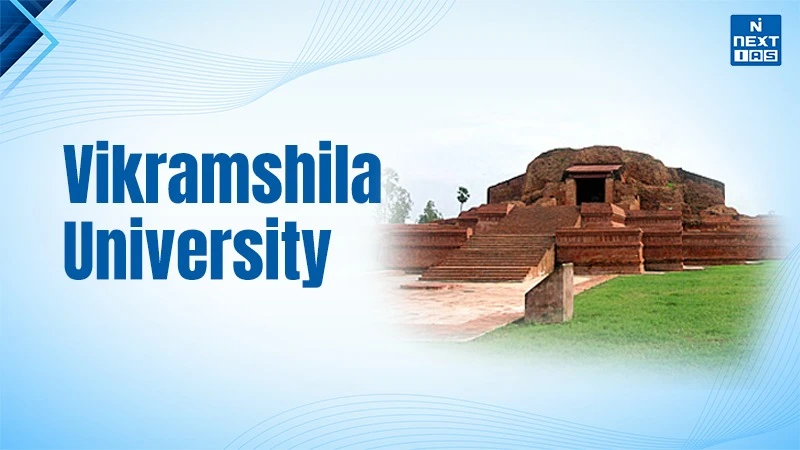
The Vikramshila University was the global centre for buddhist learning. It was patronized by the King Dharmapala of the Pala dynasty. It was founded in the 8th century CE and located in the antichak village in bhagalpur district of Bihar. The students at Vikramshila were taught logic, grammar, astrology, medicine and vedas including tantric or Vajrayana Buddhism.
It was a unique feature that the 6 expert scholars also known as the Dwar-Pandits used to take oral tests at the 6 gates of the university before enrolling any student. In the 12th century, the university was destroyed by the invasion of Bakhtiyar Khilji who was a general of the Delhi Sultanate. He burned the libraries which had years of scholarly tradition.
Historical Context of the Vikramshila University
- The Pala dynasty ruled the Bengal and Bihar region from about 8th to 12th century CE. They were ardent followers of Vajrayana and Mahayana Buddhism.
- With this thought, King Dharmapala founded the Vikramshila University where free education, accommodation, and food were offered to the enrolled students in the university.
- By the 8th century, the mahayana buddhism was shifted towards Vajrayana buddhism which included yoga, rituals, and complex philosophical discussions.
- On one side, Nalanda University heavily focussed on the mahayana buddhism whereas on the other side Vikramshila university gradually adopted the tantric or vajrayana buddhist philosophies.
- The education at Vikramshila was not only restricted to India. In the 11th century, the Tibetan King invited the chief scholar Atisa Dipankar Srijana of Vikramshila University to Tibet. Atisa's visit further increased the cultural ties between India and Tibet.
- Vikramshila University formed a highly administrative structure by the Chief abbot or Mahasthavira and council of senior scholars.
Comparison Between Vikramshila and Nalanda University
| S.No. | Aspect | Vikramshila | Nalanda |
|---|---|---|---|
| 1 | Location |
|
|
| 2 | Founder / period |
|
|
| 3 | Nature of institution |
|
|
| 4 | Doctrinal specialization |
|
|
| 5 | University Curriculum |
|
|
| 6 | Strength of students & teachers |
|
|
| 7 | Famous scholars |
|
|
| 8 | Status |
|
|
| 9 | Destruction |
|
|
Vikramshila as Buddhist Learning Centre of Pala Dynasty
- The Vikramshila University was an education centre for attaining higher learning. It flourished for about 4 centuries between 8th to 12th century CE.
- It was a home to about 1,000 to 1,600 students under 100 to 160 teachers headed by an Adhipati or Mahasthavira.
- The curriculum of the university focussed on vajrayana buddhism and logic, grammer, Philosophy, and medicine.
- The 6 gates were unique to Vikramshila university. The students who came for enrolling themselves, had to go through an oral examination conducted by the Mahasthavira or 6 scholars at 6 gates of the university.
- The architecture of the university consisted of baked bricks, lime plaster, and terracotta art which depicted tara and hevaraja mandals which were the hallmark of Pala style.
| S.No. | Aspect | Key Information |
|---|---|---|
| 1 | Location |
|
| 2 | Founder |
|
| 3 | Primary specialization |
|
| 4 | Famous scholar |
|
| 5 | Art Style |
|
| 6 | Destruction |
|
Timeline of Important Events
| S.No. | Year / Event | Description |
|---|---|---|
| 1 | c. 783–820 CE: Foundation |
|
| 2 | 9th Century: Expansion |
|
| 3 | 983–1054 CE: Atisha's Era |
|
| 4 | 11th Century: Peak |
|
| 5 | 1193 CE: Destruction |
|
| 6 | 1960–1982: Excavations |
|
FAQs about Vikramshila University
Who founded Vikramshila University?
Pala king Dharmapala founded Vikramshila University around 783-820 CE in Bihar.
What made Vikramshila unique?
Specialization in Tantric Buddhism with six debate gates for entrants.
Who are the Famous scholars from Vikramshila?
Atisha Dipankara, Naropa, Ratnakarashanti are some famous scholars from Vikramshila.
Why was it destroyed?
Bakhtiyar Khilji's invasion in 1193 razed it after Nalanda.
What is the Current status of the site of Vikramshila?
Vikramshila University is ASI-protected. Moreover, Bihar planned to build a new university.
