
 80813-00200
India’s 4th Biennial Update Report to UNFCCC
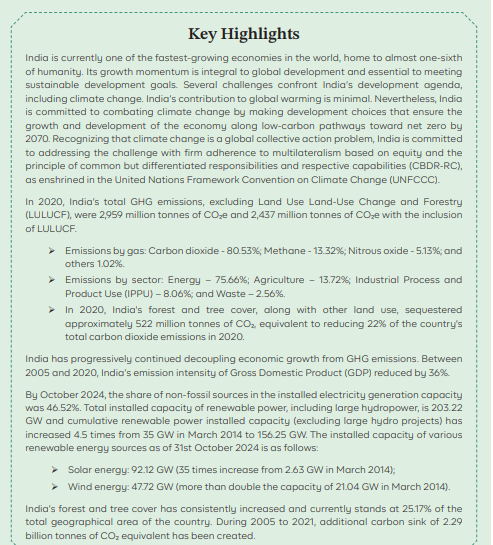
- India’s 4th Biennial Update Report (BUR-4) to UNFCCC, submitted on December 30, 2024, shows that the country emitted 2,959 MtCO2e of greenhouse gases in 2020.
- The emission intensity of GDP decreased by 36% between 2005 and 2020 and is expected to reach a 45% reduction by 2030.
- The non-fossil energy generation capacity reached 46.52% through the installation of 203.22 GW of renewable energy sources, while forests sequestered an additional 2.29 billion tonnes of CO2 from 2005 to 2021.
- The report shows requirements for climate change solutions together with necessary financial resources and technological support according to the principle of CBDR-RC.
India’s Achievements in Respect of the NDC Targets:
- India has progressively continued decoupling economic growth from GHG emissions. Between 2005 and 2020, India’s emission intensity of Gross Domestic Product (GDP) reduced by 36%.
- By October 2024, the share of non-fossil sources in the installed electricity generation capacity was 46.52%. Total installed capacity of renewable power, including large hydropower, is 203.22 GW and cumulative renewable power installed capacity (excluding large hydro projects) has increased 4.5 times from 35 GW in March 2014 to 156.25 GW.
- India’s forest and tree cover has consistently increased and currently stands at 25.17% of the total geographical area of the country. During 2005 to 2021, an additional carbon sink of 2.29 billion tonnes of CO2 equivalent has been created.
Despite India's very low contribution to historical emissions and the current levels of global emissions, India has taken proactive actions to combat climate change in the context of sustainable development and its developmental aspirations. This is in light of India’s national circumstances, reflecting principles of equity and common but differentiated responsibilities and respective capabilities (CBDR-RC), as enshrined in the UNFCCC and its Paris Agreement.
Background of 4th Biennial Update Report to UNFCCC
- India's 4th Biennial Update Report (BUR-4) to UNFCCC, submitted December 30, 2024, updates the Third National Communication (TNC).
- India, as a Non-Annex I Party under UNFCCC, must submit its BURs every two years to provide GHG inventories starting from the 2020 baseline along with details of mitigation and adaptation efforts and the required support resources including finance, technology, and capacity building.
- The report demonstrates compliance with NDC targets by following the Paris Agreement requirements, which establish CBDR-RC principles for countries with minimal historical emissions.
- The BUR-4 highlights progress through documentation of emission intensity reductions, renewable energy advancements, and forest sink developments achieved despite the country’s focus on development needs.
India’s Initiatives
Renewable Energy Expansion
The country has accomplished 203.22 GW of renewable energy, which represents 46.52% of its total non-fossil power capacity. The country plans to reach 500 GW of renewable energy capacity by 2030 through the National Solar Mission, PM-Surya Ghar, and National Bio-Energy Programme initiatives.
Forest and Carbon Sinks
The forest and tree cover area stands at 25.17%, and the sector has created a carbon sink of 2.29 billion tonnes of CO₂ equivalent. In 2020 alone, forests absorbed 522 MtCO₂.
Efficiency and Schemes
The PAT scheme and UJALA program work together to achieve energy savings, while the LiFE Movement promotes sustainable living practices. Additionally, CDRI and ISA operate at the international level to strengthen climate resilience and solar cooperation.
NDC Progress
The country has achieved a 36% reduction in GDP emission intensity from its 2005 levels while committing to reach net-zero emissions by 2070.
India’s Proactive Steps to Combat Climate Change
India takes proactive steps to combat climate change, as detailed in its 4th Biennial Update Report (BUR-4).
Renewable Energy Push
Boosted non-fossil capacity to 203.22 GW (46.52% of total), targeting 500 GW by 2030 through PM-KUSUM, the Green Hydrogen Mission, and offshore wind initiatives.
Afforestation and Sinks
Expanded forests to create a 2.29 billion tonnes CO₂ sink (2005–2021); the Green India Mission enhances carbon sequestration.
Energy Efficiency
PAT scheme saved 106 MT energy; UJALA distributed 36 crore LEDs; strengthened standards for appliances to reduce emissions.
Global Leadership
Launched CDRI (60+ partners) and ISA (120+ countries); the LiFE movement promotes sustainable lifestyles worldwide.
Adaptation Measures
National Action Plan on Climate Change (NAPCC) with 8 missions; Climate Resilient Observing Systems (CROPS) to strengthen climate resilience.
FAQs
What is India's 4th BUR to UNFCCC?
Periodic report on GHG emissions (2020: 2,959 MtCO₂e), mitigation progress, and support needs under CBDR-RC.
Key achievement in emission intensity?
GDP emission intensity reduced 36% (2005-2020), on track for 45% NDC target by 2030.
Renewable energy progress?
Non-fossil capacity at 203.22 GW (46.52%); forests absorbed 2.29B tonnes CO₂ sink.
