
 80813-00200

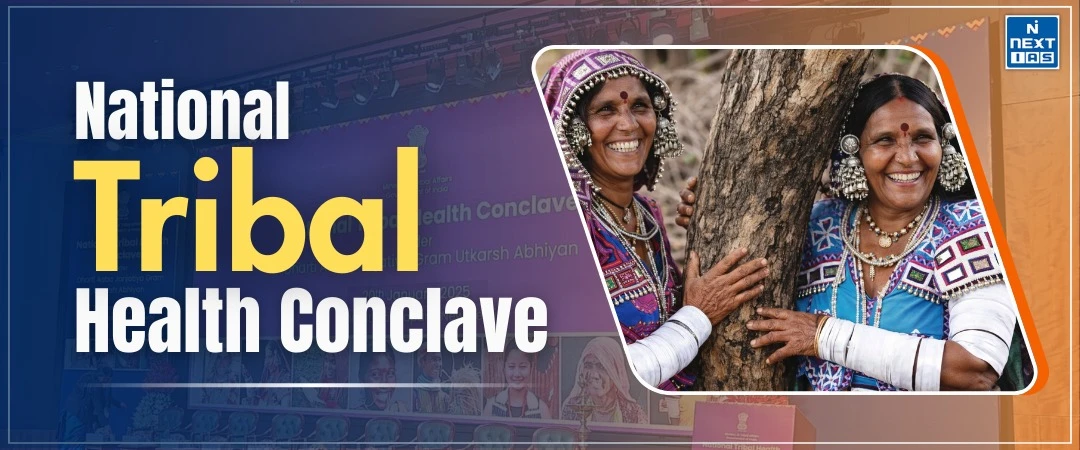
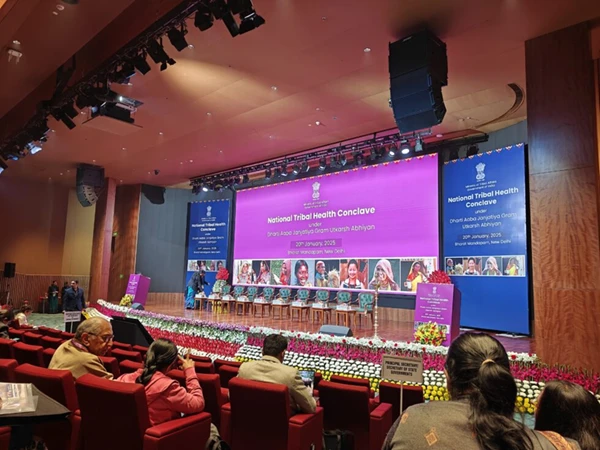
National Tribal Health Conclave was a national event organized by the Ministry of Tribal Affairs (MoTA) in collaboration with the Ministry of Health and Family Welfare (MoH&FW). The conclave is an important initiative under Dharti Aaba Janjatiya Gram Utkarsh Abhiyan. The conclave brings together the policymakers, medical directors, tribal health experts, state administrators, and research to provide healthcare problems faced by tribal people of India.
नेशनल ट्राइबल हेल्थ कॉन्क्लेव भारत में आदिवासी समुदायों की सेहत पर केंद्रित है। इस कॉन्क्लेव का आयोजन जनजातीय कार्य मंत्रालय और स्वास्थ्य एवं परिवार कल्याण मंत्रालय ने किया था। नेशनल ट्राइबल हेल्थ कॉन्क्लेव, 'धरती आबा जनजातीय ग्राम उत्कर्ष अभियान' के तहत एक ऐतिहासिक पहल है।
Major Objectives of Conclave
The main objectives of the National Tribal Health Conclave revolve around removing healthcare issues, improving service delivery in remote or isolated areas, and ensuring culturally sensitive care for the tribal population of India.
| S.No. | Major Objective | Key Focus |
|---|---|---|
| 1 | Alleviate health inequalities of tribals | Understand and address health needs specific to tribal people, especially tribals residing in far-off and neglected areas. |
| 2 | Facilitate better access to healthcare | Study the use of telemedicine, mobile clinics, building front-line capacity and better infrastructure for tribal people who live in far-off geographic locations. |
| 3 | Formulate policy and research priorities | Determine policy intervention, action-oriented research, monitoring and corrections needed to enhance the health system of tribal people. |
| 4 | Design health interventions | Design health interventions that respect the culture of tribal people and improve early diagnosis, treatment-seeking and treatment adherence. |
| 5 | Nutrition and health of adolescents | Improve nutrition, maternal and child health, reproductive health, adolescent health, and address malnutrition. |
| 6 | Address burden from diseases | Respond to disease burdens such as sickle-cell disease, communicable diseases, addiction and mental-health concerns. |
| 7 | Use traditional medicine | Acknowledge safe and efficacious traditional medicines used by tribal people and link tribal healers with the public-health system appropriately. |
| 8 | Promote multi-stakeholder collaboration | Encourage collaboration among ministries, states, health professionals, researchers, civil-society organisations, tribal leaders and development partners. |
Structural and Medical Initiatives
The National Tribal Health Conclave introduced various structural and medical initiatives to reform the healthcare delivery across the tribal regions in India. Few of them are discussed below.
- The provision of a dedicated academic chair namely the Bhagwan Birsa Munda Chair of Tribal Health and Haematology was established at the AIIMS Delhi. It serves as a central hub for field research, clinical collection of data, and special training on tribal particular health issues.
- The collaboration of the Ministry of Tribal Affairs and AIIMS Delhi adopted a tribal block in Odisha. The block acts as a live field laboratory for etiological studies, tracking localized disease vectors, and evaluating the primary health interventions.
- The government has launched 15 Specialized Centres of Competence across 14 states. These centres primarily focus on advanced prenatal diagnostics for the purpose of screening and curbing the transmission of sickle cell disease.
- The National Tribal Health Conclave included the indigenous Vaidyas or tribal healers into the formal public health system to build the trust of tribal communities and bridge cultural resistance.
- After the conclave, a national 'Training of Trainers' or ToT program was launched by the government of India. The program focussed on training doctors in genetic consultations and the reduction of stigma related to the Sickle Cell Anemia. It will support the national mission to eliminate the disease by 2047.
Timeline of Tribal Healthcare in India
| S.No. | Period | Major development |
|---|---|---|
| 1 | 1974 to 75 |
|
| 2 | 1992 |
|
| 3 | 1999 |
|
| 4 | 2005 onwards |
|
| 5 | 2013 |
|
| 6 | 2014 |
|
| 7 | 2018 |
|
| 8 | 2020 |
|
| 9 | 2021 |
|
| 10 | 2023 |
|
| 11 | 2024 |
|
| 12 | 2025 |
|
FAQs about National Tribal Health Conclave
When was the National Tribal Health Conclave 2025 held?
The conclave was held from 20 to 22 January 2025 at Bharat Mandapam in New Delhi.
What was the key focus of the National Tribal Health Conclave?
The main focus of the National Tribal Health Conclave are addressing the tribal health problems, sickle cell disease elimination, and cultural healthcare integration.
