
 80813-00200

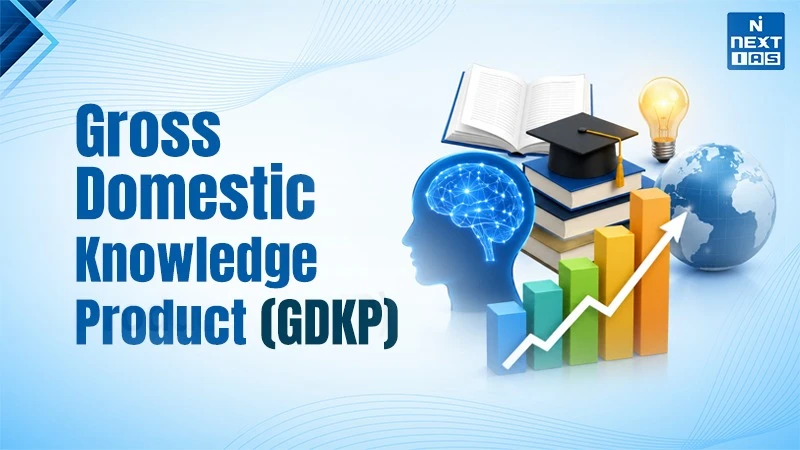
The full for of GDKP is Gross Domestic Knowledge Product, it serves as a new method to assess a country's intellectual capital and innovative capacity and scholarly output which extends beyond standard GDP measurements. Professor Umberto Sulpasso developed this system to measure educational results and research development output and patent creation and digital technology use and cultural knowledge which includes yoga and Vedic studies.
The Indian Ministry of Statistics and Programme Implementation revived GDKP in 2025 through Principal Scientific Advisor Ajay Sood who introduced human capital and intellectual property and knowledge distribution indices to supplement GDP measurement. The system helps knowledge economy policymakers by showing how intangible assets contribute to sustainable development.
Historical Background of Gross Domestic Knowledge Product
- Economic knowledge production measurement through the Gross Domestic Knowledge Product (GDKP) which Prof. Umberto Sulpasso developed at the University of Southern California Digital Center in 2016 serves as a solution to GDP measurement problems faced by digital knowledge economies that require knowledge production assessment through patent and educational and cultural asset evaluation which includes Indian yoga traditions.
- India became the first nation to calculate GDKP measurements through its 2016 partnerships which resulted in the first GDKP-India estimation process.
- The National Statistical Commission rejected the concept because it lacked proper methodology and relied on subjective judgment of the NITI Aayog which had put forth its concept in 2021.
- The Ministry of Statistics and Programme Implementation (MoSPI) organized a workshop in February 2025 to establish a comprehensive knowledge-driven growth framework in collaboration with Principal Scientific Adviser Ajay Sood.
Need of GDKP
The Indian economy requires Gross Domestic Knowledge Product (GDKP) as an essential tool to track its growing knowledge-based economy during this period of technological advancements and digital changes. The traditional GDP measurement system fails to recognize intangible assets which originate from research and development activities, patents, artificial intelligence, software, educational content, and cultural intellectual property rights such as yoga, which contribute to economic growth but do not fit into existing measurement frameworks.
Key Reasons
Holistic Measurement: GDKP uses satellite accounts to measure intellectual capital, which creates economic and social benefits, while GDP measures only physical production.
Global Alignment: The system provides a framework for developed countries to evaluate their intangible assets while providing guidance on funding knowledge infrastructure, which includes digital access systems.
The research provides guidance for entrepreneurship and research activities while solving the NSC's 2021 methodology problems, which the MoSPI 2025 workshop has brought back into focus.
The GDKP system enables Viksit Bharat to achieve its knowledge-based objectives, even though it faces difficulties with data collection and assessment methods.
Major Challenges & Barriers in it's Implementation
- Data Collection Issues: The existing data on IP R&D, digital innovation and human capital needs new measurement methods because it exists as fragmented data which does not match current GDP measurement methods.
- Subjectivity in Metrics: The process of defining and measuring "knowledge" needs to find cultural IP parameters which are suitable for evaluation but this process will face challenges because people will have different perceptions of these parameters.
- GDP Integration: The system prevents double-counting through its treatment of IP which already exists within Gross Fixed Capital Formation. The system requires a precise structure to show how different elements work together.
Way forward
India needs to establish a systematic approach to GDKP implementation because this method will help the country reach its knowledge economy capabilities.
Key Steps
Form Technical Committee: MoSPI will create an expert panel which will improve methodology through standardized satellite accounts while solving NSC 2021 data gap and subjectivity problems.
Data Infrastructure: Digital platforms will connect scattered IP filing sources with R&D expenditure sources and educational performance sources; GDKP estimates will use current GFCF-IPP data as a testing ground.
Global Benchmarking: We will work with OECD countries to develop intangible asset measurement standards while we create our policy framework for skilling and AI and cultural IP components of Viksit Bharat.
The project will achieve its objectives because regular MoSPI workshops together with NITI Aayog supervision will guide the process until its completion in 2027.
Conclusion
GDKP demonstrates a forward-looking advancement for India because it goes beyond GDP measurement to identify knowledge as the essential economic driver of Viksit Bharat. The system measures research and development work and patent achievements and cultural intellectual property through its system of evaluation which helps to identify contemporary economic deficits. The scheduled implementation of MoSPI's 2025 program together with its organized reforms will enhance innovation policies and international competitiveness and sustainable development.
FAQs about GDKP
What is GDKP?
GDKP measures a nation's knowledge output beyond GDP, including R&D, patents, education, digital skills, and cultural IP like yoga. It captures intangible assets driving modern economies.
Why was GDKP revived in India?
India revived GDKP in 2025 via MoSPI workshop to quantify knowledge economy contributions ignored by GDP, aiding Viksit Bharat policies on innovation and skilling.
What are GDKP's main challenges?
Challenges include fragmented data, subjective metrics for knowledge valuation, and avoiding double-counting with GDP. Needs robust methodology via technical committees.
