
 80813-00200


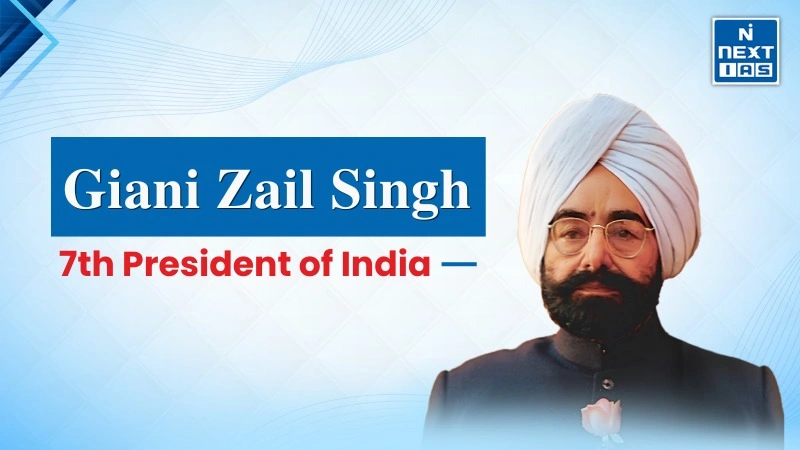
Giani Zail Singh was born on 5th may 1916 in Sandhwan in Faridkot district in Punjab. He served as the 7th President of India from 1982 to 1987. He is famously remembered as the first sikh to hold the highest constitutional office and first president from a backward class group (Ramgarhia community). Giani Zail Singh was born and brought up in a humble artisan family but soon he lost his mother. Therefore, he had to work to support the financial condition of his family. For this reason, he wasn't able to take higher education and studied till Class 10th.
His political journey started with his deep involvement in the Indian freedom movement. He was also an active participant in the Quit India Movement of 1942. He served as Chief Minister of Punjab in 1972 to 1977 and was appointed as the Union Home Minister in the cabinet of Prime Minister Indira Gandhi in 1980.
It is interesting to note that he gained the title 'Giani' because he learned all Sikh scriptures without attending any secular educational system. He became the First Sikh and Backward Class person to serve as President when he won the election in 1982. He managed the political turbulence during 'Operation Blue Star'. He used his first 'Pocket Veto' power to reject the Post Office Bill.
Childhood and Education of Shri Giani Zail Singh
- Giani Zail Singh was born as Jarnail Singh in the village of Sandhwan in the Faridkot district of the Punjab. Zail Singh was born into a family of Ramgarhia Sikhs.
- Zail Singh did not earn any graduation or university degree. His formal education was limited to Class X or the matriculation due to the poverty driven conditions. However, he learned Punjabi, Urdu, and worked as a carpenter to support his family in his early life.
- He formed Praja Mandal in 1938 in Faridkot in Punjab and demanded democratization against princely autocracy which took him 5 years in prison or 'Jail'. After independence, he adopted the nickname 'Zail Singh' which represents his origin.
- Although he lacked the formal education degree, his hold over Punjabi literature, religious texts, and robust leadership was commendable. It enabled him to rise from a freedom fighter in Praja Mandal movement to Chief Minister of Punjab (1972 to 1977), Union Home Minister (1980 to 1982), and finally the first Sikh and 7th President of India.
Timeline of Political Career of 7th President of India
| S.No | Period | Role | Key Details |
|---|---|---|---|
| 1 | Before 1947 |
|
|
| 2 | 1951 to 1956 |
|
|
| 3 | 1956 to 1962 |
|
|
| 4 | 1956 to 1962 |
|
|
| 5 | 1962 to 1972 |
|
|
| 6 | 1972 to 1977 |
|
|
| 7 | 1980 to 1982 |
|
|
| 8 | 1982 to 1987 |
|
|
| 9 | 1983 to 1986 |
|
|
Detailed Analysis of the Political Career of Giani Zail Singh
Served as Chief Minister of Punjab (1972–77)
Giani Zail Singh was appointed as Punjab Chief Minister in 1972. He implemented the land ceiling laws and redistributed surplus to landless. It earned him the title of 'Mazdoor Moza'. He promoted green revolution infrastructure but faced criticism for the arrests of Akali leaders at the time of National Emergency in India.
Union Minister and Home Affairs
Giani Zail Singh was elected as a Lok Sabha Member of Parliament from Hoshiarpur in 1980. He became Union Home Minister under Indira Gandhi. He handled the Punjab insurgency and supported Jarnail Singh Bhindranwale initially to counter Akalis. But it backfired as militancy in Punjab escalated. Moreover, the unrest in Assam and other regions marked his tenure with accusations of soft-pedaling extremism.
Presidency (1982-1987)
Giani Zail Singh was nominated by the Congress party in 1982. As a result, he won and was sworn in as the President of India succeeding Neelam Sanjiva Reddy. He served as the first Sikh President in between the Punjab tensions.
His presidency tenure saw Operation Blue Star in 1984 where the Indian army was tasked to remove the sikh militants from the Golden temple. Jarnail Singh Bindrewale has fortified the Harminder Sahib or the golden temple in Amritsar in Punjab.
This act led to the assassination of the then Prime Minister Indira Gandhi. Giani Zail Singh swore in Rajiv Gandhi who was the son of Indira Gandhi as the new PM of India in between the wake of anti-Sikh riots.
| S.No. | Key Events During Presidency | Description |
|---|---|---|
| 1 | Operation Blue Star in 1984 |
|
| 2 | Indira Gandhi Assassination in 1984 |
|
| 3 | Anti-Sikh Riots in 1984 |
|
| 4 | Bofors Scandal in 1987 |
|
The Legacy and Honors
The rise of Giani Zail Singh from a carpenter to the President of India demonstrated the egalitarian spirit of India. It has inspired the Dalit and Sikh communities. The Praja Mandal movement brought about democracy in the princely states. The policies in Punjab have been criticized for contributing to militancy. He was awarded with Padma Vibhushan in 1982. He was the first backward caste President. He was known for humility and promoted Punjabi language and Sikh granth.
Conclusion
Giani Zail Singh lived a life of resilience. He worked as a rural carpenter and finally became the 7th President of India. His life with the experiences of the turmoil in Punjab and the nation's crises was a test to his loyalty and humility.
FAQs about President Shri Zail Singh
Who was Giani Zail Singh?
Giani Zail Singh was the seventh President of India from 1982 to 1987. He was former Punjab Chief Minister and Union Home Minister.
How did Giani Zail Singh die?
Giani Zail Singh died in a Car accident in Chandigarh, India.
When did Giani Zail Singh die?
Giani Zail Singh died on December 25, 1994 at the age of 78 years.
Which college was named after Giani Zail Singh?
The college named after him is 'Giani Zail Singh Campus college of Engineering and Technology'. The Giani Zail Singh college Bathinda is located in Punjab in India.
