
 80813-00200
Home / Ishita Kishore CSE 2022
Ishita Kishore, AIR 1, UPSC CSE 2022
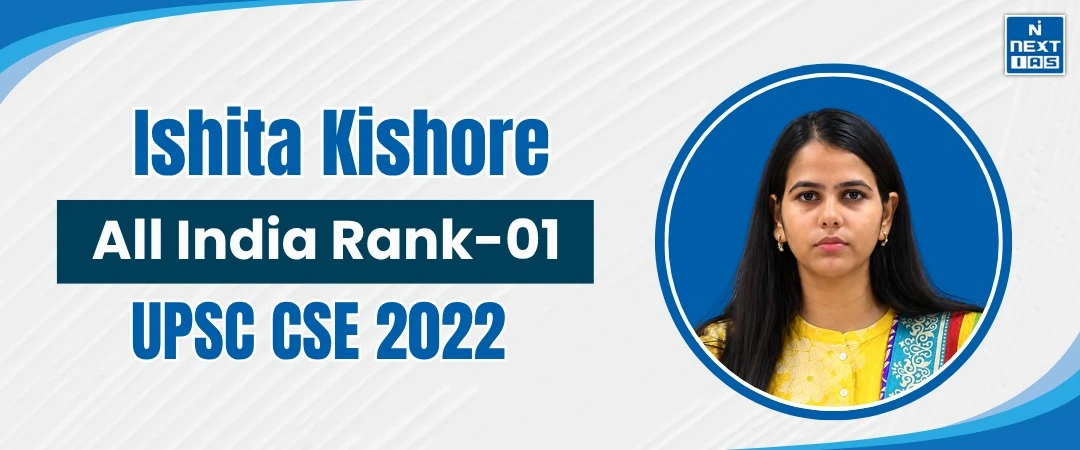
- Ishita Kishore got All India Rank 1 (AIR-1) in UPSC Civil Services Examination (CSE) 2022.
- She is in her third attempt, scoring 1094 marks (901 in written, 193 in interview).
- She was born in 1996 in Begumpet, Hyderabad. Ishita grew up in Bihar and Greater Noida, Uttar Pradesh.
- She is even talented from her childhood and consistent in college days.
Personal Profile & Educational Background
Personal Information
| Field | Details |
|---|---|
| Name | Ishita Kishore |
| Age (at qualifying) | 26 years |
| Rank | AIR-1 (2022) |
| Attempt | 3rd |
| Optional Subject | Political Science & International Relations |
| Family Background | Father (late Wing Commander, Indian Air Force), Mother (retired teacher), Brother (advocate) |
| Hometown | Greater Noida, Uttar Pradesh |
| School | Air Force Bal Bharati School, New Delhi |
| College & Stream | Shri Ram College of Commerce (SRCC), Delhi University (Economics Hons) |
| Selected for | Indian Administrative Service (IAS) |
Educational Background
- Ishita Kishore, who achieved the All India Rank 1 in the UPSC Civil Services Examination 2022, did her schooling in Commerce with Mathematics at the Air Force Bal Bharati School, New Delhi, getting 97.25% in Class 12.
- After that in 2017, she completed her graduation with a B.A. (Hons) in Economics from Shri Ram College of Commerce (SRCC), Delhi University.
| Level | Institution | Stream / Degree | Key detail |
|---|---|---|---|
| Schooling | Air Force Bal Bharati School, New Delhi | Commerce with Mathematics | 97.25% in Class 12 |
| Graduation | Shri Ram College of Commerce (SRCC), DU | B.A. (Hons) Economics | Graduated in 2017 |
Family Background
- Ishita Kishore, the top scorer of UPSC CSE 2022, has been born and brought up in a service-oriented, highly educated, middle-class family possessing a military-like ethics.
- The strictness and values of public service imparted by her deceased father, Wing Commander Sanjay Kishore (Indian Air Force), mother Jyoti Kishore (a teacher retired), and elder brother, lawyer Ishal Harsh, formed her character very strongly.
| Member | Name | Profession / Role | Key details |
|---|---|---|---|
| Father | Late Wing Cdr. Sanjay Kishore | Indian Air Force officer | Passed away in 2004; major inspiration |
| Mother | Jyoti Kishore | Retired school teacher | Raised children single-handedly after 2004 |
| Brother | Ishan Harsh | Advocate / Lawyer | Elder brother, strong support in journey |
| Family ethos | – | Military and academic service background | Instilled discipline and public-service values |
Marks Obtained by Ishita Kishore in UPSC CSE 2022
- UPSC CSE 2022’s Ishita Kishore, who got AIR-1, had a total of 1094 marks; her marks were 901 in the written mains and 193 in the personality test.
- The main subjects she chose were General Studies and PSIR optional and she did very well in the Essay and GS-II papers which contributed to her being the first rank.
| Subject | Marks |
|---|---|
| Essay (Paper I) | 137 |
| General Studies I (Paper II) | 121 |
| General Studies II (Paper III) | 130 |
| General Studies III (Paper IV) | 88 |
| General Studies IV (Paper V) | 112 |
| Optional Paper I (Political Science & IR) | 147 |
| Optional Paper II (Political Science & IR) | 166 |
| Written Total | 901 |
| Personality Test | 193 |
| Final Total | 1094 |
Preparation Strategy of AIR 1, UPSC 2022 Topper
- Ishita Kishore who is one of the toppers of UPSC CSE 2022, made a disciplined plan that lasted about 40-45 hours per week. She used the most limited but standard books, continuous revision, self-written notes, and most mock practice intensive. She had different focus areas for prelims, mains, and interviews to counter the two prelims failures that she had in the past.
Prelims strategy
- Started with strong conceptual clarity on core subjects (Polity, Economy, History, Geography, Environment) and knowing “why” facts instead of rote memorization.
- Used heavily along the lines of PYQs and full-length mock tests to build accuracy, fine-tuned elimination techniques, and mistake analysis after each test to modify her approach accordingly.
- Set up a daily routine with fixed reading (NCERT + standard books + one newspaper) and several revisions instead of just a new source added every time.
Mains strategy
- Giving priority to answer writing, daily/regular GS and PSIR answers, timed practice, and test series to improve speed, structure, and depth of content.
- Organized answers with concise introductions, sub-headings, multi-faceted points (constitutional, economic, social, international), and enhancements like data, reports, and case studies.
- Used the limited sources, took short notes, and focused on the repeated revision of GS + PSIR (chosen for its overlap with polity, governance, IR) to reap maximum benefits across papers.
Interview strategy
| Stage | Core Focus | Key Tools & Methods | Distinctive Elements |
|---|---|---|---|
| Prelims | Concepts + accuracy + revision | PYQs, mocks, elimination practice, fixed sources | Analysing every test; learning from two failed prelims |
| Mains | Answer quality + depth + structure | Daily/timed answers, GS & PSIR tests, concise notes | Multi-dimensional, data-rich, well-structured answers |
| Interview | Personality + clarity + confidence | DAF-based prep, current affairs, multiple mocks | Calm, balanced, service-oriented responses |
Preparation Tips
- Discipline and Consistency: Ishita insisted upon disciplined study spread over 40-45 hours each week, prioritizing quality than quantity and adhering to a realistic timetable.
- Limited Resources: Limited study materials to prevent distraction, made regular use of revised notes and no new textbooks during revision.
- Extensively: Solved the papers of previous years, conducted mock tests for the prelims and mains to develop answering skills and time management.
- Note-Making: Made personal notes from newspapers and studies for better retention; used the "Read, Revise, Re-Revise" method.
- Self-Analysis: Thought back to past failures (failed prelims twice), strategy was altered, the strengths/weaknesses were understood.
- PSIR Optional: Picked Political Science & IR for GS overlap, boosting governance and current affairs understanding.
- Mental Balance: Handled self-doubt, burnout; remained motivated by not comparing to others.
