


Syllabus: GS3/Agriculture; Renewable Energy
Context
- The agriculture sector in India holds untapped potential to drive green energy revolution with over half of India’s population dependent on farming and rural livelihoods.
About India’s Agriculture & Energy Transition
- The agriculture sector in India contributes nearly 18% to India’s GDP and employs over 42% of the workforce.
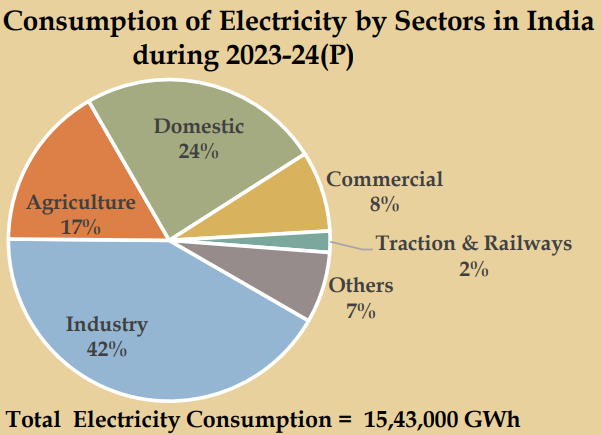
- According to India’s Energy Statistics India (2025), agriculture accounts for approximately 17% share of electricity use, particularly for irrigation.
- In several states, it constitutes over 20% of total electricity consumption.
- The agriculture sector in India is both energy-intensive and energy-deficient, heavily on diesel-powered irrigation pumps, and post-harvest losses due to inadequate cold storage and high processing infrastructure.
- Many states provide free or heavily subsidized electricity to farmers, which has led to overuse and inefficiencies, including groundwater depletion.
- According to the International Labour Organization (ILO), India’s renewable energy transition could create 3.7 million green jobs, many connected to agricultural systems.
- Each solar-powered cold storage unit represents a local enterprise requiring technicians, operators, logistics personnel, and community managers.
Issues With Agriculture Sector in India
- Hidden Cost of Food Loss: India loses 30–40% of its fruits and vegetables after harvest, happen during transport, storage, and processing which depend on reliable power.
- A cold storage unit without power is useless; so are processing centers and preservation systems dependent on erratic electricity or costly diesel generators.
- Policy Fragmentation: Energy and agriculture policies are often siloed, limiting cross-sectoral innovation.
- Schemes like PM-KUSUM, the National Solar Mission, and the PM Surya Ghar Muft Bijli Yojana have expanded solar access in rural India, but their full potential remains untapped due to fragmented policy design.
- Awareness & Training: Many farmers remain unaware of DRE solutions or lack the skills to operate and maintain them.
- Financing Gaps: Smallholder farmers often lack access to affordable credit for renewable energy technologies.
- Other challenges include high upfront costs for solar pumps despite subsidies; maintenance challenges in remote rural areas; and water overuse risk with solar irrigation.
Utilising Clean Energy in Agriculture
- Decentralised Renewable Energy (DRE) Solutions: These systems such as solar mini-grids, rooftop panels, and hybrid units reduce dependence on unreliable grids and diesel, cut operating costs, and enable community ownership of energy assets.
- DRE can make rural food systems both resilient and sustainable by localizing power.
- DRE solutions generate employment along the food chain, enhancing both livelihoods and food security.
- Transitions in Energy and Digital Innovation: India’s rural transformation is being shaped by digital platforms like ITC MAARS, offering AI-driven crop advice and market intelligence.
- But, digital tools alone cannot preserve crops or stabilize prices, as they need energy infrastructure to act on information.
- When renewable energy powers cold storages, dryers, and processing units, farmers can convert digital insights into tangible outcomes.
- Together, smart energy and smart advisory systems create a powerful engine for rural resilience.
- Local Innovation and Solutions: Across India, farmers are developing low-cost, context-specific energy innovations. These include:
- Solar dryers made from local materials;
- Converted refrigerated trucks used as mobile cold storages;
- Community-run solar processing units;
- Bridging Policy Silos: Agriculture and energy are managed by separate ministries and financing channels, resulting in missed opportunities.
- Linking renewable energy initiatives with agricultural value chains could help bridge rural infrastructure gaps and cut post-harvest losses.
- Effective coordination between these sectors is key to achieving climate-smart agriculture.
| Case Study of Odisha – The Markoma Women Farmer Producer Company (FPO) established a 5-metric-tonne Ecozen solar-powered cold storage unit to serve local vegetable growers with support from the Harsha Trust. – It has reduced post-harvest losses, stabilized prices through organized market linkages, and boosted awareness of solar energy across neighboring communities, since its pilot in 2018. a. It demonstrates reducing food loss is not just about infrastructure, but about smarter energy systems. |
Government Policy & Framework
- PM-KUSUM Scheme (MNRE): It aims to reduce farmers’ dependence on diesel and grid electricity, lower emissions, and provide additional income through surplus energy sales.
- Component A: Installation of 10,000 MW of decentralized ground-mounted grid-connected renewable power plants on barren/fallow land.
- Component B: Installation of 2 million standalone solar agriculture pumps.
- Component C: Solarization of 1.5 million existing grid-connected agriculture pumps.
- Voluntary Carbon Market Framework (Ministry of Agriculture): It encourages climate-smart agriculture while creating new income streams.
- Register GHG mitigation projects (eg, renewable energy use, sustainable practices).
- Earn carbon credit certificates under the Carbon Credit Trading Scheme.
- Monetize eco-friendly practices, especially beneficial for small and marginal farmers.
- Energy Data Management in Agriculture (NITI Aayog): It highlights the need for accurate energy consumption data to design effective clean energy interventions.
- It recommends inter-ministerial coordination and data-driven policy planning, and emphasis on monitoring DRE deployment in rural areas.
- Other Policy Initiatives:
- Clean Plant Programme (CPP): Promotes climate-resilient horticulture through disease-free planting material.
- Support for climate-smart agriculture under various centrally sponsored schemes.
- Incentives for renewable energy adoption in rural infrastructure and agri-processing.
Way Forward: Towards a Resilient, Net-Zero Future
- The NITI Aayog ‘Energy and Agriculture Nexus Report 2025’ outlines potential synergies:
- Bioenergy from crop residues could generate 20 GW of power, helping reduce stubble burning.
- Agro-voltaics (farming under solar panels) can enhance land productivity by 60%, as piloted in Rajasthan and Tamil Nadu.
- Green hydrogen from biomass and waste-to-energy plants are emerging as next frontiers for agri-linked clean energy.
- As India advances toward its 2070 net-zero goal, linking renewable energy with food systems needs to become a national priority. Key actions include:
- Expanding solar integration beyond irrigation to post-harvest systems;
- Offering targeted credit for farmer collectives;
- Encouraging public-private partnerships;
- Investing in green skills training;
| Daily Mains Practice Question [Q] Examine the role of agriculture in India’s clean energy transition. Do you agree that agriculture holds the greatest potential for clean energy transition? |
Previous article
India Needs a National Insolvency Tribunal
