


Syllabus: GS2/International Relations
Context
- Recent remarks of the Prime Minister of India highlight India’s deep dependence on foreign nations from China to Russia to the United States, as it faces the reality of strategic multi-dependence, despite the rhetoric of strategic autonomy and multi-alignment.
India’s Deep Dependence on Foreign Powers
- India’s rise as a global power is often celebrated for its economic growth, strategic diplomacy, and technological prowess.
- However, there lies a complex web of dependencies — on China for trade, on Russia for defense, and on the United States for technology and investment.
Dependence on the United States
- Trade and Markets: The US is India’s largest export destination, providing essential revenue streams for Indian industry.
- Education and Visas:
- H-1B visas: It has long served as a gateway for Indian professionals to work in the US, especially in STEM fields.
- Indians account for nearly 70% of approvals in FY2023.
- Student migration: The US rivals other nations as the top destination for Indian students.
- Green Cards: A long-term aspiration for many Indian families.
- H-1B visas: It has long served as a gateway for Indian professionals to work in the US, especially in STEM fields.
- Defence Technology and Strategy: India depends on US arms and technology, including engines for indigenous fighter jets, missiles, drones, and reconnaissance systems.
- Strategically, Washington is viewed as a counterbalance to Beijing in the Indo-Pacific.
Dependence on China
- Consumer and Industrial Goods: India’s middle class is reliant on Chinese consumer products, from electronics to white goods.
- Even in mobile phone assembly, critical components are imported from China.
- Pharmaceutical Inputs: China supplies precursor chemicals and active pharmaceutical ingredients (APIs) without which India’s pharmaceutical industry would falter.
- Commodities and Technology:
- Rare earth metals: Vital for batteries and electronics.
- Solar equipment: Polysilicon, wafers, and solar cells.
- Fertilisers and machinery: Including tunnel-boring equipment.
- Computers and semiconductors: Dominated by Chinese imports.
Dependence on Russia
- Defence Equipment: India’s reliance on Russia for arms dates back to the 1970s.
- Estimates suggest 60–70% dependence across the Army, Navy, and Air Force, covering platforms, systems, and spares.
- Energy: Russia’s share of India’s oil imports jumped from 4% in 2022 to nearly 40% at its peak.
- Indian refineries are now locked into Russian supplies, making sudden shifts difficult.
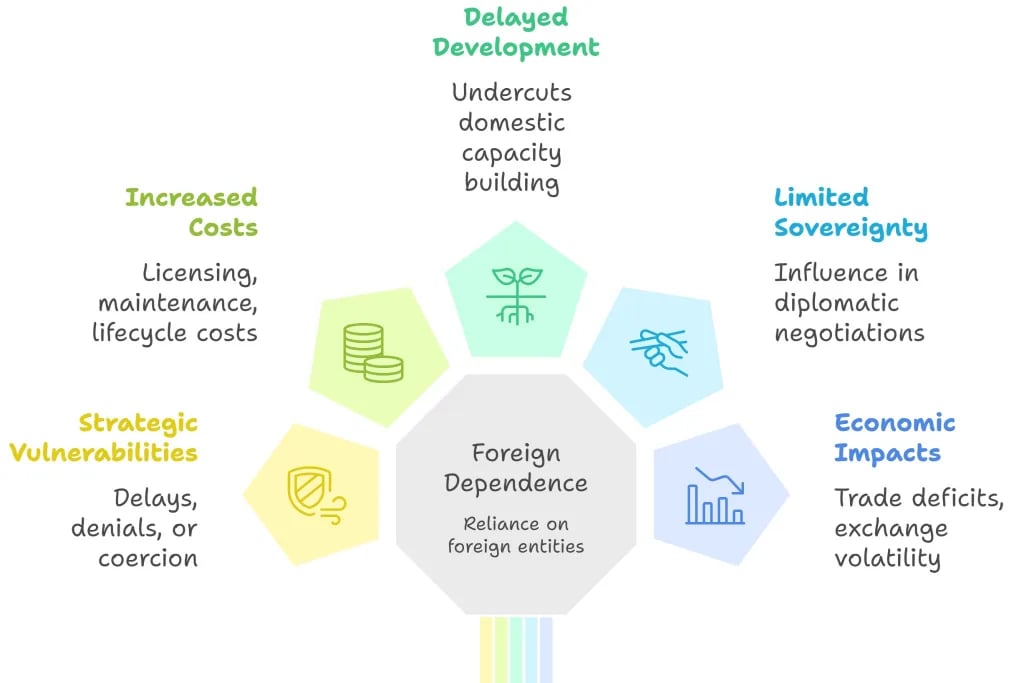
Impacts of Foreign Dependence
Gaps & Challenges
- Strategic Tightrope & Little Room to Maneuver: India’s dependence on all three powers creates serious diplomatic constraints, as it:
- cannot challenge China too strongly over the border issue.
- cannot alienate Russia despite its ties with China and Pakistan, or over Ukraine.
- cannot antagonize the US on tariffs, defence, or strategic alignments.
- It leaves India with little room to maneuver, recalling the vulnerability felt after the Soviet Union’s collapse in 1989.
- Technological Gaps in Critical Components: Even with strong policy pronouncements, India still relies on foreign sources for many core components (engines, advanced sensors, semiconductors).
- Time Lag: Building capacity takes years; policy to implementation is often slower than required by threat/vulnerability timelines.
- Capital, Skill, Institutional Weaknesses: Investment in R&D, human capital, supply chain ecosystems are uneven, suffer regulatory, infrastructure constraints.
- Reliability & Quality: Domestic alternatives sometimes struggle to match foreign technology in terms of reliability, causing inertia in procurement decision-making.
- External Pressures: Sanctions, diplomatic pressure, trade barriers; these can hit India when dependence is high.
Related Efforts & Initiatives
- Make in India: It focuses on boosting domestic manufacturing across sectors, especially defense, electronics, and infrastructure.
- Defense Production Surge: Indigenous defense production hit ₹1.27 lakh crore in FY 2023–24, with exports reaching ₹23,622 crore in FY 2024–25.
- Positive Indigenisation Lists: Over 14,000 imported defense items have been successfully indigenised.
- Private Sector Participation: Strategic policies now encourage private firms to develop advanced military platforms.
- Atmanirbhar Bharat Abhiyan (Self-Reliant India Mission): It aims to reduce reliance on imports and strengthen India’s internal capabilities.
- Semiconductor Push: India will roll out its first Made-in-India semiconductor chip by 2025.
- Nuclear Sector Liberalization: Private players are being invited to invest in nuclear energy, reducing dependence on foreign technology.
- Critical Minerals Mission: Exploration of 1,200 sites to secure essential minerals for energy and defense.
- Strategic Vision for Viksit Bharat 2047 (NITI Aayog): It envisions India as a fully developed and globally influential nation by its centenary of independence.
- Four Pillars: Economic Competitiveness, National Security, Global Partnerships, and Legal Reforms.
- Defense Supply Chain Resilience: Emphasis on AI-driven logistics, blockchain security, and public-private partnerships.
- Technology Transfers & Alliances: Strengthening ties with countries like the U.S., Russia, and Israel for joint R&D and cybersecurity.
- Deepwater & Energy Independence Missions: India is investing in offshore energy exploration and renewable infrastructure to reduce fuel import dependency.
- National Deepwater Exploration Mission: Unlocking offshore resources for energy self-reliance.
- Green Hydrogen & Solar Expansion: Scaling up domestic energy production to cut reliance on oil and gas imports.
- Strategic Autonomy in Foreign Policy: India’s diplomatic posture now emphasizes multi-alignment—engaging with major powers while preserving independence.
- Operation Sindoor: A counter-terror operation using only indigenous weapons, signaling India’s refusal to be blackmailed or compromised.
- Indus Waters Treaty Reassessment: India is reasserting control over its water resources to protect national interests.
Policy Recommendations: Path to Stronger Autonomy
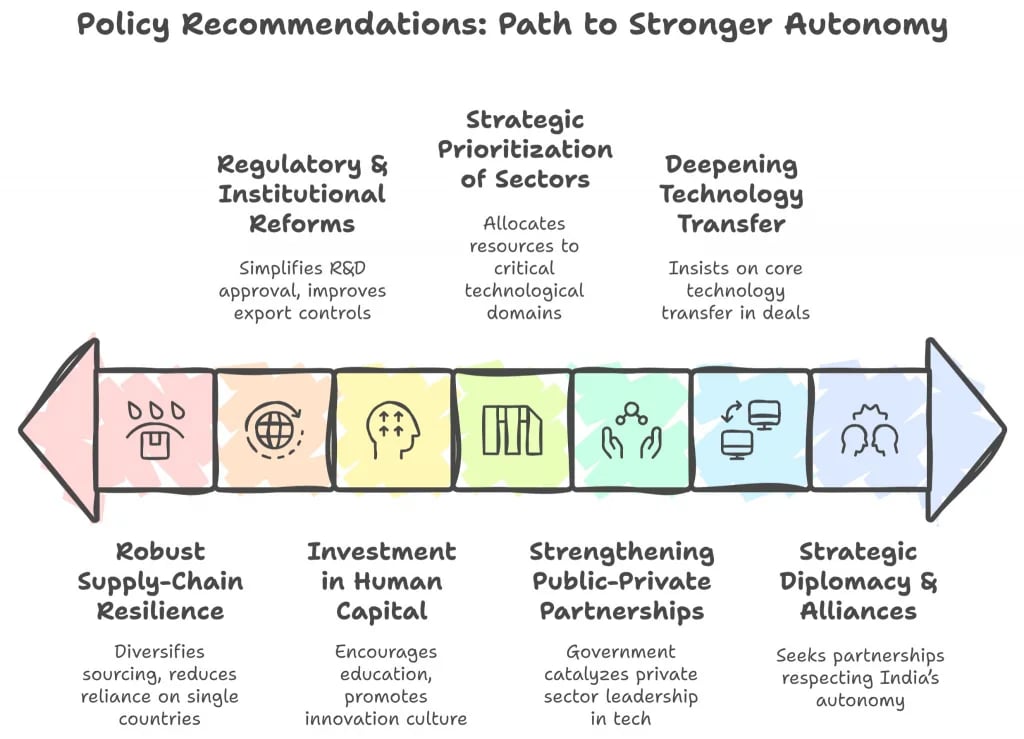
- Reviving Manufacturing: India’s economy has averaged 7% GDP growth since the 1990s, but manufacturing lags behind. The need for a manufacturing revolution is urgent.
- Diversifying Inputs: India needs to reduce reliance on single suppliers for energy; rare earths minerals; APIs and Chemicals.
- Export Diversification: Expanding markets beyond the US is vital to secure economic independence.
- Unlocking Domestic Potential: The private and public sectors need to unleash entrepreneurial spirits to build resilient supply chains, competitive industries, and global exports.
| Daily Mains Practice Question [Q] Critically examine the implications of India’s deep dependence on foreign nations such as China, Russia, and the United States. How can India balance strategic autonomy with global engagement in the current geopolitical landscape? |
Previous article
Innovation in India: As Greatest Equaliser
