


Exercise Bold Kurukshetra 2025
Syllabus: GS3/Defence
Context
- The 14th edition of India–Singapore Joint Military Exercise, Bold Kurukshetra 2025, commenced in Jodhpur, India.
About the Exercise
- First held in 2005, Exercise Bold Kurukshetra is a Table Top Exercise and Computer-Based Wargame focused on validating mechanised warfare procedures.
- It aims to boost interoperability and joint training under a United Nations mandate, reinforcing India–Singapore defence cooperation.
Do you know?
- The Singapore India Maritime Bilateral Exercise (SIMBEX), which began as ‘Exercise Lion King’ in 1994, holds the distinction of being the longest continuous naval exercise that the Indian Navy has with any other country.
Source: PIB
Teej Festival
Syllabus: GS1/Culture
Context
- The Ministry of Tourism, through its Indiatourism Delhi office, organized a vibrant celebration of the Teej Festival at 88 Janpath, New Delhi.
About the festival
- Teej, celebrated primarily by women across North India, especially in Rajasthan, Uttar Pradesh, Haryana and Punjab, marks the advent of the monsoon season and honors the reunion of Goddess Parvati with Lord Shiva.
- The festival is known for its traditional music, dance, henna (mehndi), swings, festive attire, delectable cuisine, prosperity and happiness.
| Do you know? – Teej includes three distinct festivals, each with its own significance: 1. Haryali Teej is celebrated to commemorate the wedding of Lord Siva and Parvati. 2. Kajri Teej, which falls in August, also called Badi Teej, usually takes place 15 days after Haryali Teej on the third day of Krishna Paksha (dark fortnight). 3. Hartalika Teej, which falls in Bhadon month (August-September), is observed to mark the day when female friends of Parvati abducted her and brought her into the thick, deep forests, to escape her father who was determined to marry her to another Lord. |
Source: PIB
Napne Waterfall
Syllabus: GS1/Geography
Context
- A glass bridge built over the Napne waterfall was recently inaugurated by the Maharashtra Minister.
About

- The glass bridge is part of the Sindhuratna tourism scheme, aimed at promoting lesser-known destinations across the state.
- Napne waterfall originates near Nadhavade village, it is located in the Konkan region and is a perennial waterfall in Maharashtra.
- It is home to hornbills, butterflies, and an abundance of endemic flora offering both aesthetic and ecological appeal.
- The place is also home to some exotic bird life attracting birdwatchers from all over.
Source: TH
Kyoto Protocol
Syllabus: GS3/Environment
Context
- Vijai Sharma, Kyoto Protocol architect & India’s ex-chief climate negotiator has passed away.
Kyoto Protocol
- It is an international treaty adopted under the United Nations Framework Convention on Climate Change (UNFCCC).
- It was adopted in 1997 and entered into force in 2005.
- Objective: To reduce greenhouse gas (GHG) emissions and combat global warming.
- Legally Binding Commitments: For developed countries (Annex I countries) to reduce their GHG emissions.
- Developing countries, including India and China, had no binding targets.
- Target Period: First Commitment Period (2008–2012): Reduce emissions by an average of 5.2% below 1990 levels.
- Second Commitment Period (2013–2020): Known as the Doha Amendment (not ratified by many nations, including the US and Canada).
- The targets for the first commitment period of the Kyoto Protocol cover emissions of the six main greenhouse gases, namely: Carbon dioxide (CO2); Methane (CH4); Nitrous oxide (N2O); Hydrofluorocarbons (HFCs); Perfluorocarbons (PFCs); and Sulphur hexafluoride (SF6).
- An Adaptation Fund was established to finance concrete adaptation projects and programmes in developing countries that are Parties to the Kyoto Protocol.
- Currently, there are 192 Parties to the Kyoto Protocol.
- The Kyoto Protocol is largely considered a landmark legislative achievement as one of the more prominent international treaties in regards to climate change.
- Though the treaty has been superseded by the Paris Agreement, the Kyoto Protocol remains an important part of environmental and conservation history.
| Do you know? India is a Party to the United Nations Framework Convention on Climate Change (UNFCCC), and its Kyoto Protocol (KP), and the Paris Agreement (PA). – India is also a party to the Convention on Biological Diversity (CBD) and United Nations Convention to Combat Desertification (UNCCD). |
Source: IE
Voting system in chola administration
Syllabus :GS3/History
In News
Prime Minister Narendra Modi, speaking at a Chola-era temple, highlighted the ancient democratic traditions of the Chola Empire, noting their electoral system predates the Magna Carta.
- PM Modi referenced Rajendra Chola 1 ’s symbolic act of bringing Ganga water to his capital, reflecting a vision of ethical and ritual statecraft.
Chola Empire’s Democratic system
- The inscriptions of Uttaramerur, a village in present-day Kanchipuram district, offer some of the world’s earliest surviving evidence of a formal electoral system and provide evidence of formal local self-rule.
- The Chola administrative system was built on two local governing bodies — the Sabha for Brahmin settlements and the Ur for non-Brahmin villages — which had real powers over governance aspects like revenue, irrigation, and justice.
- Elections were held through the Kudavolai or “ballot pot” system, using palm leaf lots drawn publicly to ensure fairness.
- Strict eligibility and disqualification criteria upheld moral governance, while annual audits ensured accountability.
- Candidates had to own tax-paying land, be between 35 and 70 years old, possess knowledge of Vedic texts or administration, and have no record of crime or domestic abuse.
- Debt defaulters, alcoholics, and close relatives of sitting members were disqualified.
- Though progressive for its time, the system excluded women, labourers, and landless people.
- The Cholas also empowered merchant guilds and decentralized administration, combining military success with sustainable civic systems.
Source :IE
Soharai Art
Syllabus :GS1/Culture
Context
The indigenous mural tradition of Sohrai Art took centre stage at the second edition of Kala Utsav 2025 – Artists in Residence Programme, held at Rashtrapati Bhavan
- President Droupadi Murmu met with artists of Sohrai, Pattachitra, and Patua art forms
Sohrai Art
- It is a ritualistic wall-painting tradition practised by tribal communities in Jharkhand.
- It is typically created by women during harvest and festive seasons.
- It deeply rooted in the cultural tapestry of communities like the Kurmi Mahto,
- Santhals, Oraons, and Mundas.
- Artists use natural earth pigments and bamboo brushes to paint mud walls with vibrant images of animals, plants, and geometric patterns, reflecting agrarian life and spiritual beliefs.
Pattachitra
- It is a traditional cloth-based painting from Odisha which is rooted in religious and folk traditions.
- It is traditionally drawn by the Mahapatra or maharanas, the original artiste caste in Odisha.
- It involves a detailed process: preparing a cloth canvas with chalk powder and tamarind glue, sketching directly with brushes, and using natural pigments from minerals and plants.
- Common themes include Krishna Leela and Lord Jagannath.
- The Pattachitra artists also paint their themes on wooden boxes, on bowls, on tussar silk, on outer shells of the coconut, and on wooden doors.
Patua painting
- It is also known as Pattachitra or scroll painting, and stands as a vibrant testament to the rich cultural heritage of West Bengal.
- It is rooted in the traditions of the Patua community
- Themes range from Hindu mythology and local folklore to social issues and contemporary events, each narrative brought to life through bold outlines and expressive forms.
Source :PIB
Internal complaints committees
Syllabus :GS2/Governance
In News
A student’s self-immolation in Balasore, Odisha, has raised concerns about the failure of the Internal Complaints Committee (ICC) to address her sexual harassment complaint.
Evolution of internal complaints committees
- The Supreme Court first addressed workplace sexual harassment in its landmark 1997 judgment in response to the gang-rape of Bhanwari Devi, a social worker in Rajasthan who was attacked for preventing a child marriage.
- This led to the formulation of the Vishaka Guidelines, which defined sexual harassment at the workplace and mandated the formation of Complaints Committees by employers.
- These committees were to be headed by a woman, have at least 50% female members, and include an external member to ensure impartiality and prevent internal pressure.
Composition
- Vishaka Guidelines remained non-binding until the public outcry following the 2012 Nirbhaya case prompted legislative action.
- This resulted in the enactment of the Sexual Harassment of Women at Workplace (Prevention, Prohibition and Redressal) Act, 2013, known as the POSH Act, which gave legal force to the Vishaka Guidelines.
- The Act made it mandatory for all workplaces with over 10 employees to establish Internal Complaints Committees (ICCs).
- It also provided for the creation of Local Committees by district authorities to address complaints from women working in smaller or informal sector organizations.
Powers
- The Internal Complaints Committee (ICC) has powers similar to a civil court and must complete inquiries within 90 days.
- It is Headed by a senior woman, it includes members with legal or social work experience, and at least half must be women.
- It can attempt conciliation or conduct an inquiry into sexual harassment complaints filed within three months.
- If the complaint is proven, it recommends action against the accused.
- The employer must assist the victim if she seeks to file a criminal case. All proceedings and identities involved must remain confidential.
Progress
- implementation of the POSH Act remains poor, with many institutions lacking Internal Complaints Committees (ICCs).
- The Supreme Court flagged serious enforcement lapses in December 2024. Experts highlight gaps in monitoring, lack of accountability across ministries, inadequate training, and breaches of confidentiality, making many ICCs ineffective in practice.
Source : TH
Indian Railways Tests First Hydrogen-Powered Coach
Syllabus: GS3/ Energy
Context
- Indian Railways tested the first hydrogen-powered coach or driving power car at its Integral Coach Factory (ICF) in Chennai.
| What is hydrogen? – Hydrogen is the chemical element with the symbol H and atomic number 1. – Hydrogen is the lightest element and the most abundant chemical substance in the universe, constituting roughly 75% of all normal matter. – It is colorless, odorless, tasteless, non-toxic, and highly combustible gas. |
What is the project?
- Indian Railways’ Northern Railway zone has undertaken this project which began in 2020-21. The project has two major components.
- First, the conversion of two conventional 1600 HorsePower (HP) diesel power cars into hydrogen fuel cell-powered traction system, and
- Second, setting up a hydrogen storage and fuelling facility at Jind in Haryana.
- The primary design, validation, and testing is being undertaken by Indian Railways’ Research Design & Standards Organisation (RDSO).
- The hydrogen train project was conceptualised for conversion of a 10-coach diesel-electric multiple unit (DEMU) into a hydrogen-powered multiple unit, with two 1600 HP Power cars.
Importance
- The project marks a historic step in India’s mission to build hydrogen-powered trains, a feat achieved by a few nations like Germany and China.
- The hydrogen coach is part of Indian Railways broader vision to deploy 35 hydrogen-powered trains under the “Hydrogen for Heritage” initiative, specially designed to run on heritage and hill routes across India.
Source: IE
‘Power Corridors’ Through Great Indian Bustard Habitats
Syllabus: GS3/Environment
Context
- Recently, a Supreme Court-appointed expert committee has proposed the creation of designated ‘power corridors’ through the habitats of Great Indian Bustard (GIB) in Rajasthan and Gujarat.
| Background – In 2024, the Supreme Court of India pointed out that its 2021 blanket ban on overhead lines marked a shift toward coexistence between conservation and renewable energy goals. |
What the Expert Panel Proposes?
- Designated Power Corridors:
- 5 km wide in Rajasthan;
- 1–2 km wide across two zones in Gujarat
- Revised Priority Areas:
- Rajasthan: Expanded to 14,013 sq km
- Gujarat: Increased to 740 sq km
- Voltage-Based Mitigation:
- Immediate undergrounding of 33 kV lines in key habitats;
- 220 kV and above lines to be assessed individually;
- 11 kV and lower lines permitted only within corridors;
- No New Projects in Priority Zones: Wind turbines, solar plants over 2 MW, and new overhead lines are barred from priority areas.
| Great Indian Bustard – Habitat: Arid and semi-arid grasslands in Rajasthan, Gujarat, Maharashtra, Karnataka, and Andhra Pradesh. – Physical Traits: Stands nearly 1 meter tall; males weigh up to 15 kg; known for a black crown and booming mating calls. 1. Ground-nesting, slow breeder, omnivorous — feeds on insects, seeds, and small reptiles. – Status: Critically Endangered (IUCN Red List) Conservation Efforts – Captive Breeding: 29 bustards housed in Rajasthan’s breeding centers; first natural breeding recorded in 2023 – Project GIB: Rajasthan’s flagship program to fence breeding grounds and restore habitats. – ‘Jump Start’ Breeding: Using eggs from Rajasthan’s breeding centers to be incubated by wild females in Gujarat. – Tagging and Monitoring: Remaining GIBs in Gujarat will be tracked to better understand movement and habitat use. |
World’s Fastest Microscope Captures Molecular Motion in Real Time
Syllabus: GS3/ Science and Technology
Context
- An imaging technique developed by scientists at the California Institute of Technology has resulted in the world’s fastest single-shot microscope, capable of visualizing the real-time motion of molecules at the angstrom scale.
| Do you know ? Conventional microscopes are invasive, have limited fields of view, and cannot distinguish molecules as small as tens of angstroms. – They also rely on slow, point-by-point scanning methods. |
About the microscope
- It is a non-invasive, single-shot microscope that uses ultrafast laser pulses and a digital micromirror device (DMD) to observe how molecules interact with light, enabling them to estimate size based on Brownian motion.
- It is capable of filming at hundreds of billions of frames per second, offers wide-field imaging and avoids damage from sample preparation.
- It is Tested with fluorescein-dextran and even in turbulent gas environments.
- It accurately measures molecule sizes and opens up new possibilities for biomedical research, drug development, disease detection, and nanotechnology.
What is Brownian Motion?
- Brownian motion is the random movement of tiny particles in a liquid or gas.
- It was explained by Albert Einstein in 1905.
- This motion happens because molecules in the fluid keep hitting the particles, pushing them around.
Source: TH
Deep-Brain Stimulation
Syllabus: GS3/Science & Technology
Context
- Over 1.6 lakh people worldwide have received deep-brain stimulation (DBS), a cutting-edge neurotechnology increasingly used in treating complex brain disorders.
About
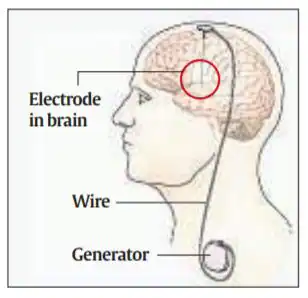
- Deep-brain stimulation (DBS) is a medical technique where doctors implant electrodes deep inside specific areas of the brain to treat certain disorders.
- These electrodes are connected by wires to a small device, similar to a heart’s pacemaker, which is usually placed under the skin in the upper chest.
- The device sends controlled, mild electrical impulses to targeted brain regions, helping adjust abnormal brain activity or chemical imbalances.
How Does It Work?
- Technically, DBS works by modifying how groups of neurons talk to each other. Many of these disorders involve faulty electrical signals in the brain.
- Delivering electrical pulses through DBS can interrupt these erratic signals, helping reduce symptoms such as tremors or muscle stiffness.
- The amount and pattern of stimulation can be precisely adjusted by doctors or, to some extent, by patients themselves using external programmers.
- One advantage of DBS is that, unlike brain surgery that destroys tissue, its effects are reversible: if you turn off the device, the stimulation stops.
Applications
- DBS is primarily used to treat movement disorders such as: Parkinson’s Disease, Essential Tremor and Dystonia.
- It has also been approved for some psychiatric conditions like obsessive-compulsive disorder, and is being studied for severe depression and epilepsy.
Source: TH
