


Syllabus: GS2/Governance
Context
- The Union minister addressed the National Workshop on Good Governance Practices as part of the observation of Good Governance Week.
About
- The workshop witnessed the launch of several initiatives of DoPT:
- Launch of Compendium on Reservation for Ex-Servicemen (ESM), AI Powered Recruitment Rules Generator Tool, Mobile App for eHRMS 2.0, New Features on iGOT Karmayogi Portal and Karmayogi Digital Learning Lab 2.0.
- These initiatives reflect the Government’s emphasis on digital governance and continuous capacity building of civil servants.
What is e-Governance?
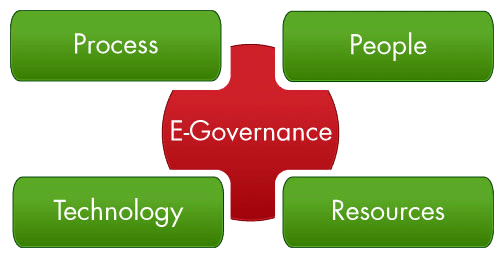
- e-Governance in India means the use of Information and Communication Technology (ICT) by the government to deliver services, exchange information, and interact with citizens.
Benefits
- Efficiency: Faster, cheaper, paperless transactions.
- Transparency & Accountability: Reduced corruption, direct monitoring.
- Inclusivity: Services to rural/remote areas via Common Services Centres (CSCs).
- Citizen Empowerment: 24×7 access, participatory governance.
- Economic Growth: Boosts startups, IT industry, and digital economy.
Key Challenges to e-Governance
- Implementation disparity: Some states or local governments lag in digital capacity, infrastructure, funding, or in adopting the central e-governance frameworks.
- Digital divide: Access to internet / smartphone and digital literacy remain bottlenecks especially in remote, tribal or underdeveloped districts.
- Data protection, security & trust: As scale increases, vulnerabilities, data leaks, misuse risk rise. Ensuring confidentiality, consent, and legal safeguards is critical.
- Sustainability and capacity-building: Maintaining and upgrading systems, training personnel, continuous feedback loops, user support are resource-intensive and ongoing tasks.
- Governance vs execution gap: Even when policy is strong, translating it on ground often faces administrative inertia, lack of technical staff, or legacy systems.
Key Initiatives
- Aadhaar & DBT: Aadhaar-enabled e-KYC simplified verification, reduced paperwork, and enhanced transparency. DBT ensured direct transfer of welfare benefits, curbing leakages.
- Karmayogi Bharat: Initiative aims to nurture a future-ready civil service by equipping officials with the right Attitude, Skills, and Knowledge (ASK) to deliver efficient and citizen-centric governance.
- It has 1.26 crore+ users, 3000 courses, and 3.8 crore+ certificates issued as of 2025.
- DigiLocker: Aims at ‘Digital Empowerment’ of citizens by providing access to authentic digital documents in the citizens’ digital document wallet.
- UMANG: Provides a single platform for all Indian Citizens to access pan-India e-Gov services ranging from Central to Local Government bodies.
- Digital Commerce: Open Network for Digital Commerce (ONDC) enables sellers, including MSMEs, SHGs, artisans, and women-led enterprises, to be discovered by buyers across multiple platforms, expanding digital market access.
- Government e Marketplace (GeM): Facilitates online procurement of common use Goods & Services required by various Government Departments/ Organizations/ PSUs.
- Over 22 lakh sellers and service providers, including MSMEs, startups, and women-led enterprises, are registered, promoting digital market access and self-reliance.
- Right to Information (RTI): The right to information stems from the basic right to free expression guaranteed by Article 19.
- Under this act, an individual can inspect, audit, evaluate, and analyze government activities and decisions to verify that they are in accordance with the principles of public interest, integrity and justice.
- BHASHINI (BHASHa INterface for India) is a pioneering initiative under the National Language Translation Mission (NLTM), aimed at bridging India’s linguistic diversity through technology.
- The SVAMITVA (Survey of Villages and Mapping with Improvised Technology in Village Areas) Scheme was launched in 2020.
- The scheme gives rural households legal ownership papers for the homes and land they occupy.
- Using drones and advanced mapping tools, it clearly marks property boundaries.
- BharatNet: It was launched in 2011, to bridge the digital divide.
- The project aims to deliver affordable, high-speed internet to every Gram Panchayat.
- eGramSwaraj:
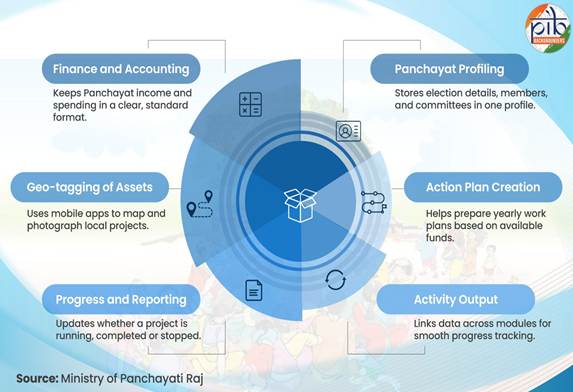
- Meri Panchayat App: Meri Panchayat App serves as an integrated mobile governance platform, designed and developed by the National Informatics Centre (NIC).
- It empowers rural communities by promoting transparency, accountability and citizen participation in Panchayat affairs.
- Gram Manchitra: Geo-Spatial Planning Tool: The Ministry of Panchayati Raj launched the Gram Manchitra Geographic Information System (GIS) application.
- It offers a unified digital map where officials can visualise developmental works across different sectors and align them with the Gram Panchayat Development Plan (GPDP).
Conclusion
- These reforms aim to make governance faster, more transparent and more inclusive.
- Tools now range from artificial intelligence (AI) meeting summarisers to geo-spatial mapping platforms, digital accounting systems and citizen-facing mobile apps.
- This shift also reflects the Government’s broader vision under Digital India and Atmanirbhar Bharat.
Source: PIB
Previous article
Birth Anniversary of Guru Gobind Singh
