


Bima Sakhi Scheme
Syllabus :GS1/Women Empowerment; GS2/Governance
In News
- Life Insurance Corporation of India (LIC) paid ₹62.36 crore as stipend to women under ‘Bima Sakhi Scheme’ during FY 2024–25.
- Currently, there are 2,05,896 Bima Sakhis across the country.
The ‘Bima Sakhi Scheme’
- It is an initiative of Life Insurance Corporation of India (LIC) designed to empower women aged 18-70 years, who are Class X pass.
- They will receive specialized training and a stipend for the first three years to promote financial literacy and insurance awareness.
- The stipend scheme is in addition to their commission pay-outs and is subject to certain performance parameters.
- The amount of the stipend ranges from Rs 7000/- per month in the first year to Rs 5000/- in the third year.
- After training, they can serve as LIC agents and the graduate Bima Sakhis would have the opportunity to qualify for being considered for Development Officer roles in LIC.
Source :PIB
Kamchatka Peninsula
Syllabus: GS1/Geography
Context
- A series of earthquakes struck Russia’s Kamchatka Peninsula.
About Kamchatka Peninsula
- Located in far eastern Russia, the peninsula lies between the Sea of Okhotsk (west) and the Pacific Ocean & Bering Sea (east).
- The peninsula is dominated by two major mountain ranges:
- Sredinny (Central) Range
- Vostochny (Eastern) Range
- It is home to the Volcanoes of Kamchatka, a UNESCO World Heritage Site, and a key segment of the Pacific Ring of Fire.
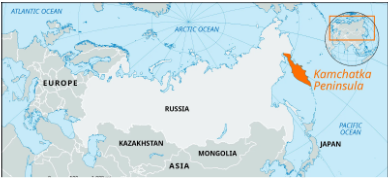
- The Kamchatka peninsula is the centre point of the Pacific and North American tectonic plates where they meet, making it a hot zone for seismic activity.
Source: AIR
“Meri Panchayat” App Wins WSIS Champion Award
Syllabus: GS2/Governance
In News
- The mobile application “Meri Panchayat” has received the World Summit on the Information Society (WSIS) Prizes 2025 Champion Award under the category Cultural Diversity and Identity, Linguistic Diversity and Local Content.
The Meri Panchayat Web Application
- It is an initiative of the Ministry of Panchayati Raj and National Informatics Centre (NIC) under the Ministry of Electronics and Information Technology.
- It is designed to provide a unified digital governance platform for rural areas, catering to residents, functionaries, and stakeholders of the Panchayati Raj Institution system.
- It integrates and consolidates diverse functions and information currently dispersed across multiple government portals into a single, seamless web-based interface.
Progress
- It empowers over 25 lakh elected representatives and approximately 950 million rural residents across India’s 2.65 lakh Gram Panchayats, transforming rural governance through digital inclusion and transparency.
Source :PIB
Parliament Passes ‘Bills of Lading, 2025’ Bill
Syllabus :GS2/Governance
In News
- The Bill of Lading Bill, 2025 was passed by the Rajya Sabha.
Bills of Lading Bill, 2025
- It replaced the 169-year-old Indian Bills of Lading Act, 1856 with a modern legal framework for shipping documents.
- The bill had earlier been cleared by the Lok Sabha in March 2025 and will now be sent to the President for assent.
- It aims to support India’s growing shipping sector by simplifying and updating maritime laws.
- It reorganizes the old Act’s provisions, introduces clearer language, and aligns with global trade practices.
- It also empowers the Central Government to issue implementation directions and includes repeal provisions to eliminate colonial-era laws.
Importance
- The bill supports Prime Minister Narendra Modi’s vision of Viksit Bharat by 2047 and reflects India’s commitment to reform outdated colonial-era laws.
- It streamlines legal language, clarifies rights and responsibilities of shipping stakeholders, reduces litigation risks, and aligns with international trade norms—boosting India’s Ease of Doing Business.
Source: PIB
Legal Status of Right to Vote
Syllabus: GS2/ Polity and Governance
Context
- The Supreme Court is examining the legality of Bihar’s Special Intensive Revision of electoral rolls, raising questions about the legal status of the right to vote.
India’s Commitment to Universal Adult Suffrage
- India after independence adopted universal adult suffrage regardless of gender, caste, religion, education, or property.
- Article 326 of the Constitution guarantees voting rights to all citizens aged 18 and above, following the 61st Constitutional Amendment, 1989.
- Status of the Right to Vote in India:
- In the N.P. Ponnuswami case (1952), a Constitution Bench of the Supreme Court held that the right to vote is a statutory right.
- The Supreme Court in Kuldip Nayar v. Union of India (2006) held that the ‘right to elect’ is a statutory right under Section 62 of the RPA, 1951, and not a fundamental or constitutional right.
- In Anoop Baranwal v. Union of India (2023), the Supreme Court declined to reopen the settled position.
- In the Jyoti Basu case (1982), the court reiterated that the right to vote is neither a fundamental right nor a common law right but a statutory right.
Source: TH
ICMR recommends Tests for TB and Hepatitis at Primary Healthcare Centres (PHCs)
Syllabus: GS2/ Health
Context
- The Indian Council of Medical Research (ICMR) has released the updated National List of Essential Diagnostics (NLED) 2025, expanding the scope of diagnostic services at the grassroots level.
Key Highlights of the NLED 2025
- Inclusion of rapid diagnostic tests for diseases like Hepatitis B, syphilis, sickle cell anaemia, and thalassaemia at sub-centre level.
- Molecular testing for TB recommended from the sub-centre level onwards; sputum samples to be collected and sent to higher centres.
- Biochemical tests like blood glucose, liver enzymes, and cholesterol to be conducted at PHCs using semi-auto analyzers.
- Addition of TB skin test and dental X-rays at community healthcare centres (CHCs).
- TB skin test can detect the presence of the pathogen even in people who do not have an active infection.
- Merger of diagnostic lists for sub-district and district hospitals reflecting infrastructure upgrades.
Source: IE
International Seabed Authority (ISA)
Syllabus: GS2/International Organization
Context
- The International Seabed Authority (ISA) is negotiating a global “mining code” to regulate the exploitation of mineral resources (nickel, cobalt, manganese) on the ocean floor in international waters.
- These minerals are critical for electric vehicles and emerging technologies.
The International Seabed Authority (ISA)
- It is an autonomous international organization established under the 1982 United Nations Convention on the Law of the Sea (UNCLOS).
- Objective: ISA is the organization through which States Parties to UNCLOS organize and control all mineral-resources-related activities in the Area for the benefit of humankind as a whole.
- It has the mandate to ensure the effective protection of the marine environment from harmful effects that may arise from deep-seabed-related activities.
- Headquarters: Kingston, Jamaica.
- Members: All States Parties to UNCLOS are ipso facto members of ISA.
- As of 2024, ISA has 170 Members, including 169 Member States and the European Union.
Source: TH
Prime Minister Internship Scheme (PMIS)
Syllabus: GS2/ Governance, GS3/ Economy
Context
- Despite over 1.53 lakh internship offers made under the Prime Minister Internship Scheme (PMIS), merely 8,700 candidates, about 6%, have joined their internships so far, according to data shared in the Lok Sabha.
Prime Minister’s Internship Scheme (PMIS Scheme)
- The PMIS Scheme announced in the Budget 2024-25, aims to provide internship opportunities to one crore youth in top 500 companies in five years.
- Salient features of the Scheme are:
- 12-month paid internships in top companies of India,
- The scheme targets individuals aged 21 to 24 who are currently not enrolled in any full-time academic program or not in full-time employment,
- Each intern will be supported with monthly financial assistance of ₹5,000, supplemented by one-time financial assistance of ₹6,000.
- Nodal Ministry: Ministry of Corporate Affairs (MCA)
- The scheme offers youth six months of real-world training to bridge the gap between academic learning and industry needs, enhancing their employability.
Source: TH
In Vitro Biotransformation (ivBT) System
Syllabus: GS3/Science and Technology
Context
- Chinese researchers have developed a method to convert methanol into white sugar, bypassing the need to grow sugar cane or sugar beets.
About
- The team has developed an in vitro biotransformation (ivBT) system that synthesises sucrose from methanol, a low-carbon chemical that is derived from industrial waste or carbon dioxide.
- By utilising enzymes to convert methanol, researchers have presented a sustainable alternative to traditional agriculture.
- Significance: In vitro biotransformation (ivBT) has emerged as a highly promising platform for sustainable biomanufacturing.
- Artificial conversion of CO2 into food and chemicals offers a promising strategy to address both environmental and population-related challenges while contributing to carbon neutrality.
Source: NDTV
Bharat NCX
Syllabus: GS3/ Security
In News
- The National Cybersecurity Exercise – Bharat NCX 2025 was officially inaugurated.
About Bharat NCX
- The exercise is being conducted by the National Security Council Secretariat (NSCS) in collaboration with Rashtriya Raksha University (RRU).
- The exercise offers an immersive learning environment focused on cyber defense and incident response, featuring live-fire simulations that mirror real-world attacks on both IT and Operational Technology (OT) systems.
Source: PIB
India to Host Chess World Cup
Syllabus: Miscellaneous
Context
- India has secured the rights to host the FIDE World Cup in 2025 after a 23-year gap, with the event scheduled from October 30 to November 27.
About
- The tournament will feature 206 players competing in a knockout format — a dynamic and unpredictable system where the losing player in each round is eliminated.
- The top three finishers will qualify for the 2026 FIDE Candidates Tournament, which decides the challenger for the World Chess Championship.
- This will be the second time India hosts the FIDE World Cup, the last being in Hyderabad in 2002.
| Origin of Chess – The history of chess in India can be traced back to 1600 years ago during the Gupta dynasty. It was called ‘chaturanga’ in earlier times. – Chess, via India, reached many countries of the world and became very popular. Today, chess is being used in schools as an education tool for children. |
Source: AIR
Next article
U.S. To Pull Out of UNESCO
