


Syllabus: GS3/Energy
Context
- As India opens its nuclear power sector to private players and explores export opportunities, the nuclear establishment has stressed the need to fast-track the fabrication of indigenous Light Water Reactors (LWR).
Light Water Reactors
- Light Water Reactors form a mainstay of the global nuclear program currently account for over 85% of the civil nuclear reactor capacity in the world.
- They use ordinary (light) water as both a coolant and a neutron moderator.
- LWRs entail simpler design and engineering compared to heavy water reactors given that they use normal water as both coolant and moderator.
- Low Cost: It usually involves lower construction costs due to economies of scale, as LWRs form the bulk of global nuclear capacity, and they are considered more thermally efficient.
Need of LWRs for India
- Leverage in Imports: Having an indigenous LWR, alongside the existing fleet of pressurised heavy water reactors (PHWR), is expected to boost India’s leverage in dealing with foreign vendors to secure better terms in imports.
- Global Supply Chain: LWRs constitute the bulk of the international reactor market, and without integrating Indian companies into the global supply chain, making a breakthrough in the export segment is likely to be difficult.
- Shanti Act: The legal changes brought by SHANTI Act are seen as necessary to tap the dominant global LWR ecosystem, even as India retains its core strengths in other reactor types.
- SHANTI Act allows public and private companies to set up nuclear power plants and undertake activities related to the transport, storage, import and export of nuclear fuel, technology, equipment and minerals.
- Dominance of Heavy Water Reactors: India’s civil nuclear programme has deep expertise in manufacturing heavy water reactors from 220 MWe PHWRs to the new 700 MWe units.
- However, these are increasingly out of sync with LWRs, which now dominate the global market.
Challenges
- Limited Indigenous Experience: India’s nuclear programme has historically focused on PHWRs and fast breeder reactors, leading to limited domestic expertise in LWR design and operation.
- Technology Access & IPR Issues: LWR technologies are largely controlled by a few countries and firms, posing challenges related to technology transfer, intellectual property rights, and localisation.
- Fuel Supply Constraints: LWRs require enriched uranium, making India dependent on imports and vulnerable to geopolitical and supply-chain uncertainties.
- High Capital Costs: LWRs involve high upfront costs, long gestation periods, and financing challenges, especially without a mature domestic supply chain.
- Export Competitiveness: Without a proven indigenous LWR design and operating track record, India faces hurdles in entering the global reactor export market.
Government Initiatives
- Nuclear Energy Mission & Capacity Targets: The Government has launched a Nuclear Energy Mission aimed at expanding nuclear power capacity to about 100 GW by 2047.
- This mission emphasises enhancing domestic capabilities and adopting advanced technologies including LWRs.
- Indigenous Reactor Development: Such as Bharat Small Reactors are under development to support scalable deployment.
- While these are PHWR and SMR variants, they lay the groundwork for a broader nuclear innovation ecosystem that can benefit future LWR fabrication.
- Research & Development Funding: The Union Budget 2025-26 allocated significant funding (around ₹20,000 crores) for R&D in advanced nuclear technologies.
- International Cooperation & Tech Access: The government is working on international partnerships and technology transfer mechanisms that can help bridge experience gaps in LWR technologies.
| India’s Three-stage nuclear programme – Establishment: India’s nuclear journey began shortly after Independence with the establishment of the Atomic Energy Commission in 1948. – In 1956, Asia’s first research reactor, Apsara, was commissioned at the Bhabha Atomic Research Centre (BARC) in Trombay. – India was the second Asian nation to build a nuclear power plant in 1969 at Tarapur, just after Japan and long before China. India has a three-phase programme of nuclear power visioned by Dr Homi J Bhabha, the father of India’s nuclear programme. First Stage (Pressurized Heavy Water Reactors – PHWRs): India’s nuclear program initially focused on establishing a fleet of PHWRs. – These reactors use natural uranium (U-238), which contains minuscule amounts of U-235, as the fissile material. – Heavy water (deuterium oxide) as both moderator and coolant. – The primary purpose of this stage was to produce – plutonium-239 as a byproduct from the uranium fuel. Plutonium-239 is a fissile material used as fuel in nuclear reactors. Second Stage (Fast Breeder Reactors – FBRs): The second stage of the program involves the deployment of Fast Breeder Reactors (FBRs). – FBRs are designed to produce more fissile material than they consume by utilizing a fast neutron spectrum. – In this stage, plutonium-239 produced in the first stage is used as fuel along withU-238 to produce energy, U-233, and more Pu-239. – Uranium-233 is another fissile material that can be used as fuel in nuclear reactors. Third Stage (Advanced Heavy Water Reactors – AHWRs): The final stage of the program entails thedeployment of Advanced Heavy Water Reactors (AHWRs). – Pu-239 will be combined with thorium-232 (Th-232) in reactors to produce energy and U-233. – Thorium is abundantly available in India, and this stage aims to harness its potential as a nuclear fuel. 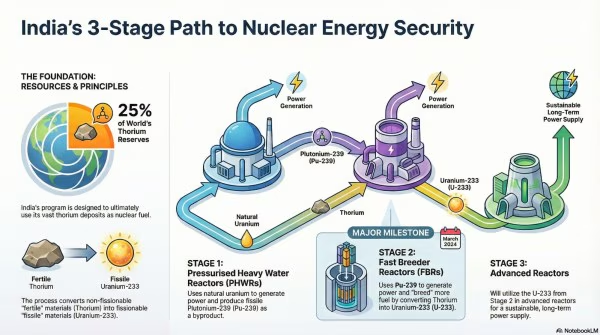 India’s Thorium Reserves – India has one of the largest reserves of thorium in the world.  Together, Kerala and Odisha account for over 70% of India’s thorium. – India has been developing a three-stage nuclear program, with thorium-based reactors being a critical part of the third stage. Challenges: Extracting thorium from ores requires high amounts of energy and creates significant waste. – While India has large thorium reserves, extracting it for nuclear energy use has faced challenges, including the need for advanced reactor technology and economic viability. |
Source: IE
Previous article
News In Short 21-01-2026
