


Chagos Islands
Syllabus: GS1/Places
In News
- The UK government defended its deal to transfer the Chagos Islands to Mauritius while retaining a lease for a strategic military base, amid criticism from US President Donald Trump.
- In 2025 The United Kingdom signed an agreement handing sovereignty over the contested and strategically located Chagos Islands to Mauritius.
About Chagos Archipelago
- It comprises more than 60 low-lying islands in the Indian Ocean roughly 1,600 km to the northeast of the main island of Mauritius.
- It was separated from Mauritius in 1965, when Mauritius was still a British colony.
- Britain purchased the islands for three million pounds but Mauritius has argued that it was illegally forced to give them away as part of a deal to gain independence from Britain.
- In the late 1960s, Britain invited the US to build a military base on Diego Garcia, the largest of the Chagos Islands, removing thousands of people from their homes.
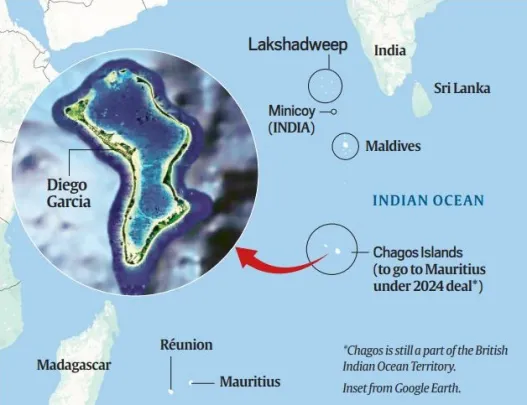
- Since the 1980s, Mauritius has claimed sovereignty over the Chagos Islands.
- In 2019, the UN’s International Court of Justice ruled that Mauritius’ decolonisation was incomplete at independence in 1968 and advised that the UK must end its administration of the islands as soon as possible.
Source :IE
Article 15(5)
Syllabus: GS2/ Polity and Governance
Context
- The opposition has urged the Union government to ensure the implementation of Article 15(5) of the Constitution while framing a single higher education regulator under the proposed Viksit Bharat Shiksha Adhishthan Bill, 2025.
What is Article 15(5)?
- Article 15(5) empowers the State to make special provisions for the advancement of Scheduled Castes (SCs), Scheduled Tribes (STs), and Other Backward Classes (OBCs).
- It enables the State to provide reservations in admissions, including in private educational institutions, whether aided or unaided.
- Minority educational institutions under Article 30(1) are exempted from its ambit.
- The provision was introduced through the 93rd Constitutional Amendment Act, 2005.
Significance of Article 15(5)
- It led to the introduction of 27% OBC reservation in Centrally-funded Higher Educational Institutions (CFHEIs) such as IITs, IIMs, NITs, and Central Universities.
- It contributed to intergenerational mobility, skill acquisition, and representation in professional education.
- It reflects the constitutional vision of substantive equality, moving beyond formal equality.
Judicial Validation
- The constitutional validity of Article 15(5) was upheld by the Supreme Court in Pramati Educational and Cultural Trust vs Union of India (2014).
- The Court affirmed that the State can mandate reservations in non-minority private educational institutions.
Source: TH
Statehood Day of Manipur, Meghalaya and Tripura
Syllabus: GS2/ Polity and Governance
Context
- The President of India has extended greetings to the people of Meghalaya, Tripura and Manipur on their Statehood Day.
- Manipur, Meghalaya and Tripura were granted statehood on January 21, 1972, following the enactment of the North-Eastern Areas (Reorganisation) Act, 1971.
About
- Manipur: Formerly a princely state, it merged with India in 1949. It functioned as a Union Territory from 1956 until it was granted statehood.
- Tripura: Also a princely state, it joined the Indian Union in 1949. Like Manipur, it was a Union Territory from 1956 before becoming a full state in 1972.
- Meghalaya: Originally part of Assam, it was first made an autonomous state within Assam in 1970 before being carved out as a separate state in 1972 to recognize its unique tribal and cultural identity.
Source: AIR
One Station One Product (OSOP)
Syllabus: GS2/ Government Initiatives
In News
- Indian Railways’ One Station One Product (OSOP) scheme has expanded to over 2,000 Railway Stations, empowering 1.32 Lakh Artisans.
About
- The One Station One Product (OSOP) scheme was launched in 2022 as an innovative initiative to promote local, indigenous, and specialised products by leveraging India’s vast railway network.
- The Ministry of Railways has designed the OSOP stalls to be aesthetically uniform yet locally distinct.
- These stalls are often designed by the National Institute of Design (NID) to ensure they are functional and attractive to travelers.
- The OSOP scheme is a key component of the PM Gati Shakti National Master Plan, which aims to provide seamless multi-modal connectivity and improve the logistics of local goods.
Source: PIB
EU’s Anti-coercion Instrument
Syllabus: GS2/IR
Context
- The French President mentioned activating the EU’s anti-coercion instrument, after US President’s tariffs threats regarding Greenland.
European Union’s Anti-coercion instrument
- It is a trade tool that the bloc adopted in 2023 but has never used.
- Aim: To respond to any country using trade weapons to pressure an EU member state.
- Measures:
- The armoury allows the EU to take measures such as import and export restrictions on goods and services in its single market.
- It also limits American companies’ access to public procurement contracts in Europe.
- Establishment: The instrument’s creation came after Lithuania accused China of banning its exports because it allowed a Taiwanese diplomatic representation to be opened in 2021.
- Implementation Process: Both the commission and member states have the right to seek its activation.
- It would need the approval of at least 55% of the member countries voting in favour, representing 65% of the bloc’s population.
Source: TH
Centre Likely to Amend Sarfaesi Act
Syllabus: GS3/ Economy
Context
- The Union government is considering amendments to the SARFAESI Act, 2002 to remove legal ambiguities and strengthen regulatory oversight.
About
- The proposed changes aim to improve credit enforcement and promote ease of doing business.
- A key focus is enhancing control over the Central Registry of Securitisation Asset Reconstruction and Security Interest of India (CERSAI).
- CERSAI is a central online registry that records security interests (mortgages/charges) over immovable, movable, and intangible assets, helping prevent fraudulent multiple lending on the same asset and increasing transparency.
What is the SARFAESI Act, 2002?
- The Securitisation and Reconstruction of Financial Assets and Enforcement of Security Interest (SARFAESI) Act provides a legal mechanism for banks and financial institutions to recover non-performing assets.
- It allows lenders to enforce security interests without court or tribunal intervention.
- The Act applies when the outstanding loan amount exceeds ₹1 lakh.
- Recovery can be carried out by taking possession of secured assets of borrowers or guarantors.
Source: BS
Steel Slag Technology
Syllabus: GS3/ Science & Technology
In News
- Union Minister of State (Independent Charge) for Science and Technology Dr Jitendra Singh advocated wider adoption of steel slag–based road construction and repair technology, particularly in hilly and Himalayan regions.
More About the News
- The Ministry’s Technology Development Board (TDB) signed an agreement with Ramuka Global Eco Work Pvt. Ltd., Visakhapatnam.
- The agreement allows commercial rollout of ECOFIX, a pothole repair mix developed by CSIR–Central Road Research Institute (CRRI).
- ECOFIX uses processed iron and steel slag, a byproduct of steel manufacturing, as a construction material.
What is Steel Slag Technology?
- Steel slag is a byproduct created during the melting of iron ore at very high temperatures.
- Traditionally considered industrial waste, it is now processed to replace natural aggregates (like crushed stone) in road construction.
Source: DD
Reusable Launch Vehicles
Syllabus: GS3/ Science and Technology
Context
- The global space sector is witnessing a paradigm shift from expendable launch systems to reusable architectures.
What Is a Reusable Launch Vehicle (RLV)?
- A Reusable Launch Vehicle is a space launch system designed to return to Earth after completing its mission and be used for multiple launches.
- Unlike traditional expendable rockets, RLVs aim to recover and reuse major components, such as boosters or entire vehicles.
- RLVs may take different forms, including:
- Winged space planes that land horizontally on runways.
- Vertically landing boosters that return using retro-propulsion.
- Fully reusable systems where both stages are recovered and reflown.
- SpaceX has successfully recovered the first stages of its Falcon 9 rockets more than 520 times.
Key Technologies Enabling RLVs
- Advanced propulsion systems capable of multiple restarts and controlled descent.
- Thermal Protection Systems (TPS) to withstand extreme heat during atmospheric re-entry.
- Autonomous guidance, navigation, and control for precision landing.
- Lightweight composite materials that endure repeated thermal and mechanical stress.
India’s Reusable Launch Vehicle Programme
- The Indian Space Research Organisation (ISRO) is developing a winged Reusable Launch Vehicle resembling a spaceplane.
- ISRO successfully conducted the RLV-LEX autonomous landing experiment, marking a major milestone in reusable spaceflight technology.
Source: TH
Darwin’s Bark Spider
Syllabus: GS3/Environment
In News
- A recent study found that the toughest biological silk (dragline silk) produced by large adult females is Darwin’s bark spider.
Darwin’s bark spider (Caerostris darwini)
- It is found in the forests of Madagascar.
- It produces the toughest biological silk known, with strength surpassing steel with a tensile strength of about 1.6 gigapascals.
- However, this extreme strength is not universal, as silk quality is closely linked to body size, with larger spiders evolving to produce tougher silk to support bigger webs and capture larger or faster prey.
- They have relatively short lifespans, typical of orb-weaving spiders, with females living longer than males.
Source :TH
Sacred Groves
Syllabus: GS3/Environment
Context
- A new study found that the Sacred groves in the northern Western Ghats show the highest levels of human disturbance.
About
- Long protected by socio-cultural norms, sacred groves are now increasingly threatened by urbanisation and the weakening of traditional practices.
- Historically, sacred groves were protected through local taboos and nature worship.
- The decline of these traditional practices has made many such areas more vulnerable to human intervention.
- The study notes that significant loss of sacred groves in the northern Western Ghats has been reported over the past five decades.
What are Sacred Groves?
- Sacred groves are patches of trees or forest areas that are traditionally protected by local communities for their religious, cultural, and ecological significance.
- They are known by diverse names: Devarakadu in Karnataka, Kavu in Kerala, Sarna in Madhya Pradesh, Oran in Rajasthan, Devrai in Maharashtra, Umanglai in Manipur, Law Kyntang/Law Lyngdoh in Meghalaya, Devan/Deobhumi in Uttarakhand etc.
- Sacred groves preserve biodiversity, regulate climate, conserve water, support livelihoods, protect cultural heritage, and promote environmental awareness.
Source: DTE
Antarctic Penguins
Syllabus: GS3/Environment
In News
- A decade-long study in Antarctica has found that penguins are shifting their breeding seasons earlier, likely due to climate change.
Penguins
- Penguins are flightless birds that are highly adapted for the marine environment. They are excellent swimmers and can dive to great depths.
- They play a key role in Antarctic food chains, including bringing nutrients from deep water up to the surface, which is vital to algae being able to complete their photosynthesis.
- They live primarily in the Southern Hemisphere.
- Major species and IUCN Red List status
- Emperor Penguin(Aptenodytes forsteri) is listed as Near Threatened
- Royal Penguin(Eudyptes schlegeli )is listed as Least Concern
- Adelie Penguin(Pygoscelis adeliae) listed as Least Concern
- Humboldt Penguin(Spheniscus humboldti) is listed as Vulnerable
- Magellanic Penguin(Spheniscus magellanicus) is listed as Least Concern
- Fiordland Penguin(Eudyptes pachyrhynchus) is listed as Near Threatened
- Gentoo Penguin(Pygoscelis papua)is listed as Least Concern.
Source :IE
