


Syllabus: GS2/Health
Context
- The Lancet Commission’s new report charts a rights-based, citizen-centred roadmap for Universal Health Coverage in India, aligning with Viksit Bharat 2047.
About
- The reforms described in the report promote community participation, transparency and equity — key principles of Universal Health Coverage (UHC) — aimed at ensuring high-quality, affordable care for all.
- It emphasizes the urgent need to strengthen India’s public healthcare by integrating services across primary, secondary, and tertiary levels.
Guiding Principles of the Commission
- A transition from a facility-centric, reactive, and fragmented delivery system focused on specific diseases towards a comprehensive, coordinated, citizen-centred health system.
- A transition from citizens being passive recipients of services to becoming active agents with rights who are engaged in the health system.
- A transition from providing weight to only professional qualifications to emphasising provider competencies, values, and motivations, and empowering frontline workers and practitioners of Indian systems of medicine (eg, Ayurveda, Yoga, Unani, Siddha, and Homeopathy).
- To responsibly and ethically leverage the power of innovative technology to support the reimagined health system and deliver citizen-centred care.
- To explicitly acknowledge rights and health equity as a core value of universal health coverage and the reduction of inequities as a measure of progress across universal health coverage goals.
What is Universal Health Coverage?
- It means that all people have access to the full range of quality health services without financial hardship.
- Key components of UHC include:
- Access to Care: Everyone should be able to obtain necessary health services when they need them.
- Quality Services: The care provided should be effective, safe, and of good quality.
- Financial Protection: Individuals should not face financial difficulties due to medical expenses.
- UHC is rooted in the universal human right to health, affirmed in international covenants and the Alma-Ata Declaration (1978), which prioritised comprehensive primary healthcare.
Need For Universal Health Coverage in Indian Context
- Historical Commitment to Universal Healthcare: Bhore Committee (1943–46) reflected a clear preference for universal healthcare over insurance-based UHC.
- Policy Evolution after Independence: India’s National Health Policy of 1983 recognized the goal of “Health for All” and emphasized the importance of primary healthcare and equitable distribution of healthcare resources.
- Shift towards Insurance-led UHC: Welfare Schemes like Rashtriya Swasthya Bima Yojana (RSBY) 2008 and Ayushman Bharat–PMJAY institutionalised UHC but reinforced an insurance-heavy approach.
- Weak Public Health System and Rising Private Dependence: Chronic underfinancing of primary healthcare has led to poor quality public provisioning, shortage of infrastructure and workforce.
- National Sample Survey (NSS) data show growing reliance of the poor on private healthcare, rising out-of-pocket expenditure (OOPE) & increased household indebtedness.
- Post-Covid Realisation: The Covid-19 pandemic exposed inequities in insurance-based access, exclusion of informal workers and migrants & fragility of hospital-centric models.
Constitutional Basis for UHC:
- The Directive Principles of State Policy in Part IV of the Constitution provides a basis for the right to health.
- Article 39 (e) directs the state to secure the health of workers; Article 42 emphasises just and humane conditions of work and maternity relief; and Article 47 casts a duty on the state to raise the nutrition levels and standard of living, and to improve public health.
- The Constitution also endows the panchayats and municipalities to strengthen public health under Article 243G.
Challenges in Adopting UHC in India
- Resource Constraints: India faces significant funding limitations in healthcare, with a low public health expenditure compared to many other countries. This affects the ability to provide comprehensive services.
- Low public health expenditure (~2.1% of GDP), below the NHP target of 2.5%.
- Infrastructure Gaps: Many areas, especially rural regions, lack adequate healthcare infrastructure, including hospitals, clinics, and trained personnel, making access to care difficult.
- Healthcare Workforce Shortages: There is a shortage of healthcare professionals, particularly in rural areas, leading to disparities in access and quality of care.
- Fragmented Health Systems: India’s healthcare system is a mix of public and private providers, leading to inconsistencies in quality and accessibility.
- And, Health is a State subject, while financing and flagship schemes are centrally driven, leading to uneven outcomes.
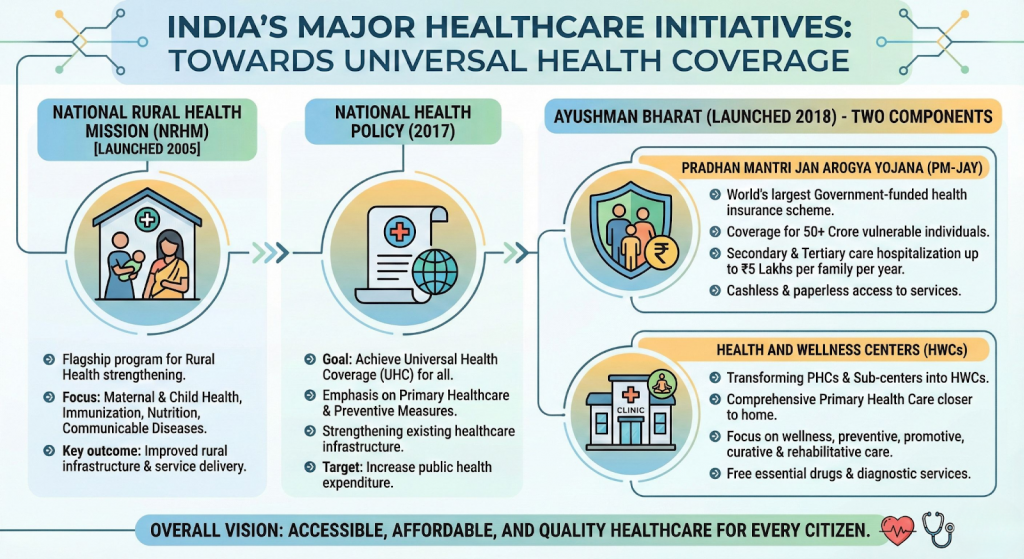
Source: HT
Previous article
Ex-CAPF Officials Concerns over IPS Appointments in CAPFs
Next article
The EV Boom is Accelerating a Copper Crunch
