


Konark Temple
Syllabus: GS1/ Art & Culture
Context
- The President of Singapore, Tharman Shanmugaratnam visited the Sun Temple at Konark in Odisha’s Puri district.
Konark Sun Temple
- Deity: Konark Sun Temple is a 13th-century CE temple dedicated to the Hindu Sun God Surya.
- History: The temple was constructed during the reign of king Narasimhadeva I of the Eastern Ganga dynasty about 1250 CE.
- Cultural Significance: It was declared a UNESCO World Heritage Site in 1984. It remains a major pilgrimage site for Hindus, who gather here every year for the Chandrabhaga Mela around the month of February.
- Other Names: This temple was called the “Black Pagoda” in European sailor accounts because it looked like a great tiered tower which appeared black.
- Similarly, the Jagannath Temple in Puri was called the “White Pagoda”.
- Architecture: The temple was designed in the shape of a huge chariot drawn by 7 horses on 12 pairs (total 24) of gorgeously decorated wheels at its base.
Source: TH
Narayana Guru
Syllabus: GS1/ History
Context
- The Narayana Guru Digital Research Resource Platform (NGDRRP), a comprehensive digital archive launched in 2023, is set to go fully online by May 2025.
About
- Early Life: Narayana Guru was born in 1856 in Chempazhanthy, Kerala, into a family belonging to the Ezhava caste, traditionally marginalized under the rigid caste system.
- Teachings: Narayana Guru emphasized the principles of equality, universal brotherhood, and spiritual upliftment.
- His famous dictum, “One Caste, One Religion, One God for All,” encapsulates his vision of an inclusive society.
Major Contributions
- Temple Entry Movement: Narayana Guru spearheaded efforts to ensure temple access for marginalized communities.
- He consecrated the Aruvippuram Shiva Temple in 1888, challenging the orthodox norms that restricted temple entry based on caste.
- Promotion of Social Equality: He actively fought against untouchability, caste discrimination, and social evils, institutionalizing reforms through the SNDP Yogam (Sree Narayana Dharma Paripalana Yogam).
- Literary Contributions: Texts like Atmopadesa Satakam and Daiva Dasakam reflect his philosophical insights and practical guidance for spiritual and ethical living.
Source: TH
Praja Mandal Movement in Punjab
Syllabus: GS1/History
Context
- January 20 marks the death anniversary of Sewa Singh Thikriwala, who spearheaded the Praja Mandal Movement in Punjab.
About
- It was a self-rule movement against the rulers of Punjab’s erstwhile princely states.
- Aim: To protect the civil liberties of the masses, protest against oppressive taxes, seek reforms in the peasants’ conditions, open educational institutions, and have a responsible government.
- Areas: The movement was active in the Patiala, Nabha, Jind, Malerkotla and Faridkot princely states initially.
Source: IE
Women in Chola Empire
Syllabus: GS1/ History
Context
- Historian Anirudh Kanisetti’s book, Lords of Earth and Sea: A History of the Chola Empire, sheds light on facets of the Chola empire, including the pivotal role of women like Sembiyan Mahadevi.
About
- The Chola dynasty, one of the longest-ruling empires in Indian history, flourished from the 9th to 13th centuries CE.
- Karikala Chola, laid the foundation of the dynasty, however it was during the Vijayalaya Chola, that the dynasty began its significant rise.
- The empire reached its zenith under Rajaraja Chola I (985–1014 CE) and his son Rajendra Chola I (1014–1044 CE).
Chola Administration
- The empire was divided into mandalams (provinces), valanadus (districts), and nadu (villages).
- The local self-government system in villages, known as the ur, sabha, and nagaram, was a hallmark of their administration.
Contributions to Art and Architecture
- Temple architecture: The Brihadeshwara Temple (Thanjavur) is an architectural marvel built by Rajaraja Chola I and is a UNESCO World Heritage Site.
- The Gangaikonda Cholapuram Temple and the Airavatesvara Temple are other iconic examples.
- Bronze Sculpture: The Cholas excelled in bronze casting, particularly the creation of Nataraja sculptures, which depict Lord Shiva as the cosmic dancer.
Maritime Trade and Expansion
- The Cholas navy was one of the most powerful in the world at the time.
- Rajendra Chola I undertook successful expeditions to Southeast Asia, including Sri Lanka, the Maldives, and the Srivijaya Empire (modern Indonesia), establishing trade and cultural links.
Role of Women in the Chola Empire
- Sembiyan Mahadevi, a queen of Gandaraditya Chola ( around 950–957 CE), was a pivotal figure during a transformative period in the Chola dynasty.
- After the untimely demise of Gandaraditya, she emerged as a regent for her son Madhurantaka Uttama Chola.
- She is credited with commissioning the construction of numerous temples, including Kailasanathar Temple in Tamil Nadu.
- Kundavai, the sister of Rajaraja I, was a trusted advisor to her brother and played a crucial role in supporting his administration.
- She donated generously for the establishment of Vedic schools and medical institutions.
Source: TH
Ratnagiri Buddhist Excavation
Syllabus: GS 1/Culture
In News
- The Archaeological Survey of India (ASI) resumed excavations at the 5th-13th Century Buddhist complex in Ratnagiri, Odisha, after 60 years.
About Buddhist Excavation
- Ratnagiri is part of Odisha’s Diamond Triangle, along with Udaygiri and Lalitgiri, known for ancient Buddhist sites.
- It was a major center of Buddhist learning, rivaling Nalanda, and hosted both Mahayana and Vajrayana sects of Buddhism.
- Discoveries: The team has unearthed a colossal Buddha head, a massive palm, an ancient wall, and inscribed Buddhist relics, dating back to the 8th and 9th Century AD.
- The last excavations occurred between 1958 and 1961, revealing a brick stupa, monastic complexes, and numerous votive stupas.
- Chinese monk Hiuen Tsang, who visited Odisha in the 7th Century, might have also visited the site.
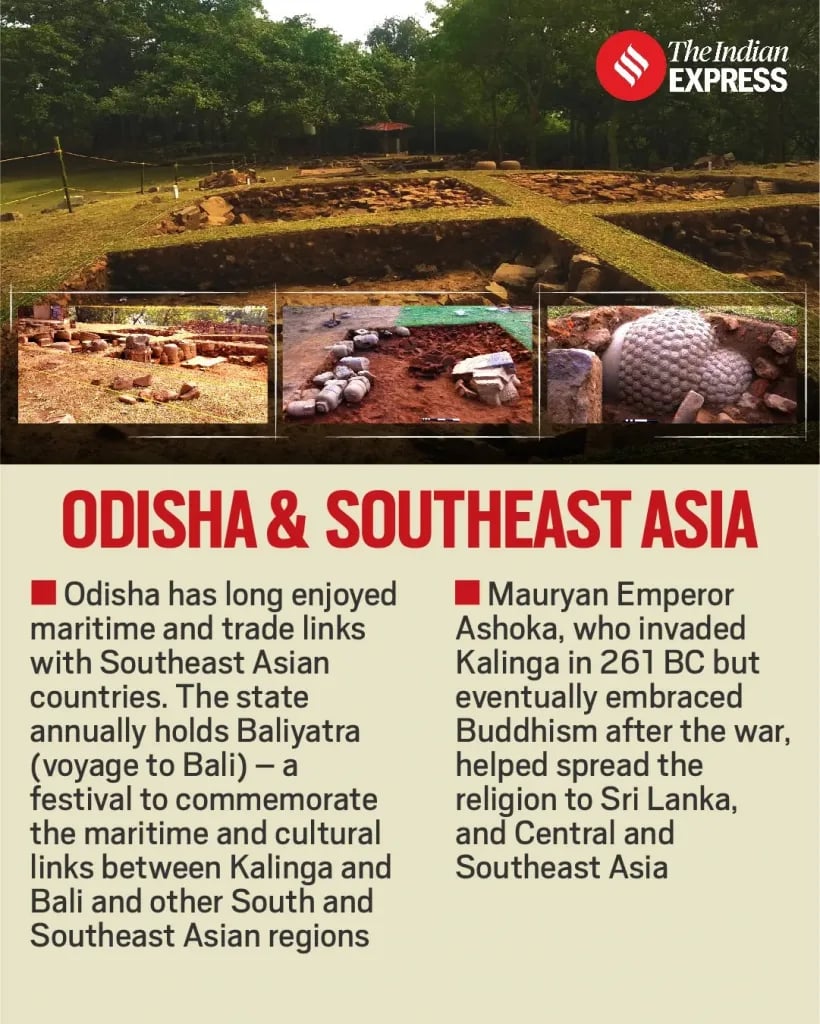
- Historical Significance: Odisha’s historical relationship with Buddhism dates back to Emperor Ashoka (304-232 BCE), who embraced Buddhism after his Kalinga invasion.
- Odisha played a significant role in the spread of Buddhism to Southeast Asia, particularly through trade connections.
- The state flourished under the Bhaumakara dynasty (8th-10th Century).
- Odisha played a significant role in the spread of Buddhism to Southeast Asia, particularly through trade connections.
- Excavation Goals: The goals were to uncover more of the site and find evidence of Odisha’s links to Southeast Asian culture.
Source :IE
Entity Locker
Syllabus: GS2/ E-Governance
In News
- The National eGovernance Division (NeGD), under the Ministry of Electronics and Information Technology (MeitY) has developed Entity Locker, a cutting-edge digital platform designed to transform the management and verification of business/organisation documents.
About Entity Locker
- Entity Locker is a secure, cloud-based digital platform designed to streamline the storage, sharing, and verification of business documents for a wide range of organizations in India.
Key Features
- Target Entities: Large corporations, MSMEs, startups, trusts, societies, and other organizations.
- Aligns with India’s Digital Public Infrastructure initiative and the Union Budget 2024-25 vision for enhanced digital governance.
- Secure Digital Infrastructure: 10 GB encrypted cloud storage for safe document storage.
- Legally valid digital signatures for authentication.
- Aadhaar-authenticated, role-based access management for secure and accountable access.
- Integration Capabilities: Real-time access and verification via integration with government databases.
- Seamless connectivity with systems like:
- Ministry of Corporate Affairs (MCA)
- Goods and Services Tax Network (GSTN)
- Directorate General of Foreign Trade (DGFT)
- Consent-based Sharing: Ensures secure sharing of sensitive business information.
Benefits
- Operational Efficiency: Reduces administrative overhead and document processing times.
- Streamlines document sharing and compliance processes.
- Tracks all document-related activities for enhanced accountability.
- Enhanced Integration: Direct integration with government platforms enables efficient compliance and reporting.
- Strategic impact: Entity Locker is part of India’s Digital Public Infrastructure and aligns with the Digital India Programme, reflecting MeitY’s commitment to leveraging technology for improving governance and fostering economic growth.
Source: PIB
Neuromorphic Device
Syllabus: GS2/ Health
In News
- Scientists at the Jawaharlal Nehru Centre for Advanced Scientific Research (JNCASR) in Bengaluru have developed a revolutionary neuromorphic device that emulates the human body’s response to pain.
Key Features
- Pain Response Simulation: Mimics the function of nociceptors, the sensors in our body that detect pain and trigger protective responses.
- Emulates the habituation process, where repeated exposure to pain reduces sensitivity over time.
- Adaptability: Learns and adjusts its response dynamically, similar to how the human body adapts to chronic stressors.
Source: TOI
White Goods
Syllabus: GS3/ Economy
In News
- The Ministry of Commerce and Industry has selected 24 companies for the third round of the Production-Linked Incentive (PLI) Scheme for White Goods.
About
- White goods refer to large home appliances, typically used for household purposes, such as cooking, cleaning, and refrigeration. They were originally manufactured in white enamel-coated steel, giving them their name, although they now come in various colors.
- For example: Kitchen Appliances, Laundry appliances etc.
- Also, Brown goods are lightweight electronic devices, mainly for entertainment and communication. Examples: TVs, Radios etc
Source: PIB
Vikas Engine
Syllabus :GS 3/Science and Tech
In News
- The Indian Space Research Organisation (ISRO) successfully demonstrated the restart of its Vikas liquid engine at the Propulsion Complex in Mahendragiri .
Vikas Engine
- It is the workhorse engine with a nominal thrust of 80 tonnes.
- It is a key component powering the liquid stages of ISRO’s launch vehicles, including the second stages of PSLV & GSLV, liquid strapons of GSLV, and the core liquid stage of LVM3.
- Liquid engines that can throttle thrust are crucial for enabling booster stage recovery in future launch vehicles.
- It is developed by ISRO’s Liquid Propulsion Systems Centre.
Source : TH
Exercise La Perouse
Syllabus :GS 3/Defence
In News
- The indigenously designed guided missile destroyer INS Mumbai is participating in the fourth edition of the Multinational Exercise LA PEROUSE.
About the Exercise
- The exercise is scheduled from January 16 to 24, taking place in the strategic straits of Malacca, Sunda, and Lombok, which connect the Indian Ocean and the Pacific Ocean.
- Participating Countries: Australia, Canada, France, India, Indonesia, Malaysia, Singapore, the U.K., and the U.S. are involved in the exercise.
- Strategic Importance: The exercise focuses on strengthening maritime safety, developing interoperability among navies, and enhancing collective action in maritime crises, particularly in the strategically important straits vulnerable to various risks.
- India’s participation highlights its strong synergy, coordination, and commitment to a rules-based international maritime order.
- The exercise aligns with India’s vision of SAGAR (Security and Growth for All in the Region), aiming to enhance maritime cooperation and ensure a safer Indo-Pacific region.
Source :TH
Previous article
India Became the 7th Largest Producer of Coffee
Next article
World Bank on Indus Water Treaty Dispute
