


Syllabus: GS2/Polity and Governance
Context
- The Supreme Court struck down several provisions of the Tribunals Reforms Act, 2021, which had earlier been introduced through the Tribunals Reforms Ordinance, 2021.
Why the Supreme Court Struck Down These Provisions?
- Violation of Judicial Independence: The Act gave the executive a dominant role in the appointment and service conditions of tribunal members.
- Since the government regularly appears as a litigant before tribunals, excessive control undermines the independence and impartiality of adjudication.
- Violation of Separation of Powers: Tribunals perform judicial functions. Allowing the executive to control appointments and tenure intrudes into the judicial domain, violating the basic structure of the Constitution.
- Arbitrary and Discriminatory Provisions: Some provisions unfairly restricted the pool of qualified candidates, violating Article 14 (Right to Equality).
Key Highlights of the Supreme Court’s Judgment
- Minimum Age of 50 for members: The Act mandated that only persons above 50 years could be appointed as tribunal members. The Court held this to be arbitrary, exclusionary, and violative of Article 14.
- Four-year tenure for chairpersons and members: The Act provided only four-year terms for tribunal members. SC held this too short and security of tenure is essential for independence.
- National Tribunals Commission: Reiterated SC’s earlier direction to the Centre to establish, within four months, an independent commission to oversee tribunal appointments and functions.
Tribunal System in India
- Tribunals are institutions established for discharging judicial or quasi-judicial duties.
- Objective: To reduce caseload of the judiciary or to bring in subject expertise for technical matters.
- Constitutional Provisions: In 1976, Articles 323A and 323B were inserted in the Constitution of India through the 42nd Amendment.
- Article 323A empowered Parliament to constitute administrative Tribunals (both at central and state level) for adjudication of matters related to recruitment and conditions of service of public servants.
- Article 323B specified certain subjects (such as taxation and land reforms) for which Parliament or state legislatures may constitute tribunals by enacting a law.
- In 2010, the Supreme Court clarified that the subject matters under Article 323B are not exclusive, and legislatures are empowered to create tribunals on any subject matters under their purview as specified in the Seventh Schedule of the Constitution.
- Currently, tribunals have been created both as substitutes to High Courts and as subordinate to High Courts .
- In the former case, appeals from the decisions of Tribunals lie directly with the Supreme Court.
- In the latter case appeals are heard by the corresponding High Court.
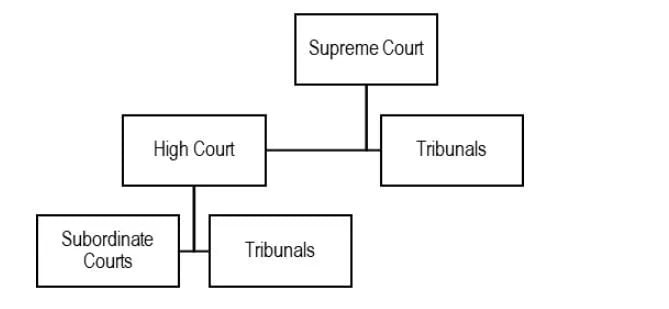
Difference between Courts and Tribunals
| Regular Courts – Jurisdiction: Can hear a wide range of civil and criminal cases. – Procedure and Rules: Civil Procedure Code (CPC) for civil cases and the Criminal Procedure Code (CrPC) for criminal cases. – Composition: Judges are appointed based on their legal qualifications and experience. – Appeal Process: Decisions of regular courts can be appealed to higher courts. | Tribunals – Each tribunal is set up to deal with specific types of cases or disputes, such as administrative matters, tax appeals, environmental issues, etc. – The laws establishing each tribunal outline the procedures to be followed, and they are often less formal than those in regular courts. – Tribunals may include both judicial and technical members. – The route of appeal is specified in the law establishing the tribunal. |
Concerns of Tribunal System in India
- Constitutional foundation and competence of tribunals: The constitutional standing of tribunals has been questioned.
- In particular, whether the jurisdiction of High Courts and Supreme Court can be removed.
- Delay in Adjudication: Despite the intention to provide speedy justice, some tribunals have faced delays in disposing of cases.
- Vacancies and Lack of Members: Delays in appointing members can hinder the effective functioning of the tribunal and contribute to the backlog of cases.
- Independence and Autonomy: The manner of appointment, removal, and terms of service of members can influence the impartiality and effectiveness of the tribunal.
- Pendency of cases: The reasoning for setting up some tribunals was to reduce pendency of cases in courts, several tribunals are facing the issue of a large case load and pendency.
- Enforcement of Decisions: There have been instances where the enforcement of tribunal decisions has faced challenges.
- Costs and Accessibility: Accessibility to the tribunal system might be a concern for certain sections of society, particularly those facing financial constraints.
- The costs associated with legal representation and proceedings can be a barrier for some litigants.
Way Ahead
- Recommendations of SC: In order to ensure that tribunals are independent from the executive, the Supreme Court had recommended that all administrative matters be managed by the law ministry rather than the ministry associated with the subject area.
- Later, the Court recommended creation of an independent National Tribunals Commission for the administration of tribunals.
- These recommendations have not been implemented.
- SC Judgement: The Supreme Court has ruled that tribunals, being quasi-judicial bodies, should have the same level of independence from the executive as the judiciary.
- Key factors include the mode of selection of members, the composition of tribunals, and the terms and tenure of service.
- Addressing these concerns requires continuous evaluation, reforms, and improvements in the functioning of tribunals.
- The aim should be to strengthen their independence, enhance efficiency, and ensure that they effectively serve their intended purpose in the legal system.
Source: AIR
Previous article
Rights of Transgender Persons in India
