


Syllabus: GS2/IR
Context
- The current reciprocal tariff policies and protectionism by the US is a bad sign for the development of a multi-state, multimodal transport and trade corridor like the India–Middle East–Europe Economic Corridor (IMEC).
About
- For almost all the participating nations except the US, IMEC does not represent a geopolitical contest.
- Instead, it serves as economic insurance to future-proof global trade in an era marked by supply-chain shocks, geopolitical fragmentation, and climate stress.
India-Middle East EU Economic Corridor (IMEC)
- Background: The IMEC is a proposed 4,800 km long route that was announced in 2023 on the sidelines of the G20 Summit.
- Members: India, European Union, France, Germany, Italy, Saudi Arabia, UAE and US.
- Aim: Integration of Asia, Europe and the Middle East.
- The IMEC will comprise of two separate corridors:
- The east corridor connecting India to the West Asia/Middle East and
- The northern corridor connecting West Asia/Middle East to Europe.
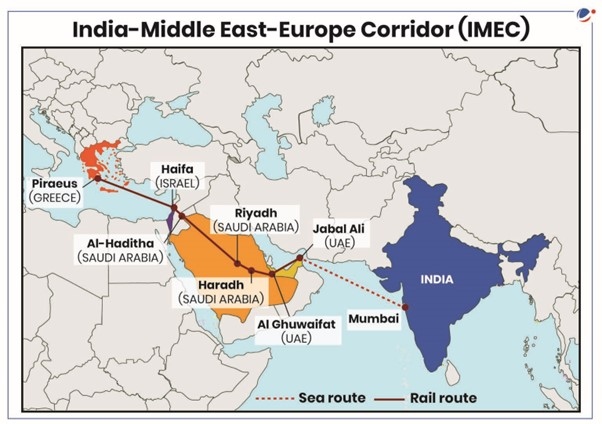
Ports Which are Part of IMEC
- India: Ports in Mundra (Gujarat), Kandla (Gujarat), and Jawaharlal Nehru Port Trust (Navi Mumbai).
- Europe: Piraeus in Greece, Messina in Southern Italy, and Marseille in France.
- Middle East: Ports include Fujairah, Jebel Ali, and Abu Dhabi in the UAE, as well as Dammam and Ras Al Khair ports in Saudi Arabia.
- Israel: Haifa port.
- Railway Line: The railway line will link Fujairah port in the UAE to Haifa port in Israel, passing through Saudi Arabia (Ghuwaifat and Haradh) and Jordan.
IMEC’s Relevance To India and Its Chokepoints
- Suez Canal Blockage (2021): It was blocked by the massive container ship, leaving several vessels stranded.
- This disruption impacted nearly 12 percent of global trade until a major salvage operation successfully freed it.
- Red Sea Crisis (2023-24): It was caused by the Houthis’ attacks on commercial shipping, exposing the fragility of over-concentrated trade routes.
- Nearly a quarter of India’s cargo transiting the Red Sea faced delays.
- Vessels were rerouted around the Cape of Good Hope, adding around 3,500 nautical miles, increasing transit time by over a week, raising fuel costs by close to a million dollars per voyage.
- Impact on India-EU Trade: With the largest EU-India trade concentrated in the Red Sea-Suez Canal corridor, Indian exporters chose to hold back shipments during the last quarter of 2023–24, leading to a decline in EU-India trade.
- With the EU being one of India’s largest trading partners, accounting for over 12 percent of total merchandise trade, the vulnerability is perceptible.
- IMEC directly responds to this structural risk: It is not designed to replace existing maritime routes such as the Suez Canal corridor or the North-South Corridor (that goes through Russia), but to complement them.
- For India, therefore, IMEC represents not a geopolitical provocation, but a strategy for economic risk management through diversification of trade routes.
Significance of IMEC for India
- Economic Development: By linking Asia, West Asia, the Middle East and Europe through enhanced connectivity and economic integration, the corridor aims to give a boost to economic development in the regions.
- Enhances India’s Connectivity and Trade Access: IMEC provides India with a direct, faster, and safer trade route connecting Indian ports to Europe via the Arabian Peninsula and the Mediterranean.
- Reduces dependence on the Suez Canal route, cutting shipping time by up to 40% and costs by 20–30%.
- Strengthens India’s Strategic Partnerships: Deepens India’s ties with the U.S., EU, Saudi Arabia, UAE, and Israel, all core IMEC participants.
- Aligns with India’s broader “Act West Policy” and encourages cooperation among traditional partners and new regional players.
- IMEC creates a triangular economic architecture: India as a manufacturing and services hub; the Gulf as a logistics, energy, and capital platform; and Europe as a technology and consumption centre.
- Boost to Energy Security: The corridor can integrate energy pipelines and green hydrogen networks linking India with Gulf producers and European consumers.
- Facilitates diversification of India’s energy imports and enhances collaboration in renewable and clean energy sectors.
- Eco-friendly Infrastructure: It places emphasis on developing environmentally friendly infrastructure.
Concerns
- The security challenges in the region have made other partners reluctant to invest in the project.
- The instability in the Middle East has given a fatal blow to the project, the delay in the project could negatively impact the aspirations of India in the region.
- Lack of Political Consensus: Although signed during the G20 Summit 2023, the IMEC memorandum is not legally binding, relying on voluntary participation.
- Divergent priorities among members slow coordination and execution.
- Economic and Financial Viability: Estimated project costs are high, involving ports, railways, pipelines, and digital infrastructure across multiple jurisdictions.
- There is a lack of clarity on financing mechanisms whether it will be multilateral, public-private, or state-funded.
- Infrastructure Gaps and Technical Challenges: Significant infrastructure deficits in West Asian countries especially in cross-border railway connectivity.
- Integration of different railway gauges, standards, and customs procedures remains unresolved.
Way Forward
- IMEC spans regions with uneven fiscal capacities and credit profiles, making traditional public funding or stand-alone public–private partnerships insufficient.
- IMEC requires a portfolio approach to financing combining public investment, multilateral guarantees, sovereign wealth capital, and private investment that can lower the capital cost and attract long-term institutional investments.
Source: ORF
Previous article
News In Short 19-01-2026
