


Syllabus: GS3/ Environment
Context
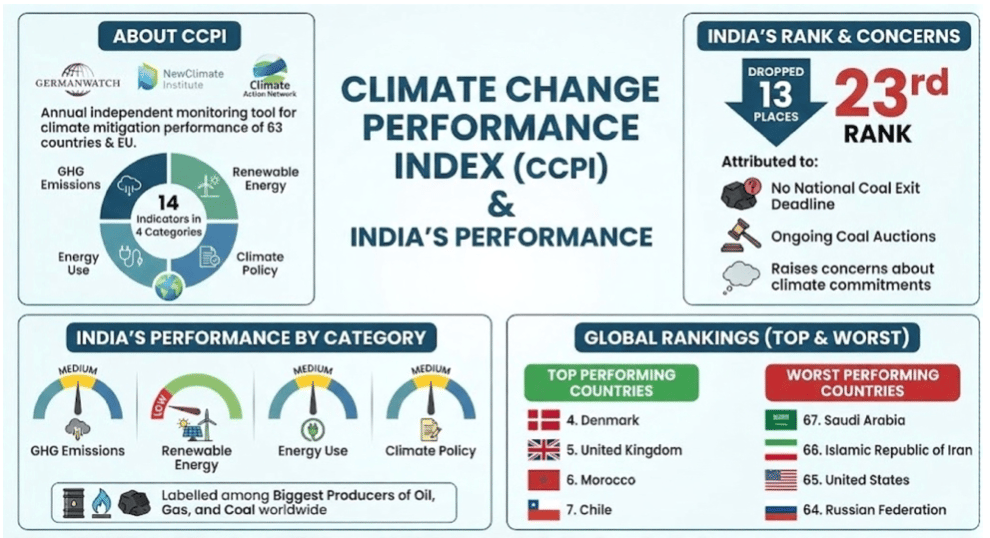
- India dropped 13 places to 23rd in the Climate Change Performance Index released during COP30 in Brazil in November 2025.
About
- The main reason is the lack of progress in India’s phase out of coal.
- Challenges with Phaseout: Coal creates a difficult policy paradox—its gradual elimination could deprive many States of employment and affordable electricity, yet persisting with current coal dependence endangers people’s health and livelihoods due to escalating global warming and pollution.
- India’s far deeper coal dependence and limited economic alternatives in coal regions make its transition more complex.
- This trade-off draws attention to Chile’s experience in tackling it.
India’s Energy Share
- As of 2025, the country’s total installed electricity capacity has crossed 500 GW, reaching 500.89 GW.
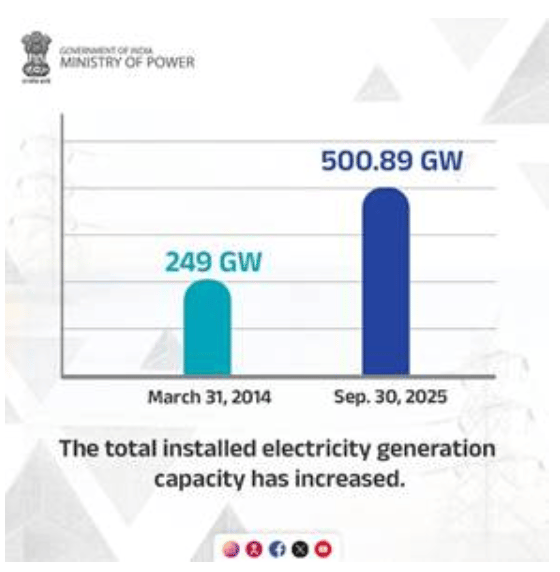
- Non-fossil fuel sources (renewable energy, hydro, and nuclear): 256.09 GW – over 51 % of the total.
- Fossil-fuel-based sources: 244.80 GW – about 49 % of the total, making coal a source of up to almost half the energy needs. Also, coal contributes about 75% of total electricity production in India.
- Within renewables:
- Solar power: 127.33 GW.
- Wind power: 53.12 GW.
- During FY 2025–26 India added 28 GW of non-fossil capacity and 5.1 GW of fossil-fuel capacity.
Chile’s Model
- In comparison, coal’s share of Chile’s electricity generation fell from 43.6% to 17.5% during 2016-24.
- Today, renewables (especially wind and solar) make up over 60% of the country’s power mix.
- Measures Taken by the Government:
- The government imposed stringent emission standards on coal plants, raising construction and compliance costs by 30%. Competitive auctions for wind and solar power helped push renewables.
- Chile has also aggressively built out energy storage systems to stabilise the grid, and committed to phase out all coal by 2040.
- All this makes the case that even economies with coal dependence can accelerate a transition.
- Challenges in Replicating the Model:
- As compared to India coal occupies a smaller share of Chile’s energy, giving it fewer plants to shut down and a smaller dependent workforce.
- The transition was also enabled by a political environment that allowed swift, market reforms following privatisation of key sectors.
India’s Green Commitments
- As part of the updated NDC submitted to the UNFCCC (United Nations Framework Convention on Climate Change) in 2022:
- India has committed to reducing its emissions intensity by 45% by 2030 (compared to 2005 levels),
- achieving 50% of cumulative electric power capacity from non-fossil fuel sources by 2030,
- These targets also contribute to India’s long-term goal of reaching net-zero emissions by 2070.
- The National Electricity Plan (NEP) envisions significant growth in renewable energy generation by 2032, with solar power expected to contribute 50% of that growth.
Suggestions for India
- TERI has suggested that India could phase out coal power entirely by 2050 to meet its net zero goals.
- In the transition to this target, there could be an incremental scaling down of coal, improved efficiency and decommissioning.
- Three sets of action that India can opt for:
- India should focus on tackling the limitations faced by renewable energy sources. The effort would also be aided by a drive to electrify transport, industry and households.
- Reform of markets and regulation to disincentivise coal, for example through carbon pricing, removal of coal subsidies, clean dispatch rules and power procurement contracts that favour renewables.
- Providing robust support for workers through reskilling and alternative livelihoods. A dedicated transition fund is essential, such as the “Green Energy Transition India Fund” proposed by the Inter-Ministerial Committee.
Way Ahead
- Considering the high stakes, a phaseout of coal needs to become a top political priority.
- Renewable energy gains show tremendous promise, but without an actionable plan to replace coal, climate ambitions would remain hollow.
- The time has come for a coal exit road map, one that enshrines delivery timelines, financing of social protection, market reform, and learning from peers such as Chile.
Source: TH
Previous article
Need of Neurotechnology in Present Scenario
Next article
News In Short 09-12-2025
