


Syllabus: GS2/ International Relations
Context
- India and the Gulf Cooperation Council (GCC) have signed the Terms of Reference for a Free Trade Agreement (FTA) in New Delhi.
About
- The terms of reference (ToR) outline the scope and modalities of a proposed trade pact.
- It defines the scope of the agreement, including trade in goods, trade in services, investments, and other trade-related issues;
- Lay down the structure and timelines for negotiations;
- Specify tariff reduction modalities and dispute settlement mechanisms;
- Provide clarity on technical standards, rules of origin, customs cooperation, and trade facilitation measures.
About Gulf Cooperation Council (GCC)
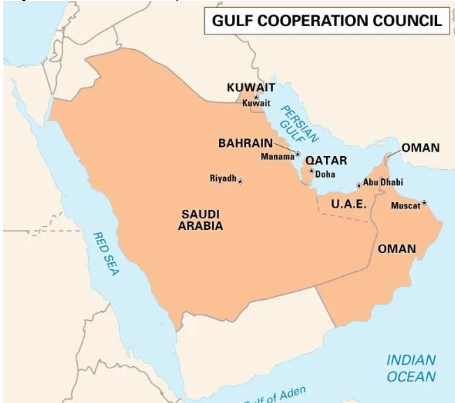
- GCC is a regional political and economic union established in 1981.
- It comprises six member countries: Saudi Arabia, Kuwait, the United Arab Emirates, Qatar, Bahrain, and Oman.
- It is Headquartered at Riyadh, Saudi Arabia.
- It aims to achieve unity among its members based on their common objectives and similar political and cultural identities, rooted in Arab and Islamic cultures.
Significance of GCC to India
- The GCC countries collectively represent a market of 61.5 million people (2024) and US$ 2.3 trillion in terms of GDP at current prices, ranking 9th globally in this category.
- It is also home to nearly ten million members of the Indian community.
- The free trade agreement between India and GCC will benefit India’s food processing infrastructure, petrochemical, and ICT sectors, taking the relationship between the two sides to great heights.
India-GCC Trade Cooperation
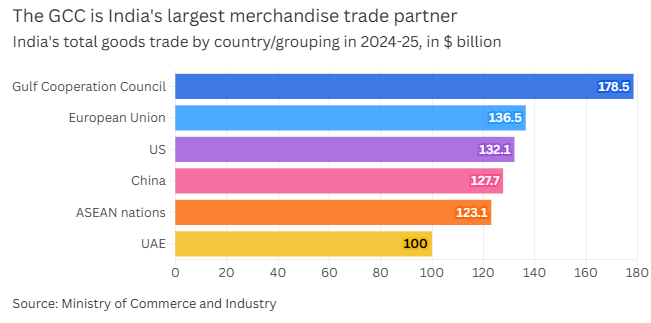
- India’s trade with GCC stood at USD 178.56 billion (Exports: USD 56.87 billion; Imports: USD 121.68 billion) in FY 2024-25, accounting for 15.42% of India’s global trade.
- In the last five years, India’s trade with the GCC has expanded with an annual average growth rate of 15.3 percent.
- Key exports from India to GCC include engineering goods, rice, textiles, machinery, gems and jewelry.
- Key sectors of imports from GCC primarily comprise crude oil, LNG, petrochemicals, and precious metals such as gold.
- The GCC region is also a significant source of FDI for India, with cumulative investments exceeding USD 31.14 billion as on September 2025.
Challenges in India–GCC Free Trade Agreement
- Persistent Trade Deficit: India runs a large and structural trade deficit with the GCC, primarily due to heavy imports of crude oil, LNG, and gold. Even with tariff reductions, energy imports will continue to dominate trade flows.
- Limited Export Diversification: India’s export basket to the GCC is still concentrated in a few sectors.
- Many GCC countries are diversifying into manufacturing and services under programs like Saudi Vision 2030, which may increase competition for Indian exporters.
- Competition for Indian MSMEs: Trade liberalisation will expose India’s MSMEs and small manufacturers to competition from Gulf-based re-export hubs like Dubai.
Way Ahead
- India must negotiate balanced tariff concessions with phased reductions.
- Strong Rules of Origin should be incorporated to prevent trade circumvention.
- Export competitiveness must be enhanced through:
- Logistics improvement
- Quality standardisation
- Production-linked incentives
- Strategic energy partnerships should include cooperation in renewables, green hydrogen, and petrochemical value chains, not just crude imports.
Source: TH
