


Syllabus: GS3/Mineral & Energy Resources; Distribution of Key Natural Resources
Context
- Illegal coal mine explosion in East Jaintia Hills, Meghalaya, killing 18 workers, highlights continued prevalence of rat-hole mining despite regulatory bans.
What is Rat Hole Coal Mining?
- Illegal coal mining is most prevalent in Jharkhand, Odisha, Chhattisgarh, West Bengal, and Meghalaya’s Jaintia, Khasi, and Garo Hills, where coal seams are thin and scattered, making mechanized mining economically unattractive.
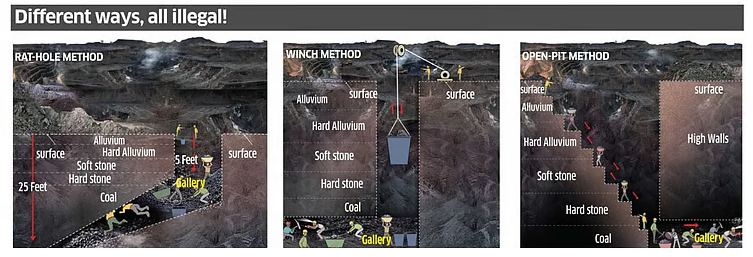
- Rat-hole mining refers to a primitive form of underground coal extraction where narrow horizontal tunnels are dug into coal seams. Workers crawl inside these tunnels to extract coal manually.
- Two Main Types:
- Side-cutting mining, where horizontal tunnels are drilled into hill slopes.
- Box-cutting mining, where a vertical shaft is dug first, followed by horizontal tunnels.
Reasons for the Persistence of Rat-Hole Mining in India
- Livelihood Dependence and Lack of Alternatives: The rat-hole mining historically supported thousands of livelihoods in Meghalaya, especially in regions with limited alternative employment opportunities.
- Coal extracted through the rat-hole mining method has been supplied to nearby industries, including cement plants and brick kilns, contributing to local and regional economies.
- Customary Land Ownership: Meghalaya operates under the Sixth Schedule of the Indian Constitution, which grants tribal communities customary rights over land and minerals.
- Many local landowners historically did not view rat-hole mining as illegal, since mining occurred on privately or clan-owned land.
- Weak Enforcement and Governance Deficits: Limited state presence in remote mining areas, understaffed regulatory agencies, and poor monitoring allow illegal mining to continue largely unchecked.
- Political Economy and Elite Interests: Coal extraction networks involve mine owners, transporters, contractors, and political intermediaries who benefit economically from continued operations.
- These actors often exert pressure on state institutions to dilute or delay regulatory action.
- Geological and Economic Constraints: Meghalaya’s coal seams are thin, shallow, and discontinuous, making large-scale mechanized mining technically and economically unattractive.
- Rat-hole mining remains the cheapest and most feasible extraction method under these geological conditions.
Major Concerns & Issues
- Worker Safety & Exploitation of Labor: Lack of ventilation, risk of flooding, cave-ins, and explosions make illegal mines extremely dangerous.
- Migrant and impoverished workers are most affected, often working without contracts or legal protection.
- Environmental Damage: Illegal mining leads to deforestation, water pollution, land subsidence, and long-term ecological harm.
- Acid mine drainage (AMD) contaminates rivers and streams, drastically lowering pH levels and rendering water bodies biologically dead.
- Unregulated excavation leads to deforestation, soil erosion, and landscape destabilization, particularly in the ecologically fragile hills of Meghalaya.
- Loss of Revenue: The government loses significant royalties and taxes, affecting public finances.
- Child Labour and Human Rights Violations: Children have historically been employed due to their ability to navigate narrow tunnels, in direct violation of Indian child labour laws.
- Informal employment structures deprive workers of minimum wages, social security, healthcare, and legal resources.
- Legal Non-Compliance and Regulatory Failure: Most operations lack environmental clearance, mining leases, and safety approvals mandated under Indian law.
- Enforcement remains weak due to jurisdictional conflicts between customary tribal governance and statutory mining laws despite the 2014 NGT ban.
- The absence of mandatory EIA exacerbates unchecked environmental damage.
- Governance Gaps and Institutional Weakness: Remote terrain, limited administrative capacity, and inadequate monitoring enable illegal mining to persist.
- Political patronage networks protect mine owners and traders from prosecution.
- Fragmented institutional responsibility between state and central agencies dilutes accountability.
- Ethical and Intergenerational Concerns: Rat-hole mining shifts environmental and health costs onto future generations while providing limited long-term economic benefits.
- The continued degradation of fragile ecosystems threatens biodiversity and regional climate resilience.
Current Laws and Regulations Related to Mining in India
- Mines and Minerals Act, 1957: It governs the mining of minerals in India, including their exploration, extraction, and management.
- Illegal mining, such as rat-hole mining, violates provisions of this Act, leading to penalties and legal action.
- Coal Mines (Nationalisation) Act, 1973: Restricts mining activities to government and authorized entities.
- Rat-hole mining is often unregulated and conducted outside this framework, making it illegal.
- Environmental Protection Act, 1986 (EPA): Requires environmental clearances for mining activities.
- Rat-hole mining bypasses these regulations, causing severe environmental damage.
- Meghalaya Mines and Minerals Policy, 2012: It was introduced to regulate mining practices in the state. However, enforcement has been weak, and rat-hole mining continues illegally.
Policy Efforts & Initiatives
- The Supreme Court and National Green Tribunal (NGT) have banned or restricted unsafe mining practices such as rat-hole mining.
- State governments periodically launch crackdown drives and task forces to shut down illegal mines.
- Reforms in the coal sector, including commercial coal mining and transparent auctions, aim to reduce incentives for illegal extraction.
- Environmental clearance norms and mine safety regulations exist but face implementation gaps.
Way Forward
- Strict and consistent enforcement of mining laws, with accountability for officials enabling illegal operations.
- Alternative livelihoods and skill development for communities dependent on illegal mining.
- Use of technology (satellite imagery, drones) to detect and monitor illegal mining activities.
- Strengthening worker rehabilitation, compensation mechanisms, and environmental restoration.
- Greater coordination between state agencies, local administration, and communities to ensure sustainable and lawful mining practices.
Previous article
News In Short 05-02-2026
