


Syllabus: GS3/ Economy and agriculture
Context
- India’s pesticide market is undergoing a structural transformation, driven by shifting pest dynamics, labour shortages, and changing cropping practices.
Background
- Pesticides, or crop protection chemicals, include substances used to kill or deter pests that harm crops. These include:
- Insecticides: For insect pests (e.g., white-backed plant hopper in paddy).
- Fungicides: For fungal diseases (e.g., blast, sheath blight).
- Herbicides: For weed control.
- Historically, pesticide use in India was low in the mid-20th century, but has grown with the Green Revolution.
- In recent decades, regulatory changes (banning DDT, endosulfan etc.) and rising labour costs have boosted herbicide and biopesticide adoption.
Composition of India’s Crop Protection Market
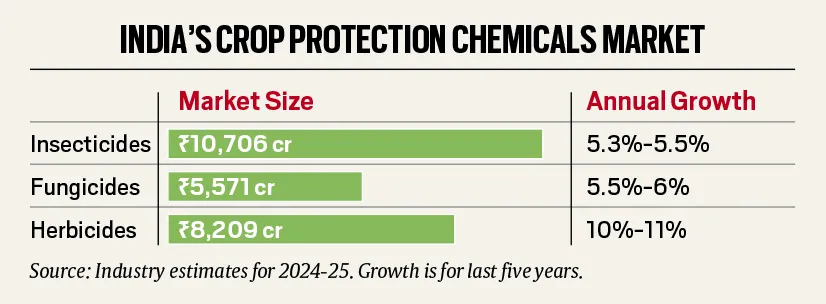
- India’s organised domestic crop protection chemicals market is valued at roughly Rs 24,500 crore.
- The largest segment within that is insecticides (Rs 10,700 crore), followed by herbicides (Rs 8,200 crore) and fungicides (Rs 5,600 crore).
- Herbicides are growing at >10% annually, highest among all sub-segments.
- Global scenario:
- As per Food and Agriculture Organization (FAO), over 3.7 million tonnes of pesticides were used globally in 2022, doubling since 1990.
- Asia leads in production and consumption, with China and India at the forefront.
Driving Factor for the Growth of Herbicides
- Manual weeding requires 8–10 hours per acre, while the average daily wage for plant protection workers rose to ₹447.6 in Dec 2024 (from ₹326.2 in 2019) according to the Labour Bureau’s data.
- Due to migration and rising opportunity costs, labour availability is erratic, especially during peak agricultural operations.
- Herbicides now act as labour substitutes, like tractors or mechanised harvesters.
Regulatory Framework
- Insecticides Act, 1968: Governs import, registration, manufacture, sale, transport, and use of pesticides.
- Banned/Restricted Pesticides: India has banned 46 pesticides; others like Paraquat and Glyphosate remain under scrutiny.
- CIB&RC (Central Insecticide Board & Registration Committee): Approves new pesticides and ensures safety compliance.
- Anupam Verma Committee: It was constituted by the Department of Agriculture & Farmers Welfare to review 66 pesticides which are banned/restricted in other countries but continued to be registered for use in India.
Schemes Promoting Sustainable Use of Pesticides
- National Mission on Sustainable Agriculture (NMSA): Encourages Integrated Pest Management (IPM) and climate-resilient farming.
- Paramparagat Krishi Vikas Yojana (PKVY): Promotes organic farming, including biopesticide usage.
- Kisan Drone Scheme (2022): Provides subsidies for agricultural drones, enabling precision spraying and reducing health risks.
- Kisan Kavach Protective Kit: Developed byDepartment of Biotechnology, it offers safety gear to pesticide applicators.
What are the Concerns?
- Environmental and Health Risks: Excessive or improper pesticide use leads to soil and water contamination, resistance buildup, and human health hazards.
- Regulatory Oversight: India lacks a robust regulatory framework like the EPA (USA) or EFSA (EU) for approving or banning hazardous chemicals.
- R&D and Indigenous Capacity: India is dependent on MNCs for active ingredients and formulations. It needs more investment in domestic R&D and public-private innovation platforms.
Way Ahead
- Promote Bio-pesticides: Streamline approval and incentivize production of eco-friendly alternatives.
- Strengthen Regulatory Enforcement: Improve state-level monitoring to curb the sale of spurious and substandard pesticides.
- Farmer Awareness & Training: Expand extension services to educate farmers on judicious, need-based pesticide use.
- Digital Traceability Systems: Implement QR-based tracking from manufacturer to farmer to ensure quality and transparency.
- Increase R&D Funding: Support innovation in green chemistry, nano-pesticides, and Integrated Pest Management (IPM).
- Ban Hazardous Chemicals: Phase out Class I pesticides (highly hazardous) in alignment with FAO-WHO guidelines.
Concluding Remarks
- India’s pesticide sector is at a crossroads—while it plays a crucial role in ensuring crop protection and food security, it simultaneously raises environmental and health concerns.
- A judicious blend of regulation, innovation, and farmer awareness is essential to transition toward safer, more sustainable agriculture.
Source: IE
Previous article
News In Short 02-08-2025
Next article
Bio-fortified Potatoes
