


Syllabus: GS2/Judiciary; Governance
Context
- Recently, the Union Home Ministry decided to convene a multi-stakeholder conference to examine reforms required in India’s poorly functioning plea bargaining system.
About Plea Bargaining in India
- It is a pre-trial negotiated settlement in which the accused voluntarily agrees to plead guilty in exchange for reduced punishment, lesser charges, or faster disposal of the case.
- It aims to reduce judicial backlog, ensure speedy trial, lower litigation costs, reduce undertrial detention, and improve efficiency in criminal justice administration.
- It applies to offences punishable with imprisonment up to seven years, not affecting socio-economic conditions, and not committed against women or children below 14 years.
- It is voluntary in nature. Mutual satisfaction of parties is necessary, and court supervision is mandatory.
Types of Plea Bargaining
- Charge Bargaining: The accused pleads guilty to a lesser charge.
- Sentence Bargaining: The accused pleads guilty in exchange for reduced punishment.
- India primarily follows sentence bargaining.
Legal Framework
- Constitutional Basis: The Supreme Court has repeatedly emphasised speedy justice as part of fair procedure. Plea bargaining is linked with:
- Article 21: Right to life and speedy trial
- Article 39A: Equal justice and free legal aid
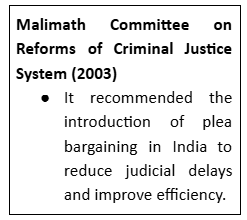
- Statutory Framework: Plea bargaining was formally introduced into the CrPC through the Criminal Law (Amendment) Act, 2005.
- Sections 265A to 265L of CrPC dealt with procedure for plea bargaining, role of court, compensation to victim, and sentencing norms.
- Position under BNSS, 2023: The Bharatiya Nagarik Suraksha Sanhita (BNSS), 2023 retains plea bargaining provisions under Section 294.
- However, concerns remain because plea bargaining still results in formal conviction, social stigma continues, and incentives for accused remain weak.
Why Plea Bargaining Matters?
- Plea bargaining is widely used across advanced criminal justice systems to decongest courts.
- Percentage of cases resolved through plea bargaining are 90–95% in the United States, 85–90% in Canada, 80–90% in Australia, and less than 1% in India.
- NCRB Data Reflects Failure: According to NCRB data (2023), 1.65 crore criminal cases tried, 35,889 cases resolved through plea bargaining, making 0.216% disposal rate through plea bargaining in India.
- It reveals the near-total underutilisation of the mechanism.
Reasons for the Failure of Plea Bargaining in India
- Stigma of Conviction: A successful plea bargain results in a formal conviction and reduced sentence rather than acquittal.
- However, criminal record remains, social stigma persists, employment disqualifications may arise, and future legal disadvantages continue.
- It discourages accused persons from opting for plea bargaining.
- Competition from Compounding of Offences: Compounding allows parties to settle certain minor offences privately, leading to formal settlement, avoidance of trial, and acquittal of accused.
| Compounding vs Plea Bargaining | |
| Compounding of Offences (Section 359, BNSS): Compounding allows parties to settle certain offences privately, leading to acquittal. | |
| Plea Bargaining | Compounding |
| Conviction remains | Acquittal granted |
| Reduced sentence | No punishment |
| Criminal stigma persists | Clean record |
- Lack of Prosecutorial Interest: The success of plea bargaining depends heavily on prosecutors.
- However, problems persist like poor training, lack of negotiation skills, focus on conviction rates rather than efficient justice, and institutional indifference.
- India lacks a specialised prosecutorial culture for negotiated settlements unlike countries such as Canada.
- Absence of Institutional Mechanisms: India does not have dedicated plea-bargaining cells, trained facilitators, monitoring systems, and accountability frameworks.
- It has led to inconsistent and ineffective implementation.
- Constitutional and Ethical Concerns: While plea bargaining offers efficiency, concerns remain regarding possibility of coercion, unequal bargaining power, risk of innocent persons pleading guilty, and impact on fair trial rights under Article 21.
- Therefore, safeguards and judicial scrutiny are indispensable.
Why is Reform Necessary?
- Addressing Judicial Pendency: India’s judiciary is operating beyond capacity with 58.8 million pending cases.
- Key concerns include massive backlog, delay in justice delivery, high undertrial population, and rising litigation costs.
- Plea bargaining can reduce the burden on trial courts significantly.
- Protecting Undertrial Prisoners: A large percentage of India’s prison population consists of undertrials. Effective plea bargaining can reduce unnecessary incarceration, speed up disposal, and improve prison management.
- Enhancing Access to Justice: For economically weaker litigants, prolonged litigation is costly and exhausting. Negotiated settlements can ensure faster closure, reduced legal expenses, and better victim compensation.
Suggested Reforms
- Remove the Stigma Attached to Plea Bargaining: The punishment under plea bargaining should be made largely stigma-free.
- Measures include removing employment disqualifications arising from negotiated pleas, restrict disclosure of minor plea convictions, and treat certain plea outcomes as non-custodial settlements.
- Introduce Acquittal-Based Outcomes: One major reform could be permitting acquittal as one possible negotiated outcome in suitable cases. It would increase acceptance, reduce fear among accused persons, and bring parity with compounding provisions.
- Create Plea Bargaining Mediation Cells: Each district court should establish a dedicated plea-bargaining facilitation centre, legal aid representatives, victim liaison officers, and trained mediators.
- Such institutional support can improve transparency and trust.
- Strengthen Prosecutorial Capacity: Canada’s system focuses on fair negotiated outcomes, efficient case disposal, and ethical prosecutorial conduct.
- India should similarly train prosecutors in negotiation, shift focus from conviction statistics, and develop standard operating procedures.
- Judicial Oversight Must Continue: Even after parties agree on a plea, courts need to verify voluntariness, examine factual basis, prevent coercion, and ensure proportional punishment.
- Judicial supervision is essential to protect due process.
- Develop Data-Based Accountability: A High Court-directed digital dashboard can track number of plea bargains, offence categories, time-to-resolution, and district-wise performance.
- Regular monitoring can improve implementation and transparency.
Conclusion & Way Forward
- Plea bargaining has immense potential to transform India’s criminal justice administration, but its current framework suffers from structural weaknesses, institutional indifference, and lack of incentives.
- India requires a balanced plea bargaining framework that combines speedy justice, fairness, victim participation, judicial oversight, and institutional accountability.
- Reforming it is not merely an administrative necessity but a constitutional imperative linked to the right to speedy justice.
| Daily Mains Practice Question [Q] Examine the challenges associated with plea bargaining in India. Suggest reforms required to make it an effective instrument of criminal justice administration. |
Previous article
India’s EV Transition and the Dilution of CAFE Norms
