


Syllabus: GS2/Governance & Welfare Policies; GS3/Inclusive Growth
Context
- Recent policy shifts, particularly the implementation of the four Labour Codes and the proposed Viksit Bharat-Guarantee for Rozgar and Ajeevika Mission (Gramin) Bill, 2025 replacing MGNREGA have reignited debates on inequality, labour welfare, and rural distress.
Understanding Inequality in India
- Inequality refers to the uneven distribution of income, wealth, consumption, opportunities, social and political power.
- It may exist across class, caste, gender, religion, region, and urban-rural divide
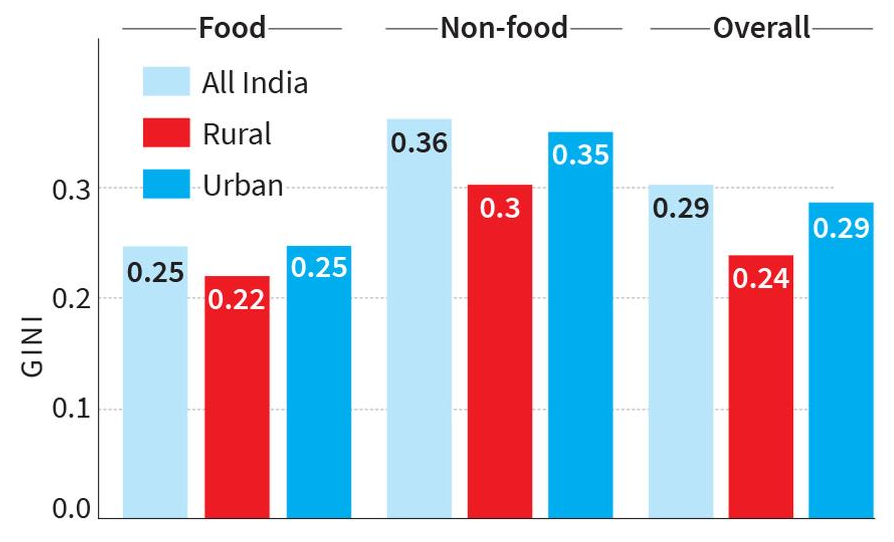
- The measurement of inequality depends on data sources, survey methodologies, and indicators such as the Gini Index, decile shares, and consumption ratios.
Types of Inequality in India
- Income Inequality: Income inequality refers to unequal earnings among individuals or groups.
- Key Trends: Top earners capture a disproportionate share of national income; informal workers face stagnant wages; and corporate profits have risen faster than labour incomes.
- Evidence: According to World Inequality Database estimates the top 1% holds a significant share of national income and wealth; and wage growth remains uneven between formal and informal sectors.
- Wealth Inequality: Wealth inequality is much higher than income inequality.
- Causes: Unequal ownership of assets, land concentration, inheritance advantages, and financial asset accumulation by elites.
- Impact: Reduced social mobility, intergenerational inequality, and concentration of economic power.
- Consumption Inequality: Consumption expenditure is often measured through NSSO surveys.
- HCES 2023-24 Findings: India’s consumption Gini Index is estimated around 0.29 (significantly higher than the widely cited World Bank estimate of 0.25).
- Average urban non-food monthly per capita expenditure (MPCE) is about 1.5 times higher than the all-India average.
- Rural non-food expenditure remains far below the national average.
- The top 10% in urban India accounts for 27% of total non-food expenditure. It means the remaining 90% contributes only 73%.
- MPCE Gap:
- Urban top decile spends 6 times more than the bottom decile.
- Rural top decile spends 4.5 times more than the rural bottom decile.
- Urban richest decile spends 9 times more than the rural poorest decile.
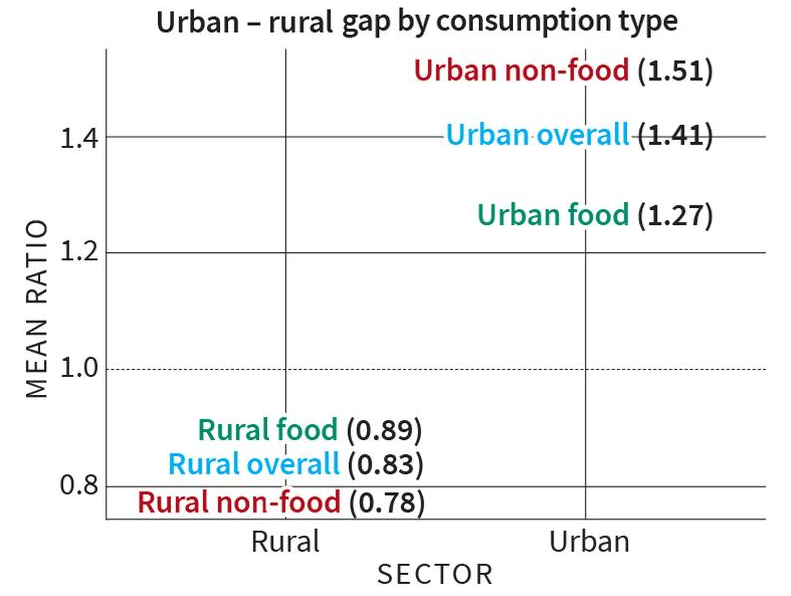
- Rural-Urban Inequality: Urban India enjoys better infrastructure, higher wages, and greater employment opportunities.
- Rural India continues to face agricultural distress, underemployment, and poor public services.
- Caste-Based Inequality: Historically disadvantaged groups like SCs, STs, and OBCs continue to face lower educational attainment, wage discrimination, limited asset ownership, and occupational segregation.
- Gender Inequality: Women face disparities in labour force participation, wages, education, property ownership.
- Challenges like unpaid care work, informal employment, and occupational segregation.
- India’s female labour force participation remains lower than global averages.
- NSS Surveys Underestimate Inequality: NSS consumption surveys fail to capture the super-rich adequately. Therefore, actual inequality is likely much higher.
- About one-fourth of the richest 10% reportedly benefited from PMGKY.
- Around 13% of them possessed BPL ration cards.
Causes of Inequality in India
- Unequal Economic Growth: Post-1991 reforms accelerated growth but benefits were unevenly distributed.
- Growth favoured urban skilled workers, corporate sectors, and service industries.
- Neglected Groups: Agricultural labourers, small farmers, and informal workers.
- Informalisation of Labour: Over 90% of India’s workforce is employed in the informal sector.
- Problems: Low wages, lack of social security, job insecurity, and absence of legal protection.
- Educational Disparities: Quality education remains inaccessible for many due to regional imbalance, digital divide, poor public schooling. It reproduces inequality across generations.
- Agricultural Distress: Agriculture suffers from fragmented landholdings, low productivity, climate vulnerability, price instability.
- Rural incomes remain stagnant compared to urban incomes.
- Unequal Access to Healthcare: Healthcare inequality worsens economic vulnerability through high out-of-pocket expenditure, inadequate rural health infrastructure, and unequal access to quality care.
Impact of Inequality
- Economic Impact: Weak domestic demand, uneven consumption growth, and reduced productivity.
- Social Impact: Social exclusion, crime and unrest, and marginalisation.
- Political Impact: Democratic alienation, policy capture by elites, and weakening of social cohesion.
Impact of Recent Policy Changes
- Labour Codes and Informal Workers: India’s workforce is over 90% informal, making social security protections critical. The four Labour Codes aim to simplify labour laws, improve ease of doing business, and formalise labour markets
- However, they may dilute workers’ bargaining power, increase contractualisation, reduce job security, and weaken trade unions.
- Replacement of MGNREGA: The proposed Viksit Bharat-Guarantee for Rozgar and Ajeevika Mission (Gramin) Bill, 2025 seeks to replace MGNREGA.
- Concerns like reduced rights-based framework, possible centralisation of implementation, exclusion errors through digitisation, wage-payment delays, and weakening of rural safety nets.
- MGNREGA historically acted as a livelihood stabiliser, a distress migration buffer, and a rural wage floor mechanism.
Government Initiatives to Reduce Inequality
- Welfare Schemes: PM Garib Kalyan Anna Yojana; PM-KISAN; Ayushman Bharat; National Food Security Act; e-Shram Portal; and Jal Jeevan Mission.
- Financial Inclusion: Jan Dhan Yojana, Direct Benefit Transfer (DBT); and UPI ecosystem.
- Skill Development: Skill India Mission and PMKVY
Way Forward
- Strengthen Rural Employment: Preserve the rights-based nature of employment guarantees; and ensure timely wage payments.
- Improve Data Quality: Better capture top-income groups; and enhance transparency in NSS and tax data integration.
- Expand Social Security: Universal social protection for informal workers; and portable benefits for migrant labourers.
- Address Class and Regional Disparities: Boost agricultural productivity; and promote labour-intensive manufacturing.
- Progressive Fiscal Policies: Rational wealth taxation debates; and higher public spending on health and education.
| Daily Mains Practice Question [Q] Examine the nature and causes of inequality in India. Suggest measures to ensure inclusive and equitable growth. |
