


Syllabus: GS3/Economy
In News
- The Union Cabinet has approved Rs.5659.22 crore for the Mission for Cotton Productivity (2026–27 to 2030–31.
About
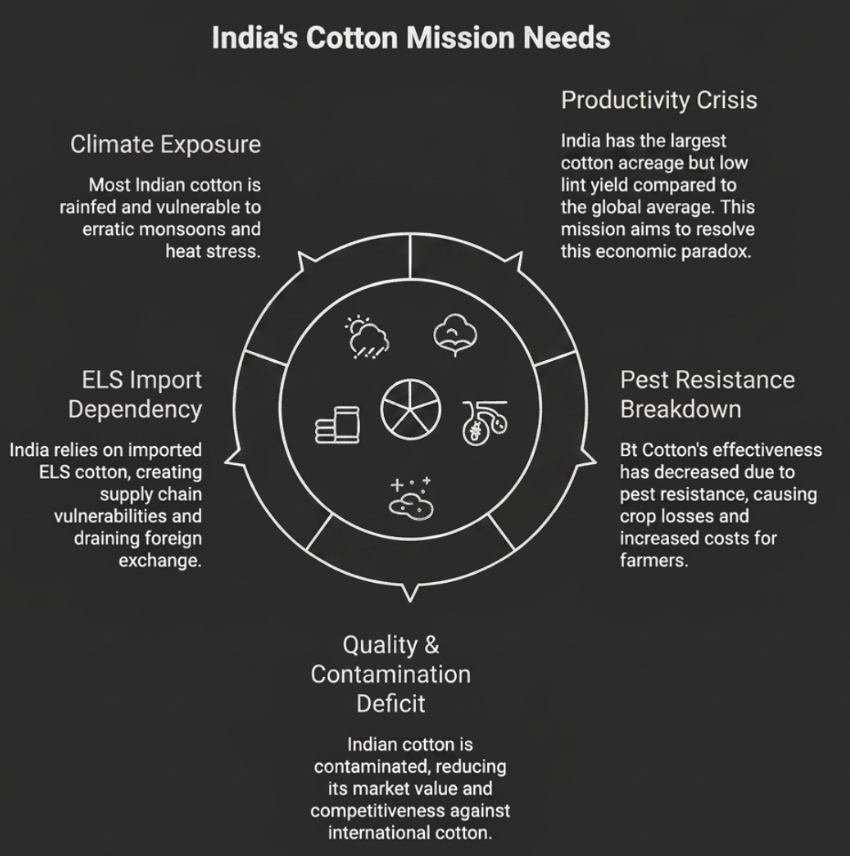
- The mission targets stagnant yields, pest vulnerability, quality deficits, and import dependence while positioning India’s textile sector as globally competitive through its integrated 5F Vision (Farm to Fibre to Factory to Fashion to Foreign).
Key Features of the Mission
- Implementing agencies: Ministry of Agriculture & Farmers Welfare + Ministry of Textiles, supported by 10 ICAR institutes and CSIR.
- Coverage: 140 districts across 14 major cotton-growing states (initial phase)
- Core focus areas: Climate-smart seed development, pest-resistant varieties, extra Long Staple (ELS) cotton promotion, mechanization, and ginning quality upgrades.
- Extra Long Staple cotton (Gossypium barbadense), with staple length ≥30 mm, is the gold standard in premium textiles. India currently imports it heavily from Egypt and the USA.
- Targeted outcomes by 2031: To accomplish the production of 498 lakh bales (170 kg lint each) of cotton by enhancing lint productivity from 440 kg/ha to 755 kg/ha by 2031.
- Promotion of Kasturi Cotton Bharat for traceability and certification, targeting trash reduction <2% and promotion of natural fibres like flax, ramie, sisal, milkweed, bamboo and banana.
Cotton Cultivation in India
- Popularly called “White Gold”, It is a semi-xerophyte, and is grown in tropical and subtropical conditions.
- Cotton needs deep alluvial (North), black cotton/regur soil (Central/Deccan), red-black mixed soils (South).
- India is the only country that grows all four species of cotton G. Arboreum and G. Herbaceum (Asian cotton), G. Barbadense (Egyptian cotton) and G. Hirsutum (American Upland cotton).
- India is the world’s second-largest producer and consumer (after China), with the largest cultivated area globally.
- There are nine major cotton-growing states in India, as per the Ministry of textiles, these are grouped into three diverse agro-ecological zones:
- Northern Zone – Punjab, Haryana, and Rajasthan
- Central Zone – Gujarat, Maharashtra, and Madhya Pradesh
- Southern Zone – Telangana, Andhra Pradesh and Karnataka.
Major Challenges Confronting the Mission
- Irrigation Deficit in HDPS Adoption: The mission’s push for High-Density Planting System (HDPS) requires assured soil moisture. Without micro-irrigation coverage, HDPS adoption in rainfed belts risks systemic failure.
- Fragmented Landholdings: A majority of cotton farmers hold less than 2 hectares. Capital-intensive interventions like mechanized harvesting and HDPS require contiguous land parcels — structurally incompatible with India’s smallholder agrarian reality.
- Soil Health Degradation: Decades of monocropping and heavy chemical fertilizer use have depleted soil organic carbon across traditional cotton belts, limiting the efficacy of new High-Yielding Varieties (HYVs).
- Mechanization Gap: Mechanized cotton harvesters remain unaffordable for individual farmers. Without robust Custom Hiring Centres (CHCs) or cooperative models, labour shortage during picking season remains a bottleneck.
- Farmer Behavioural Resistance: Shifting farmers from traditional spacing and seed varieties requires intensive extension hand-holding, risk-mitigation guarantees, and financial incentives not just technology delivery.
Way Ahead: Strengthening the Mission
- Extension Services: Mobilise Krishi Vigyan Kendras (KVKs) and State Agricultural Universities (SAUs) for active “Lab to Land” transfer of HDPS and HYV protocols
- Irrigation Convergence: Integrate with PMKSY – Per Drop More Crop to provide micro-irrigation support in rainfed cotton zones
- Next-Gen Integrated Pest Management: Mandate pheromone traps, biopesticides, and refuge crop planting alongside Bt seed distribution to slow pest adaptation
- Mechanization Push: Parallel subsidies for mechanized harvesters through CHCs and FPO-led cooperative models
- Digital Agriculture (Agri-Stack): Deploy AI and satellite-based hyper-local advisories for weather, soil moisture, and early pest warnings via farmer smartphones.
Source:PIB
Previous article
Cabinet Approves Increase in the Judge Strength of the Supreme Court
Next article
Decarbonising Industrial Heat for Sustainable Growth
