

Gajapati Inscription in Guntur
Syllabus: GS1/ Medieval India
Context
- A medieval inscription linked to the Gajapati Dynasty has been discovered at the Lakshmi Narasimha Swamy Temple in Guntur, Andhra Pradesh.
Key Findings
- The inscription is engraved on a stone pillar in the temple mandapa.
- It mentions Kumaraguru Mahapatra, an officer serving under Purushottama Deva in the 15th century CE.
- The record indicates that the idol of Lord Narasimha and the mandapa pillars were relocated from Kondaveedu Fort following invasions in the region.
- The inscription was originally dedicated to Lord Mallikarjuna of Kondaveedu but was later shifted to the Guntur temple.
- It also refers to temple rituals such as milk offerings and mentions the management of cows by local communities.
- The findings reflect the practice of Hari-Hara worship, indicating a syncretic tradition combining Shaiva and Vaishnava beliefs.
Gajapati Dynasty
- The Gajapati Dynasty was a powerful medieval kingdom that originated in Odisha and flourished during the 15th–16th centuries.
- It was founded by Kapilendra Deva after the decline of the Eastern Ganga dynasty.
- At its peak, the empire extended from parts of present-day West Bengal to Tiruchirappalli in Tamil Nadu, with its capital at Kataka (modern-day Cuttack).
- The Gajapati rulers were known for their patronage of art, architecture, and literature, and they maintained continuous rivalry with the Vijayanagara Empire.
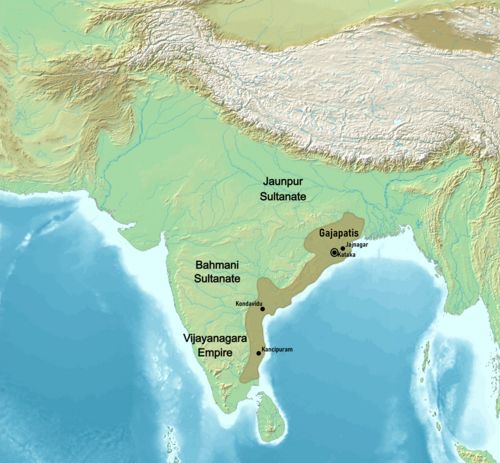
Source: DC
Ladakh Magmatic Arc
Syllabus: GS1/ Geography
In News
- Scientists from the Wadia Institute of Himalayan Geology have recently decoded the evolution of the Ladakh Magmatic Arc (LMA) in the North-West Himalaya.
About
- The Ladakh Magmatic Arc is a belt of igneous rocks located in the Trans-Himalayan region of India (mainly Ladakh).
- It represents a long-extinct volcanic arc system.
- The present-day Ladakh region once lay above the Neo-Tethys Ocean. Beneath this ocean, the oceanic crust of the Indian Plate was moving towards the Eurasian Plate.
- The denser oceanic plate subducted (sank) beneath the Eurasian Plate. This process led to melting of mantle material, formation of magma & rise of magma to form volcanic arcs.
Source: TH
Adoptive Mothers Get Equal Maternity Rights
Syllabus: GS2/ Governance
Context
- The Supreme Court of India held that all female employees adopting children are entitled to 12 weeks of paid maternity leave, regardless of the child’s age.
Background
- The legal framework governing maternity benefits in India originates from the Maternity Benefit Act, 1961 and through the 2017 Amendment for the first time, adoptive and commissioning mothers were granted 12 weeks of maternity leave.
- However, a restrictive condition was introduced that maternity leave was available only if the adopted child was below 3 months of age.
- This provision was later incorporated into the Code on Social Security, 2020 under Section 60(4).
Supreme court ruling
- Concern: India’s adoption process, governed by Central Adoption Resource Authority guidelines, rarely permits adoption of children below three months.
- As a result, most adoptive mothers were effectively denied maternity benefits, rendering the provision largely illusory.
- The court ruled that age-based classification was discriminatory and violative of Articles 14 and 21 of the Constitution, emphasising that adoption is an equally valid pathway to parenthood and cannot be treated differently from biological childbirth.
Source: HT
Cholesterol and Cancer Metastasis Link
Syllabus: GS2/ Health
Context
- A recent study has identified a novel link between cholesterol accumulation in the nuclear membrane and increased cancer metastasis, especially in Melanoma.
What is Melanoma and Metastasis?
- Melanoma is an aggressive skin cancer originating in melanocytes (melanin-producing cells).
- Metastasis refers to the spread of cancer cells from the primary site to distant organs.
- Cancer progression involves uncontrolled cell division, evasion of immune destruction, ability to invade and spread to other tissues.
Role of Cholesterol in Nuclear Structure
- Cholesterol accumulation in the nuclear envelope leads to increased nuclear deformability, making the nucleus more “squishy” in nature.
- This increased deformability enhances the ability of cancer cells to pass through tight tissue spaces.
Lamin B Receptor (LBR)
- LBR is a protein located in the inner nuclear membrane that performs dual functions.
- It helps in anchoring DNA to the nuclear structure, thereby maintaining nuclear organization.
- It also plays a role in promoting cholesterol synthesis within the cell.
- Overexpression of LBR in cancer cells leads to increased cholesterol levels in the nuclear membrane.
- In contrast, reduction of LBR strengthens the nuclear envelope and reduces its deformability.
What is Cholesterol?
- Cholesterol is a fat-like (lipid) substance that is essential for the normal functioning of the human body. It is a key structural component of cell membranes and required for the synthesis of:
- Hormones such as steroids (e.g., estrogen and testosterone).
- Vitamin D.
- Bile acids, which aid in digestion of fats.
- The body produces most of its cholesterol in the liver, while a smaller portion is obtained from dietary sources such as animal-based foods.
- Cholesterol is transported in the blood through lipoproteins, mainly:
- Low-Density Lipoprotein (LDL), often termed “bad cholesterol” due to its role in plaque formation.
- High-Density Lipoprotein (HDL), known as “good cholesterol” as it helps remove excess cholesterol from the bloodstream.
- While cholesterol is essential, excessive levels, especially of LDL, can lead to health issues such as cardiovascular diseases.
Source: TH
India Leads Global Coconut Production
Syllabus: GS3/Economy
Context
- India is the world’s largest producer of coconuts contributing to 30.37% of the Global coconut production.
About
- Type of Plant: Coconut is a perennial plantation crop and a monocotyledonous palm belonging to the family Arecaceae.
- Coconut is native to the Indo-Pacific region, with its origin commonly traced to Southeast Asia.
- Climatic Requirements: Coconut requires a warm and humid tropical climate for optimal growth. It grows best in regions with temperatures ranging between 25°C and 30°C and requires high and evenly distributed rainfall.
- Soil Requirements: Coconut thrives in well-drained sandy loam, alluvial, laterite, and coastal soils.
- Distribution in India: It predominantly grows in Kerala, Tamil Nadu, Karnataka, Andhra Pradesh, Odisha, Goa, and West Bengal.
Do you know?
- Coconut Promotion Scheme (Budget 2026–27): Aims to boost production by replanting old trees with improved varieties.
- The initiative is part of a broader ₹350 crore allocation for high-value agriculture, which includes coconut, cashew, and cocoa.
Source: PIB
Dimethyl Ether (DME)
Syllabus: GS3/Science and Tech
Context
- Scientists at the CSIR-National Chemical Laboratory have developed indigenous technology to produce Dimethyl Ether (DME) as an alternative to LPG amid supply disruptions.
Dimethyl Ether (DME)
- DME is a colourless, clean-burning gas produced from biomass, methanol, or fossil fuels.
- Key Features: Emits significantly lower soot, NOx, SOx, and particulate matter than conventional fuels and offers thermal efficiency comparable to LPG.
- Regulation & Adoption:
- Recognized under the National Policy on Biofuels, 2018 as an alternative fuel.
- Bureau of Indian Standards permits use under IS 18698:2024, allowing up to 20% blending with LPG.
- Up to 8% blending requires no modification in existing LPG infrastructure like cylinders, regulators, or burners.
- Economic Impact: Replacing 8% LPG with DME can save about ₹9,500 crore annually in foreign exchange.
- Other Uses: Can be used as an automotive fuel (diesel substitute) and as an aerosol propellant replacing CFCs.
Source: ET
China’s New ‘ethnic unity’ Law
Syllabus: Miscellaneous
Context
- China’s top legislative body adopted a law for securing “unity and harmony” among the country’s ethnic groups.
About
- Objective: Outlawing discrimination and promoting inter-community marriages, it also seeks to punish acts that undermine ethnic unity and create ethnic division.
- It further advocates for Mandarin as the nation’s common language and script.
- It speaks of a common historical “heroic” struggle to save the nation and “jointly resisting foreign aggression,” referencing colonial control over parts of Imperial China in the 19th century.
- It further recognises the Communist Party of China as “the vanguard” of the working class and of the Chinese people.
- No organisation or individual may interfere with the freedom of marriage on grounds such as ethnic identity, customs, or religious beliefs.
What is China’s Ethnic Composition?
- China recognises 56 ethnic groups, including the Hans, the Uyghurs (primarily in the northwestern region of Xinjiang), the Tibetans, the Manchus and the Mongols.
- The Han Chinese constitute over 90% of the total population.
- The Hans are also the largest group in Taiwan, which China claims as its own region, and in Hong Kong, which is China’s Special Administrative Region.
Source: IE
