


Syllabus: GS3/Economy
Context
- India’s state-of-the-art healthcare has attracted patients from across the world over the last few decades, but the travel disruptions caused by the ongoing conflict in West Asia are creating new challenges.
What is Medical Tourism?
- Medical tourism refers to the practice of traveling to another country or region for medical treatment, procedures, or health-related services.
- Reasons:
- Individuals seek medical care in countries where the quality of treatment is high, but the costs are significantly lower than in their home country.
- Travel for specialized treatments not available locally or for services that have long wait times.
Medical Tourism in India
- The medical tourism industry in India is valued at approximately $9 billion, the country attracts patients from across the globe for advanced treatments in cardiology, orthopedics, oncology, and organ transplants.
- Medical tourism in India increased by around 33% year-on-year in 2023.
- Popular destinations for medical tourism in India include cities like Delhi, Mumbai, Chennai, Bangalore, and Hyderabad, which are home to premier healthcare facilities.
- India has been ranked 10th in the Medical Tourism Index (MTI) for 2020-21 out of 46 destinations in the world by the Medical Tourism Association.
Factors Responsible for the Growth of Medical Tourism in India
- Cost-Effective Treatment: India offers medical procedures at a fraction of the cost compared to countries like the US or Europe.
- High-Quality Healthcare: India has a well-established healthcare infrastructure with internationally accredited hospitals and skilled medical professionals.
- Availability of Advanced Medical Technology: Indian hospitals are equipped with state-of-the-art medical technology and cutting-edge treatments, particularly in fields like cardiology, oncology, and orthopedics.
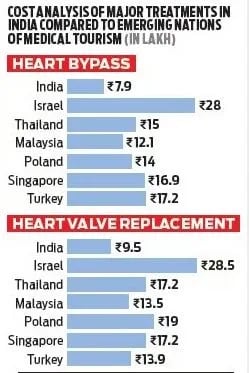
- Shorter Wait Times: Medical tourists can access timely treatment, often avoiding long wait times common in some Western healthcare systems.
- Government Support and Policies: The Indian government has implemented policies that encourage medical tourism, including medical visa facilitation and promoting the sector internationally.
Significance for India
- Economic Growth: It boosts the economy by generating revenue from international patients, contributing to the healthcare sector and related industries (e.g., hospitality, transportation).
- Improved Healthcare Infrastructure: To cater to medical tourists, hospitals invest in state-of-the-art facilities, which also benefits local patients by improving overall healthcare quality.
- Promotion of India’s Global Image: It enhances India’s reputation as a global healthcare destination, attracting more foreign investment and partnerships in the medical field.
- Technological Advancements: The demand for advanced treatments and international standards of care drives innovation and the adoption of new medical technologies in Indian healthcare.
- Skill Development: It fosters the development of a highly skilled workforce, as healthcare professionals gain exposure to international standards and diverse patient needs.
- Diplomatic Ties: As patients from different nations seek treatment in India, they are exposed to rich cultural heritage and hospitality.
- This exchange of experiences can foster greater understanding and goodwill between nations, paving the way for strengthened diplomatic ties.
Challenges
- Strong competition from Malaysia, Thailand and Singapore.
- Most of the medical care is not covered by insurance and it makes medical value travel (MVT) less attractive.
- The MVT facilitators are not well organized and accredited. Many unprofessional agents exploit the travellers.
- Lack of Regulations: There are no comprehensive regulations to govern the MVT sector, which leaves the sector unorganised and lacks monitoring of the quality of services.
- Lack of Promotion: Individual Hospitals are carrying out their publicity but there is no effective campaign to establish India as a brand for medical value travel.
- Accreditation: India maintains a robust accreditation system through National Accreditation Board for Hospitals and Healthcare Providers (NABH).
- There is not much awareness about NABH in foreign countries and international patients still attach much greater value to Joint Commission International (JCI) accreditation.
Way Ahead
- Opportunities for India:
- Demand from Countries with Aging Population: There will be increased demand for healthcare services from countries with an aging population.
- Long waiting periods in Developed Countries: In many developed countries, there is a shortage of supply, which results in long waiting periods.
- India has invested heavily in AYUSH and is in a unique position to attract medical value travellers for a cure through AYUSH and also for enhancing wellness.
- There is a need for greater support from the Government towards regulation, facilitation and marketing of India as a Medical Value Travel destination.
Source: TH
Previous article
News In Short 17-03-2026
