



Golestan Palace
Syllabus: GS1/ Art & Culture
In News
- Tehran’s Golestan Palace, a UNESCO World Heritage Site, sustained damage from shockwaves and debris caused by US-Israel airstrikes.
About
- Golestan Palace is a historic royal complex that served as the official residence of the Qajar dynasty and is one of the oldest historic monuments in Tehran.
- The origins of the complex date back to the Safavid Dynasty, when Tehran first gained importance as a political centre. Later rulers expanded and renovated the palace complex.
- Golestan Palace reflects a blend of traditional Persian architecture and Western influences introduced during the 19th century.
- Inscribed by UNESCO in 2013, it preserves cultural archives, early Iranian photography, and sites of historic coronations.
Important Structures within the Complex
- Shams-ol-Emareh (Edifice of the Sun): One of the most famous buildings in the palace complex.
- It was built in the 1860s by Naser al-Din Shah Qajar.
- Marble Throne Hall (Takht-e-Marmar): Used for royal coronations and official ceremonies.
- Mirror Hall: Famous for extensive mirror mosaics and luxurious decoration.
- Museum Buildings: The complex houses several museums displaying Qajar-era paintings & royal gifts and artefacts.
Source: TH
High Chances of El Niño After July: WMO
Syllabus: GS1/Geography
In News
- The World Meteorological Organization forecasts a high likelihood of El Niño developing in the latter half of 2026, following the fading of the current La Niña into ENSO-neutral conditions.
El Niño-Southern Oscillation (ENSO)
- It is a recurring natural phenomenon characterised by fluctuating ocean temperatures in the equatorial Pacific, coupled with changes in the atmosphere, which have a major influence on climate patterns in various parts of the world.
- Phases :
- El Niño: It refers to an abnormal Warming of the central and eastern tropical Pacific Ocean. It is known to suppress monsoon rainfall.
- It weakens easterly winds or reverses them; reduces rainfall over Indonesia and increases it over the tropical Pacific.
- La Niña – Cooling of the central and eastern tropical Pacific Ocean; strengthens easterly winds; increases rainfall over Indonesia and decreases it over the central tropical Pacific.
- Neutral – Sea surface temperatures are near average; neither El Niño nor La Niña dominates, though sometimes ocean and atmosphere conditions may not fully align.
- El Niño: It refers to an abnormal Warming of the central and eastern tropical Pacific Ocean. It is known to suppress monsoon rainfall.
- Impacts on India : In India, El Niño is associated with decreased rainfall and higher temperatures, while La Niña is associated with increased rainfall and hence lower temperatures.
Source :IE
United Nations Convention on the Law of the Sea (UNCLOS)
Syllabus: GS2/IR
Context
- The Iranian frigate IRIS Dena was reportedly sunk off the south-western coast of Sri Lanka after a torpedo strike by a United States Navy submarine.
About About United Nations Convention on the Law of the Sea (UNCLOS)
- UNCLOS is a comprehensive international treaty that establishes the legal framework for governance of oceans and seas.
- Adopted in 1982 at Montego Bay, Jamaica and entered into force in 1994.
- It defines:
- Maritime boundaries of coastal states
- Rights and duties of states in maritime zones
- Rules for navigation, resource exploitation, and environmental protection
- Because of its extensive scope, it is commonly referred to as the “Constitution of the Oceans.”
- Membership: 168 parties, including the European Union.
- Countries such as India, Japan, and China are parties.
- The United States has signed but not ratified the convention.
Maritime Zones under UNCLOS
UNCLOS divides the oceans into several legal zones, each with different rights and responsibilities.
- Territorial Sea: Extends up to 12 nautical miles from a coastal state’s baseline. The coastal state has full sovereignty over these waters. Foreign ships enjoy the right of innocent passage.
- Contiguous Zone: Extends 12–24 nautical miles from the baseline. Coastal states can enforce laws relating to Customs, immigration, sanitation & security.
- Exclusive Economic Zone (EEZ): Extends up to 200 nautical miles. The coastal state has exclusive rights over natural resources. However, other states retain freedom of navigation and overflight.
- High Seas (International Waters): Areas beyond the EEZ of any state. No country has sovereignty over them. Governed by international law and UNCLOS principles.
Source: TH
India renews Bilateral Swap Arrangement with Japan
Syllabus: GS2/ International Relation
In News
- India has renewed its Bilateral Swap Arrangement (BSA) with Japan with effect from 28th February, 2026.
About
- A currency swap involves exchanging cash flows in one currency for another under predefined terms, here facilitating rupee-yen-USD conversions. It acts as a safety net, deterring speculative attacks on currencies and enhancing RBI’s exchange rate management.
- India maintains multiple Currency Swap Arrangements (CSAs) including the SAARC framework (2024-27, $2 billion total), India-UAE ($50 billion equivalent), and India-Sri Lanka ($4 billion). The Japan pact underscores deepening Indo-Japanese economic ties under their Special Strategic Partnership.
- Renewal complements IMF facilities, boosts investor confidence, and supports regional financial resilience without altering the original 75 billion USD limit from prior agreements.
Source: AIR
International Atomic Energy Agency (IAEA)
Syllabus: GS2/ International Organisation
In News
- The Director General of the International Atomic Energy Agency (IAEA has said that there has been no evidence of Iran building a nuclear bomb.
About
- It was established in 1957 as the world’s “Atoms for Peace” organisation within the UN, and governed by its own founding treaty, the Statute of the IAEA.
- It serves as the UN’s nuclear watchdog, promoting peaceful atomic energy use while verifying safeguards against proliferation.
- Headquartered in Vienna, the body got the 2005 Nobel Peace Prize for non-proliferation efforts.
- The IAEA has 178 member states, India being one of the founding members of it.
Source: TH
Nucleic Acid Test (NAT)
Syllabus: GS2/ Health
In News
- The Supreme Court of India has agreed to examine a petition seeking mandatory Nucleic Acid Testing (NAT) in all blood banks, viewing safe blood transfusion as part of the right to life under Article 21.
About NAT
- NAT is a molecular technique that amplifies and detects viral RNA or DNA directly, identifying infections like HIV, Hepatitis B, and C earlier than antibody-based ELISA tests.
- It reduces transfusion-transmitted infections (TTIs) risks by screening during the window period when antibodies are absent.
Source: TH
Project HANUMAN
Syllabus: GS3/ Environment
In News
- Project HANUMAN is a new initiative by the Andhra Pradesh government to mitigate human-wildlife conflicts through advanced rescue, monitoring, and community protection measures.
About
- Its full name is Healing and Nurturing Units for Monitoring, Aid and Nursing of Wildlife.
- It targets forest-fringe areas prone to incidents like elephant raids and snake bites, promoting coexistence via scientific tools and local involvement.
Key Features
- 100 GPS-enabled vehicles, 93 rapid response units and 7 wildlife ambulances for quick rescues and aid.
- Four rescue centers in Visakhapatnam, Rajamahendravaram, Tirupati, and Birlut (or Byrluti).
- ‘Vajra’ volunteer teams at village level for minor incidents like snake rescues.
- AI systems for tracking animal movements and early warnings to settlements.
- HANUMAN app for reporting conflicts and coordination.
- Enhanced compensation like ₹10 lakh for human deaths, ₹2 lakh for injuries, market value for livestock.
Source: DTE
Sungudi Saris
Syllabus: GS1/Art and Culture
In News
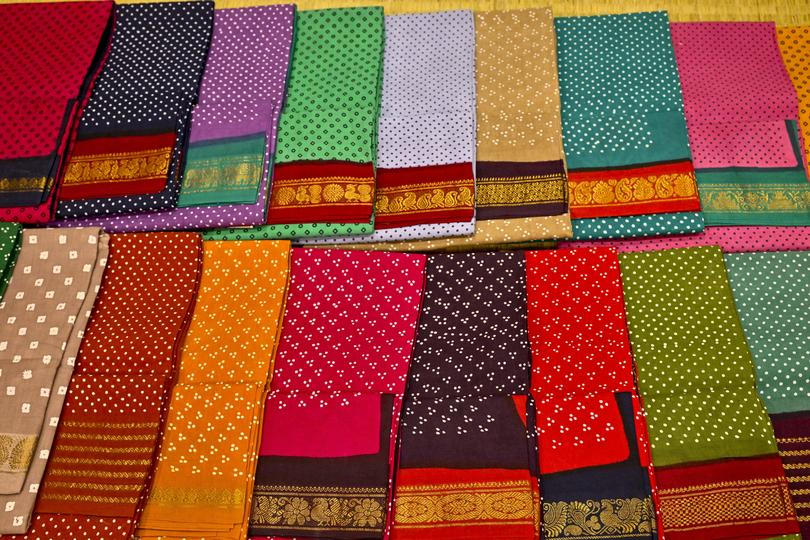
- Sungudi sarees are gaining popularity among consumers looking for distinctive and eco-friendly fashion.
Sungudi saris
- Sungudi saris are traditional cotton saris which are Perfected by the Saurashtrian community, who migrated from Gujarat to Madurai (Tamil Nadu) in the 17th century.
- It features intricate tie-and-dye patterns inspired by the night sky. Each sari, woven on a base cloth with a zari border.
- It is hand-knotted, dyed, washed, starched, and sun-dried, often revealing over 15,000 delicate white dots.
- The process takes more than 15 days, producing breathable, culturally rich garments prized across generations.
- The Madurai Sungudi sari received the Geographical Indication (GI) tag in December 2005.
Source :TH
Previous article
World Obesity Atlas 2026
