



Syllabus: GS2/International Relations
Context
- Recently, India and Canada signed a $1.9 billion, 10-year uranium supply agreement and committed to conclude a Comprehensive Economic Partnership Agreement (CEPA) in 2026.
- It marks an effort by both countries to rebuild strategic trust after several years of diplomatic tensions.
India–Canada Relations
- Establishment of Diplomatic Relations: India and Canada established diplomatic relations in 1947, soon after India’s independence.
- Both countries are members of the Commonwealth of Nations, which initially shaped their diplomatic engagement.
- Canada opened its High Commission in New Delhi in 1947, while India established its mission in Ottawa soon thereafter.
- Early Cooperation (1950s–1970s): India and Canada maintained close cooperation in development and nuclear energy.
- Canada supported India’s nuclear energy programme for peaceful purposes by supplying CIRUS (Canada–India Reactor, US) research reactor.
- Canada assisted in setting up reactors at the Rajasthan Atomic Power Project (RAPP) in the 1960s.
- Strained Relations After 1974: Relations deteriorated after India conducted its first nuclear test (Pokhran-I) in 1974.
- Canada alleged that plutonium from the CIRUS reactor contributed to the nuclear test, and suspended nuclear cooperation with India.
- Gradual Normalisation (2000s Onwards): Relations began improving in the early 21st century. Key developments included:
- The 2008 India–US Civil Nuclear Agreement and the NSG waiver, which allowed India to engage in international nuclear trade.
- In 2010, India and Canada signed a Civil Nuclear Cooperation Agreement.
- In 2015, Canada agreed to supply uranium to India through Cameco Corporation.
Present Status of India-Canada Relations
- Uranium Supply Agreement (2026): Canada’s Cameco Corporation will supply around 10,000 tonnes of uranium to India over a long-term period from 2027 to 2035, valued approx $1.9 billion.
- Strategic Energy Partnership: India and Canada announced a Strategic Energy Partnership covering multiple sectors like Uranium supply and nuclear energy cooperation; Renewable energy development; Liquefied Petroleum Gas (LPG) cooperation; and Collaboration in critical and emerging technologies.
- Additionally, Canada agreed to join two India-led global initiatives i.e. International Solar Alliance (ISA), and Global Biofuel Alliance.
- Comprehensive Economic Partnership Agreement (CEPA): India and Canada agreed on Terms of Referencefor CEPA negotiations with the aim of concluding the agreement within the year.
- Expected Outcomes are expansion of trade in goods and services; investment promotion; supply-chain cooperation; and economic diversification
- Both countries aim to double bilateral trade by 2030.
- Security Cooperation: The joint statement highlighted plans to strengthen cooperation in counterterrorism, combating violent extremism, organized crime, and intelligence sharing.
- Both sides agreed to convene an early meeting of the Joint Working Group on Counterterrorism.
Significance for India
- Strengthening India’s Nuclear Fuel Security: Ensures stable nuclear fuel supply for India’s civilian nuclear reactors.
- It supports India’s plan to expand nuclear power capacity from about 9 GW to 100 GW by 2047.
- Strengthens India’s energy security and supports low-carbon energy generation.
- The deal reduces risks related to fuel shortages or geopolitical supply disruptions.
- Diversification of Uranium Sources: The agreement is part of India’s broader strategy to diversify uranium imports.
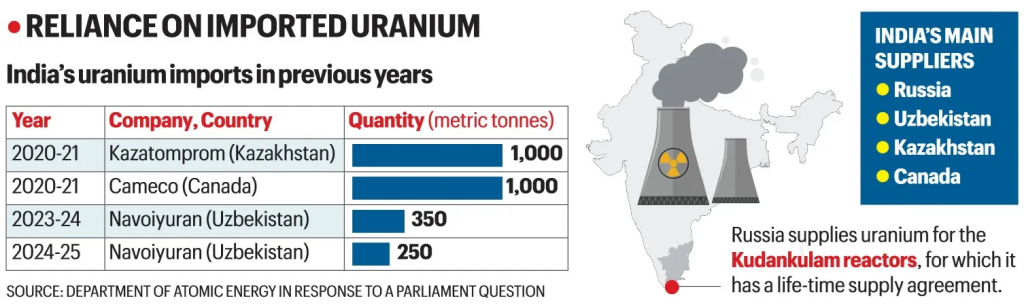
- India already imports uranium from Kazakhstan, Uzbekistan, Russia, and now Canada under long-term contracts.
- In the future, India may also procure uranium from Australia, and the United States, and Indian companies are also exploring overseas uranium mining opportunities.
- Diversification improves energy security and supply resilience.
- Strategic Partnerships: Enhances cooperation with a major G7 country.
- Economic Gains: Potential increase in trade, investment, and technology cooperation through CEPA.
- Global Climate Goals: Supports India’s commitments to low-carbon energy and renewable transition.
Why Does India Depend on Imported Uranium?
- Low Grade Domestic Uranium: Although India possesses uranium deposits, the ore quality is relatively low, ranging from 0.02% to 0.45% uranium content, compared to the global average of 1–2%.
- In contrast, some mines in Canada contain ore grades as high as 15%, making extraction significantly more economical.
- Import Dependence: Due to the low-grade nature of domestic reserves:
- Over 70% of India’s uranium requirements are met through imports.
- India consumes roughly 1,500–2,000 tonnes of uranium annually.
- In 2025, the requirement was about 1,884 tonnes.
- Even with expanded domestic mining, India is expected to meet only around 30% of its future uranium demand domestically.
Domestic Uranium Production in India
- Major Mining Regions: Uranium mining in India is currently concentrated in a few regions ie Jharkhand, and Andhra Pradesh.
- Seven mines are currently operational, managed primarily by Uranium Corporation of India Limited (UCIL).
- Other states with uranium deposits include Meghalaya, Rajasthan, and Telangana.
Uranium Reserves
- Total uranium ore reserves: about 4.3 lakh tonnes;
- Reserves allocated to UCIL mines: more than 80,000 tonnes;
- About 40% of these reserves have already been extracted, highlighting the need for both new exploration and diversified imports.
India’s Three-Stage Nuclear Programme
- Stage 1: Pressurised Heavy Water Reactors (PHWRs): Use natural uranium as fuel. Produce plutonium as a by-product.
- Most of India’s current nuclear reactors belong to this stage.
- Stage 2: Fast Breeder Reactors (FBRs): Use plutonium-based fuel. Produce more fissile material than they consume.
- India’s Prototype Fast Breeder Reactor (PFBR) at Kalpakkam is close to becoming operational.
- Stage 3: Thorium-Based Reactors: Use thorium to produce Uranium-233 as fuel. Aim to achieve long-term energy independence.
- India possesses one of the world’s largest thorium reserves, making this stage crucial for future energy security.
Challenges Ahead
- Diplomatic tensions related to Khalistani activism and the Nijjar case;
- Domestic political pressures in both countries;
- Implementation challenges in trade negotiations;
- Slow progress in the three-stage nuclear programme;
- Environmental and safety concerns regarding nuclear energy;
- High cost of nuclear power projects;
- Limited domestic uranium production.
Conclusion
- India’s recent uranium supply agreements with Canada represent a major step toward securing the fuel required for its ambitious nuclear energy expansion.
- Its long-term strategy remains focused on developing thorium-based reactors through its three-stage nuclear programme while imports will continue to play a dominant role due to low-grade domestic reserves.
- If successfully implemented, it could significantly enhance energy security, reduce carbon emissions, and strengthen India’s strategic autonomy in the global energy landscape.
Previous article
News In Short 02-03-2026
Next article
Anthropic–U.S. Defense Clash Over AI Safety
