

Syllabus: GS3/Science and Technology
In News
- India is entering an AI-driven era where technology is transforming daily life by improving healthcare, supporting farmers and enhancing education.
What is Artificial Intelligence?
- Artificial Intelligence (AI) is the ability of machines to perform tasks that normally require human intelligence.
- It enables systems to learn from experience, adapt to new situations, and solve complex problems independently.
- It uses datasets, algorithms, and large language models to analyse information, recognise patterns, and generate responses.
- Over time, these systems improve their performance, allowing them to reason, make decisions, and communicate in ways similar to humans.
Applications
- AI in daily life: Artificial Intelligence is improving healthcare, agriculture, education, governance, and climate services by making processes faster, smarter, and more accessible.
- Large Language Models power chatbots, translation tools, and virtual assistants, helping people access information, government services, and learning in their own languages.
- Healthcare: Early disease detection, medical image analysis, and personalised treatment support.
- AI-enabled telemedicine connects rural patients with specialists.
- Global collaborations and participation in HealthAI promote ethical and safe AI use.
- Agriculture: AI predicts weather, detects pests, and advises on irrigation and sowing.
- Initiatives like Kisan e-Mitra, National Pest Surveillance System, and Crop Health Monitoring improve farm productivity and income security.
- Education and Skilling: AI education introduced under NEP 2020 from Class VI onwards.
- DIKSHA platform uses AI for accessibility, including read-aloud and search tools.
- YUVAi programme enables students (Classes 8–12) to apply AI across social and development themes.
- Governance and Justice Delivery: AI supports translation, case management, scheduling, and citizen services under the e-Courts Project.
- Judgments are translated into regional languages, improving transparency and access to justice.
- Weather Forecasting and Climate Services: AI models improve prediction of rainfall, cyclones, fog, lightning, and fires.
- Tools like the Advanced Dvorak Technique and upcoming MausamGPT support farmers and disaster management.
AI Ecosystem in India at Present
- India’s technology sector is expanding rapidly, with annual revenues projected to cross USD 280 billion this year.
- Over 6 million people are employed in the tech and AI ecosystem.
- India hosts 1,800+ Global Capability Centres, including more than 500 focused on AI.
- India has around 1.8 lakh startups, and nearly 89% of new startups launched last year used AI in their products or services.
- Artificial Intelligence is often seen as a threat to jobs, but in reality, it is creating new kinds of opportunities.
- According to NASSCOM’s report “Advancing India’s AI Skills” (August 2024), India’s AI talent base is expected to grow from about 6 to 6.5 lakh professionals to more than 12.5 lakh by 2027, at a compound annual growth rate of 15 percent.
- Leading sectors in AI adoption include industrial and automotive, consumer goods and retail, banking, financial services and insurance, and healthcare.
- Together they contribute around 60 percent of AI’s total value.
- About 26% of Indian companies have achieved AI maturity at scale, according to a recent BCG survey.
Global Rankings
- India has secured the 3rd position globally in Artificial Intelligence competitiveness, according to a report by Stanford University’s 2025 Global AI Vibrancy Tool. The ranking emphasises India’s rapid growth in the global AI landscape.
Related Steps
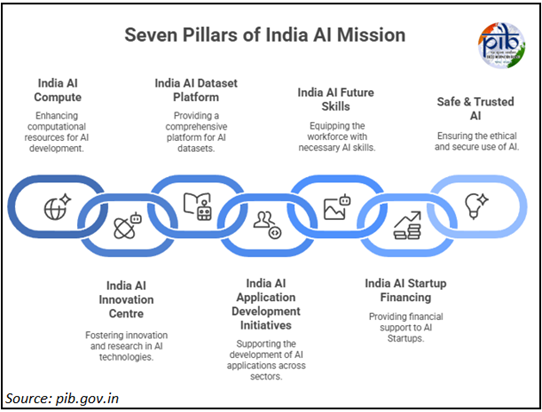
- The India AI Mission, approved in March 2024 with a budget of ₹10,371.92 crore over five years, aims to make India a global leader in Artificial Intelligence under the vision “Making AI in India and Making AI Work for India.”
- It has significantly expanded AI computing infrastructure, increasing GPU availability from an initial target of 10,000 to 38,000, enabling affordable access to advanced AI resources.
- Artificial Intelligence was a key focus at the 9th India Mobile Congress (IMC) 2025, inaugurated by Prime Minister Narendra Modi under the theme “Innovate to Transform,” .
- The Government of India is actively implementing its AI vision through comprehensive initiatives that combine policy, infrastructure, research, and skill development to build an inclusive AI ecosystem.
- Key efforts include establishing Centres of Excellence in Healthcare, Agriculture, Sustainable Cities, and Education, along with National Centres of Excellence for Skilling to prepare a future-ready workforce.
- The AI Competency Framework trains government officials in applying AI to governance, while partnerships like Sarvam AI with UIDAI are enhancing public services through secure, sovereign AI models.
- Platforms such as Bhashini promote digital inclusion by enabling multilingual access to services, and BharatGen AI represents India’s first government-funded, homegrown multimodal large language model supporting 22 Indian languages.
Concerns and Issues
- AI-powered facial recognition and policing raise civil liberty concerns due to lack of regulation.
- Next-gen AI models may pose high Cybersecurity Risks if misused for hacking or fraud.
- IndiaAI notes hurdles like affordability, data quality, and infrastructure gaps that slow AI adoption.
- AI systems risk perpetuating biases in credit scoring, recruitment, and governance if not carefully monitored.
Conclusion and Way Forward
- Artificial Intelligence offers immense potential to accelerate India’s development across sectors like justice and education, but unregulated use can threaten privacy, fairness, and accountability.
- To harness its benefits responsibly, India must balance innovation with strong ethical frameworks, invest in skilling and inclusion to address job displacement, build global partnerships while protecting national interests, and ensure transparency and accountability in AI deployment.
- Key initiatives such as the IndiaAI Mission and foundational model development ensure that AI benefits every citizen, strengthens skills and research, and positions India as a global AI leader aligned with the vision of Viksit Bharat 2047.
Source :PIB
Previous article
Farmer Suicides in India: 28 Years of Data
Next article
News In Short 01-01-2026
