

Syllabus: GS3/ Science and Technology
Context
- 2025 has been declared the International Year of Quantum Science and Technology by UNESCO, marking 100 years since the formal development of quantum mechanics in 1925.
- The milestone commemorates the Helgoland breakthrough by Werner Heisenberg, which laid the foundations of modern quantum theory.
What is Quantum Mechanics?
- Quantum mechanics is the branch of physics that explains the behaviour of matter and energy at atomic and subatomic scales.
- It departs from classical Newtonian physics and is based on principles such as quantisation of energy, wave–particle duality, uncertainty, and superposition.
- It explains how extremely small objects simultaneously have the characteristics of both particles (tiny pieces of matter) and waves (a disturbance or variation that transfers energy).
- Domains of quantum technologies:
- Quantum communication: It applies the properties of quantum physics to provide better security and improved long-distance communications.
- Quantum simulation: It refers to the use of a quantum system to simulate the behavior of another quantum system.
- Quantum computation: It is a field of computing that utilizes the principles of quantum mechanics to perform certain types of calculations more efficiently than classical computers.
- Quantum sensing and metrology: It leverages the principles of quantum mechanics to achieve highly precise measurements.
Evolution of Quantum Theory
- 1900: Max Planck proposed that energy is emitted in discrete packets called quanta while explaining black-body radiation.
- 1905: Albert Einstein used the quantum idea to explain the photoelectric effect, establishing light as consisting of photons.
- 1913: Niels Bohr applied quantum ideas to explain the structure of the hydrogen atom.
- 1925: Werner Heisenberg, during his stay at Helgoland, formulated matrix mechanics, the first complete framework of quantum mechanics.
- 1925–26: Max Born and Pascual Jordan provided the mathematical foundation using matrix algebra.
- 1926: Erwin Schrödinger developed the wave equation, offering an alternative but equivalent formulation.
- 1927: Paul Dirac unified quantum mechanics and relativity principles, describing it as a complete theory of dynamics.
Indian Contributions to Quantum Theory
- Satyendra Nath Bose: His work led to the prediction of Bose–Einstein Condensate, experimentally confirmed decades later.
- C V Raman: His discovery of the Raman Effect (1928) provided direct experimental proof of quantum interactions between light and matter, earning India its first Nobel Prize in science (1930).
Application of Quantum Technology
- Electronics and Computing: Enabled semiconductors, transistors, integrated circuits, and modern computers.
- Communication and Navigation: Basis of lasers, optical fibre communication, atomic clocks, and GPS systems.
- Healthcare and Medicine: Applications in MRI scanners, nuclear imaging, radiation therapy, and advanced diagnostics.
- Energy and Materials: Supports nuclear power generation and development of advanced materials and sensors.
- Emerging Technologies: Foundation for quantum computing, quantum communication, precision sensing, and ultra-secure data transmission.
National Quantum Mission (NQM)
- The government approved the NQM in 2023 from 2023-24 to 2030-31.
- Aim: To seed, nurture and scale up scientific and industrial R&D and create a vibrant & innovative ecosystem in Quantum Technology (QT).
- The Mission objectives include developing intermediate-scale quantum computers with 50-1000 physical qubits in 8 years in various platforms like superconducting and photonic technology.
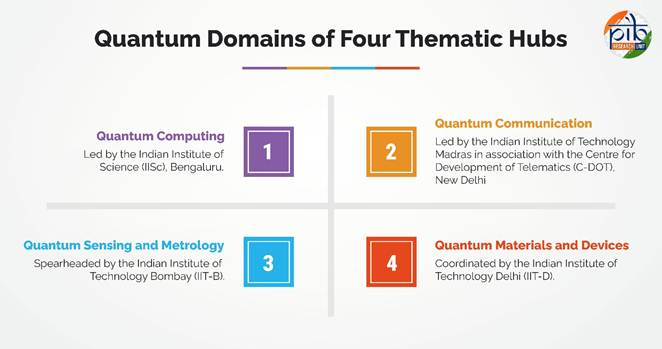
- Implementation: Setting up of four Thematic Hubs (T-Hubs) in top academic and National R&D institutes.
Challenges of Quantum Technology
- Decoherence: Quantum states are highly sensitive to environmental interactions, leading to loss of coherence and system instability.
- Quantum Measurement and Control: Precise measurement and manipulation at the quantum level are difficult due to noise, disturbances, and the fragile nature of quantum states.
- Scalability and Error Correction: Expanding quantum systems for practical use requires complex error-correction mechanisms and large numbers of qubits.
- Cost and Accessibility: Quantum technologies are expensive and resource-intensive.
Way Ahead
- Strengthening Research: Ensure sustained public funding for fundamental research in quantum physics to bridge gaps between theory and application.
- Capacity Building: Develop skilled human resources through specialised courses, interdisciplinary programmes, and global research collaboration.
- Public–Private Partnerships: Encourage start-ups and industry participation for scaling prototypes into commercially viable products.
Source: IE
