


Ulcerative colitis (UC)
Syllabus: GS2/Health
Context
- A new study has suggested that ulcerative colitis may be triggered when a normally hidden layer of immune cells, located just beneath the gut lining, becomes thinner.
About
- Ulcerative colitis (UC) is a chronic inflammatory bowel disease (IBD) that causes long-lasting inflammation and ulcers in the inner lining of the large intestine (colon) and rectum.
- It is an auto-inflammatory/immune-mediated condition with periods of flare-ups and remission.
- Causes: Immune system dysfunction attacking the gut lining, Genetic susceptibility, environmental factors (diet, infections, gut microbiome imbalance).
- Management:
- Anti-inflammatory drugs, steroids for flares, immunosuppressants and biologics, surgery in severe or refractory cases (can be curative).
Source: TH
National Test House
Syllabus: GS3/Economy
In News
- The National Test House (NTH) will be empanelled as a recognised laboratory for NHAI. It will send samples related to highway construction and allied works to NTH laboratories across the country for testing and inspection.
National Test House (NTH)
- It is India’s largest multi-location multidisciplinary industrial central government’s testing laboratory dealing with almost all sorts of testing, calibration and quality evaluation related to industry, commerce, trade etc. as per international and national standards.
- It was established in 1912 under the Department of Consumer Affairs, Ministry of Consumer Affairs, Food & Public Distribution.
- It is a leading scientific testing and quality assurance organisation with a pan-India presence.
Importance
- This would improve transparency, standardisation and efficiency in quality assurance processes.
- It will help enhance the safety, durability and performance of national highways and support the Government of India’s vision of strong, reliable and world-class infrastructure.
Source :PIB
JIVA Programme
Syllabus: GS3/ Environment/ Agriculture
Context
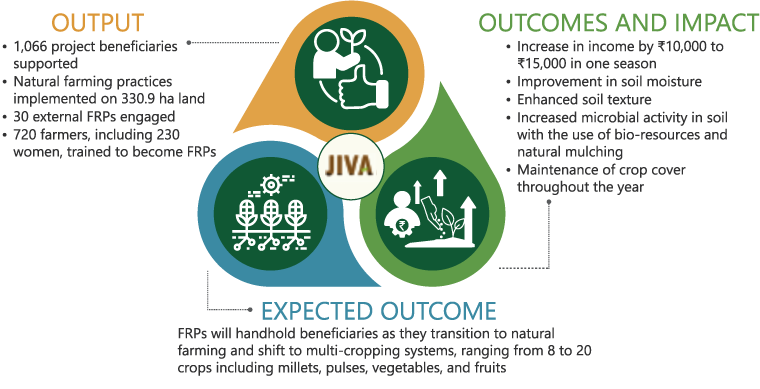
- The JIVA programme in drought-prone Nanded district of Marathwada has been beneficial for small and marginal farms.
Components of JIVA Programme
- The JIVA programme (Joint Initiative for Village Advancement), launched in 2022 by the National Bank for Agriculture and Rural Development (NABARD), is an agroecology-based initiative to promote natural farming in India.
- The program is implemented in three phases viz., Learning Phase and Upscaling and Consolidation phases.
- Objectives of the Programme:
- Promote long-term sustainability of farming systems using natural and low-cost inputs.
- Strengthen resilience against climate variability and drought through ecological methods.
- Enhance soil health, biodiversity, and food security in rural landscapes.
- Facilitate a shift from input-intensive to ecosystem-based agriculture for small and marginal farmers.
- Focus Areas: Implemented in existing watershed and tribal development projects in ecologically sensitive regions.
Source: DTE
Alternate Wetting and Drying (AWD)
Syllabus: GS3/Agriculture
Context
- Alternate Wetting and Drying (AWD) offers Indian rice farmers a simple way to save water, cut methane emissions, and earn carbon income without reducing yields.
About
- Conventional rice farming uses flooded fields to suppress weeds, but the resulting anaerobic soil promotes methane-producing microbes, emitting methane—a greenhouse gas 28 times more potent than CO₂.
- Methane is responsible for 30% of global warming, and rice farming contributes 12% of the overall methane emissions stack.
- Globally, conventional rice farming contributes to the same amount of GHGs as the aviation industry.
- Under AWD, the paddy fields, instead of being constantly flooded, are periodically dried out before re-flooding. The idea is to disrupt the waterlogged anaerobic conditions conducive to methane-producing microbes.
- Simple water tubes, approximately 30 cm long, with perforations across the submerged half, are used to measure the depth of the water table.
- Practice: Flood paddy fields for the first 20 days after transplanting.
- Between day 21–65: two dry cycles of ~6 days each.
- Significance:
- India is the world’s largest rice producer and exporter, AWD aligns food security, water conservation and climate mitigation.
- It supports India’s NDC targets and climate-resilient agriculture agenda.
Source: IE
Carbon Border Adjustment Mechanism (CBAM)
Syllabus: GS2(IR)/GS3/Environment
In News
- The European Union has begun rolling out the Carbon Border Adjustment Mechanism (CBAM), which will significantly impact steel and aluminium exporters.
- This comes at a difficult time for Indian metal exporters, who are already facing a 50% duty on exports to the US.
Carbon Border Adjustment Mechanism (CBAM)
- It was introduced in 2023, taxes certain imported goods based on the carbon emissions generated during their production.
- It is an import duty imposed by the European Union on goods produced outside Europe.
- It applies to products made using processes with higher carbon emissions than those permitted for European manufacturers.
- The objective is to prevent “carbon leakage”, where production shifts to countries with weaker climate rules.
- It is in a transitional phase from 2023 to 2025 and will fully come into force in 2026.
- Coverage: Under CBAM, imports are taxed based on the carbon emissions generated during their production.
- CBAM currently covers steel, aluminium, cement, electricity, fertilizers, and some other goods, though India exports limited quantities of non-metal products to the EU.
Criticisms
- Developing countries such as India and China have strongly opposed the EU’s Carbon Border Adjustment Mechanism (CBAM), calling it a unilateral and unfair trade barrier that violates international trade and climate agreements.
- They have repeatedly raised their concerns at global platforms, including climate conferences, but the European Union has remained firm.
- BRICS nations condemned CBAM as a discriminatory, protectionist measure imposed under the guise of environmental concerns.
Impacts on India
- India is the second-largest exporter of steel and aluminium to the EU, after China.
- Since most Indian steel is produced using blast furnaces, which are carbon-intensive, Indian exports will face higher costs.
- As a result, exports to the EU may become economically unviable, pushing Indian companies to explore alternative markets in Africa and West Asia.
- There is uncertainty about whether CBAM will be applied at a company level or country level.
- The Indian government is seeking a CBAM exemption through an ongoing free trade agreement (FTA) negotiation with the EU.
Source :TH
National Frequency Allocation Plan 2025 (NFAP-2025)
Syllabus: GS2/Governance/GS3/Economy
In News
- The Department of Telecommunications (DoT), Ministry of Communications, released the National Frequency Allocation Plan 2025 (NFAP-2025).
National Frequency Allocation Plan 2025
- It is a key policy document that governs the management and allocation of radio-frequency spectrum in India.
- It will provide the allocation of radio-frequency spectrum to various radio-communication services in the frequency range 8.3 kHz to 3000 GHz.
- It serves as an essential reference for spectrum managers, wireless operators, and telecom equipment manufacturers.
Key Enhancements in NFAP-2025
- NFAP-2025 introduces several strategic and future-ready revisions to meet the growing spectrum demand for next-generation technologies:
- Identification of the 6425–7125 MHz band for International Mobile Telecommunications (IMT), significantly enhancing mid-band spectrum availability for 5G, 5G Advanced, and future 6G networks.
- Allocation of Ka, Q, and V bands for satellite-based services, crucial for high-throughput Geo-Stationary Orbit (GSO) satellites and large non-GSO satellite constellations.
- Additional spectrum for In-Flight and Maritime Connectivity (IFMC) to ensure seamless broadband access in the air and at sea.
- Support for emerging technologies such as Vehicle-to-Everything (V2X) communication, LEO/MEO satellite services, and expanded broadband connectivity solutions.
| What is Satellite Spectrum? – Satellite spectrum refers to the specific radio frequency bands allocated for communication between Earth-based stations and satellites in orbit. – These frequencies enable services such as: a. Television broadcasting b. Satellite internet and broadband c. Navigation (GPS) d. Disaster management and emergency communication Regulatory Oversight – Unlike terrestrial spectrum (used by mobile towers), satellite spectrum is borderless. – Signals from satellites can cover multiple countries simultaneously. Hence, global coordination is required. – This role is performed by the International Telecommunication Union (ITU), a United Nations specialised agency. Why Satellite Spectrum is Important? – Rising demand for satellite broadband (LEO constellations), emergency and disaster communication, defence and navigation services. – Critical for remote, border, island, and underserved regions where terrestrial networks are weak or absent. |
Source :PIB
Previous article
Issues with Gig Workers in India
Next article
PM chairs 50th meeting of PRAGATI
