

Syllabus: GS2/Governance; Sports
Context
- Recently, a government-empowered task force led by Olympic gold medallist Abhinav Bindra has revealed serious systemic weaknesses and structural deficiencies within India’s sports governance framework.
| Task Force Mandate and Ambition – The government established the Task Force on Capacity Building of Sports Administrators on July 30 of the previous year, under Bindra’s chairmanship. – Its primary mandate was to develop a sustainable, professional, and future-ready governance system capable of positioning India among the world’s top-10 sporting nations and as a credible contender for hosting the 2036 Olympic Games. |
Key Findings: A System Under Strain
- Systemic Deficiencies in Key Sports Institutions: India’s major sports institutions, including the Sports Authority of India (SAI) and state sports departments, suffer from chronic understaffing, poor inter-agency coordination, and excessive reliance on generalist civil servants or short-term contractual employees lacking domain expertise.
- These shortcomings impede the effective implementation of national sports policies, weaken coordination with federations, and undermine India’s capacity to build a modern, athlete-centric ecosystem.
- Absence of Professional Sports Administration Framework: India is lacking a national institute or structured framework for sports administration and governance.
- It leaves sports administrators without defined career pathways, competency standards, or continuous professional development opportunities.
- India’s sports governance model remains ad hoc, with weak institutional memory and minimal long-term professionalisation.
- Findings on Institutional Shortcomings: The report points to systemic deficits across the entire sports ecosystem, including the Ministry of Youth Affairs and Sports; Sports Authority of India (SAI); Indian Olympic Association (IOA); National Sports Federations (NSFs); and State sports departments.
- Each of these bodies, according to the report, suffers from critical shortcomings in human resource planning, deployment, and institutional capacity, undermining overall effectiveness and efficiency.
Proposed Institutional Reforms
- National Council for Sports Education and Capacity Building (NCSECB): The task force proposes setting up the NCSECB under the Sports Ministry to:
- Regulate, accredit, and certify sports administration training programs.
- Develop India-specific curricula tailored to national needs.
- Promote dual career pathways for athletes transitioning into governance or management roles.
- Integration with Civil Services Training: The report recommends integrating sports administration education into IAS and state cadre programs, ensuring bureaucrats managing sports have domain-specific grounding to bridge the expertise gap.
- Global Exposure and Collaboration: The task force urges partnerships with international sports bodies and universities to offer global training opportunities for Indian administrators.
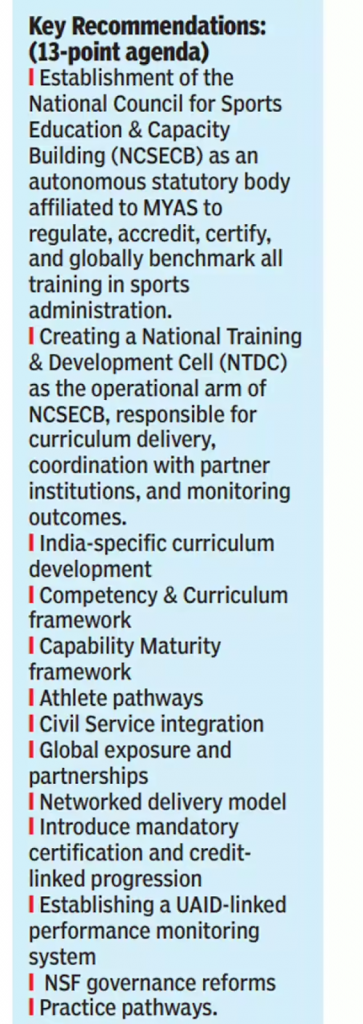
- Other recommendations include:
- Establishing a national institute for sports administration and management;
- Creating standardised competency benchmarks for administrators;
- Implementing long-term career progression frameworks;
- Enhancing coordination mechanisms between central, state, and federation-level bodies;
Government’s Commitment to Reform
- Commenting on the findings, the Sports Ministry affirmed the government’s resolve to implement the recommendations alongside the upcoming National Sports Governance Act.
- It plans to operationalise the roadmap as part of India’s long-term preparation for the 2036 Games.
Previous article
India’s 2025 Economic Reforms
