


Raulane Festival
Syllabus: GS1/ Art & Culture
In News
- The Raulane Festival Himachal Pradesh recently drew attention.
About Raulane Festival
- The Raulane Festival is an ancient, 5,000-year-old traditional festival celebrated in the Kinnaur district of Himachal Pradesh that honors mystical celestial fairies known as Saunis.
- Key elements of the festival include two men acting as the symbolic groom (Raula) and bride (Raulane), fully covered in traditional Kinnauri woollens, adorned with masks and ornaments to represent these mystical beings.
- The pair undertake a slow devotional procession and dance to the Nagin Narayan Temple.
- The dance and procession are seen as a channel between the human and spirit worlds, expressing gratitude, protection, and blessings for the community.
Source: TH
Adi Kumbeswarar Temple
Syllabus: GS1/Culture
Context
- The kumbabishekam (consecration) of the Adi Kumbeswarar Temple in Kumbakonam, Tamil Nadu, has brought renewed attention to the temple’s unique stone nagaswaram, a rare wind instrument preserved here.
About the temple
- The Adi Kumbeswarar Temple in Kumbakonam (Thanjavur district, Tamil Nadu) is dedicated to Lord Shiva, worshipped as Adi Kumbeswarar in the form of a lingam.
- The temple is an architectural landmark showcasing the key features of Dravidian architecture and is believed to be over 1,300 years old.
- The temple dates back to the Chola period (9th century CE) and was later renovated by the Nayak rulers.
- It is one of the 12 Shiva temples associated with the Mahamaham festival, held once every 12 years in Kumbakonam.
Source: TH
Senkaku Islands
Syllabus: GS1/Places
In News
- A China Coast Guard ship formation conducted a “rights enforcement patrol” near the Senkaku/Diaoyu Islands, escalating tensions with Japan.
The Senkaku Islands
- The Senkaku Islands” is the collective term that refers to a group of islands that includes Uotsuri, Kitakojima, Minamikojima, Kuba, Taisho, Okinokitaiwa, Okinominamiiwa, and Tobise
- They are part of Ishigaki City, Okinawa Prefecture.
- They are located in the East China Sea and are also situated approximately 170km from Taiwan and 330km from China.
- Dispute: The Senkaku Islands have long been a contentious issue in Japan-China relations, with both nations asserting historical claims over the uninhabited rocky chain.
- At present it is being controlled by the Japanese.
Source :TH
Quantum Clock
Syllabus: GS3/Science and Technology
Context
- Scientists are now studying how timekeeping works at the quantum level by analyzing Quantum Clock.
About
- Researchers found that measuring a quantum clock consumes vastly more energy than the clock’s own operation—up to a billion times more.
- Reason: Traditional clocks, from swinging pendulums to atomic oscillators, depend on irreversible processes to track time.
- At the quantum level, these processes become extremely weak or may barely occur at all, making accurate timekeeping much more difficult.
- Devices that rely on precise timing will need clocks that use as little energy as possible.
- The energy required to read the clock is roughly one billion times larger than the energy required to run the clock.
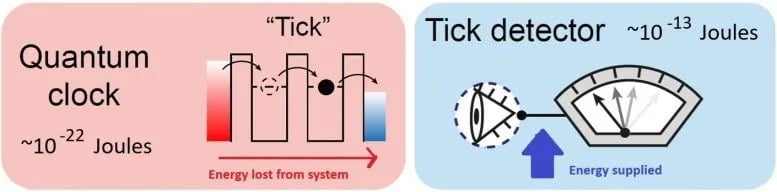
- Significance: This finding overturns the long-standing assumption that measurement costs in quantum physics are negligible.
- It also reveals a striking idea: observation is what gives time its direction by making the process irreversible.
- This result challenges the common belief that improving quantum clocks requires better quantum systems.
- Instead, the researchers argue that progress will depend on developing more efficient ways to detect and interpret the ticks.
Source: TH
Coronal Mass Ejection
Syllabus: GS3/Science and Technology
In News
- Astronomers have, for the first time, detected a coronal mass ejection (CME) on a star other than the Sun.
Coronal Mass Ejections (CMEs)
- Coronal mass ejections are massive bubbles of plasma and magnetic fields expelled from the Sun, often appearing as twisted “flux ropes.”
- They may accompany solar flares or occur independently, with frequency tied to the 11-year solar cycle—about once a week at solar minimum and up to 2–3 per day at solar maximum.
- CMEs disrupt solar wind, merge with Earth’s magnetic field, and transfer large amounts of energy into the magnetosphere.
- This makes them major drivers of geomagnetic storms and substorms, which can damage near-Earth systems but also produce spectacular auroras at high latitudes.
Source :TH
Siliguri Corridor
Syllabus: GS3/Internal Security
Context
- Indian Army sets up three new garrisons near the strategic Siliguri Corridor.
About
- There are security concerns amid the change of regime in Bangladesh and concerns over China’s growing presence near the vulnerable Siliguri Corridor.
- The newly operational stations are expected to strengthen the Army’s operational readiness and improve coordination with the Border Security Force.
About Siliguri Corridor
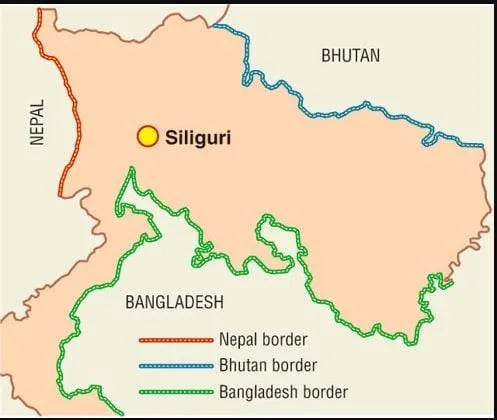
- It is also referred to as the Chicken’s Neck, is a narrow strip of land in West Bengal that connects the Northeastern States to the rest of the country.
- It is a very important strategic area of eastern India, located between Mahananda and Teesta river.
Significance of Siliguri Corridor
- Strategic Connectivity: If disrupted, it would isolate the north east states, making it difficult for the government to supply essential goods, services, and military support.
- Military and Defense Considerations: It lies close to sensitive international borders, particularly with China, Nepal, and Bangladesh.
- Securing it ensures unhindered movement of Indian forces and supplies in the event of a conflict.
- Geopolitical Vulnerability: The narrowness of the corridor makes it vulnerable to blockages or control by adversaries.
- Any disruption could sever India’s access to the northeast, giving external powers an opportunity to influence or destabilize the region.
Source: TH
Next article
The Trajectory of Anti-rape Laws in India
