

SC Asked HCs to Upload Details of Time Taken by Judges to Deliver Verdicts
Syllabus: GS2/Polity and Governance
Context
- The Supreme Court said all High Courts should put out in the public domain the time taken by their judges to pronounce verdicts in pending cases.
About
- There are no specific timelines within which judges have to deliver judgments.
- The convention is that the judiciary ought to pronounce judgments within a reasonable time, from two to six months, of reserving cases.
- However, judges, including in the Supreme Court and the High Courts, have in practice reserved judgments for well over a year before delivering them.
- This may be due to the complexity of the question of law involved or the burden of work.
Recommendations by SC
- There ought to be a dashboard on High Court websites, exclusively focussing on the reservation and pronouncement of judgments.
- This will show the transparency and accountability of the judiciary to the people.
- State High Courts to file reports on their existing mechanisms to bring into the public domain:
- the dates when pending judgments were reserved,
- the time taken between the reservation of judgments and their pronouncement,
- and when a pronounced judgment is actually uploaded on their official websites.
Significance
- Promotes judicial transparency and public trust.
- Helps in monitoring judicial efficiency and reducing delays in pronouncing judgments.
- Strengthens accountability mechanisms within the judiciary.
| Judiciary in India – Supreme Court: The highest court in India, with the authority to interpret the Constitution, adjudicate disputes between states and the center, and oversee the legality of laws and government actions. – High Court: Each state or group of states has a High Court, which handles appeals from lower courts and issues related to state-level legal matters. – District Courts handle civil and criminal cases at the district level, and various specialized courts such as family courts, consumer courts, and labor courts. – Each branch operates independently but is designed to work in harmony with the others, providing a system of checks and balances to ensure fair governance and adherence to the Constitution. |
Source: TH
GI Tag Fee Cut
Syllabus: GS3/Economy
In News
- Recently, the Government announced a reduction in the GI tag application fee from ₹5,000 to ₹1,000, encouraging tribal artisans to protect traditional crafts.
More About the News
- GI tag certificates distributed for crafts and products like Kannadippaya (Kerala), Apatani textile (Arunachal), Marthandam honey (Tamil Nadu), Lepcha Tungbuk (Sikkim), Bodo Aronai (Assam), Ambaji Marble (Gujarat), and Badri cow ghee (Uttarakhand).
Geographical Indications (GIs)
- They are a form of industrial property that identify products as originating from a specific place, where their quality or reputation is linked to that origin.
- They are recognized under the Paris Convention and TRIPS Agreement (Articles 22–24).
- GIs are part of international intellectual property rights. India, as a WTO member, enacted the Geographical Indications of Goods (Registration & Protection) Act, 1999, which came into effect on 15 September 2003.
- The first product in India to be accorded with GI tag was Darjeeling tea in the year 2004-05.
- Benefits: Legal protection to the products
- Prevents unauthorised use of GI tag products by others
- It helps consumers to get quality products of desired traits and is assured of authenticity
- Promotes the economic prosperity of producers of GI tag goods by enhancing their demand in national and international markets
Source :TH
Quantum Diamond Microscope
Syllabus: GS3/ S&T
In News
- India has developed its first indigenous Quantum Diamond Microscope (QDM) for dynamic magnetic field imaging, marking a major milestone in the field of quantum sensing.
About
- The technology allows for three-dimensional magnetic field imaging at the nanoscale, offering widefield visualization of dynamic magnetic activity similar to an optical microscope.
- This innovation holds immense potential in neuroscience, materials research, and the non-destructive testing of semiconductor chips, where it can map buried current paths and multilayer structures in 3D.
- QDM offers a transformative solution for high-resolution, 3D magnetic mapping across integrated circuits, microelectronics, and energy storage systems.
Source: DD News
Climate Risk Index (CRI) 2026
Syllabus: GS3/Disaster Management
Context
- The new Climate Risk Index (CRI) 2026 report has been released by Germanwatch.
- The analysis was presented at the ongoing COP30 in Belem, Brazil.
Key Findings
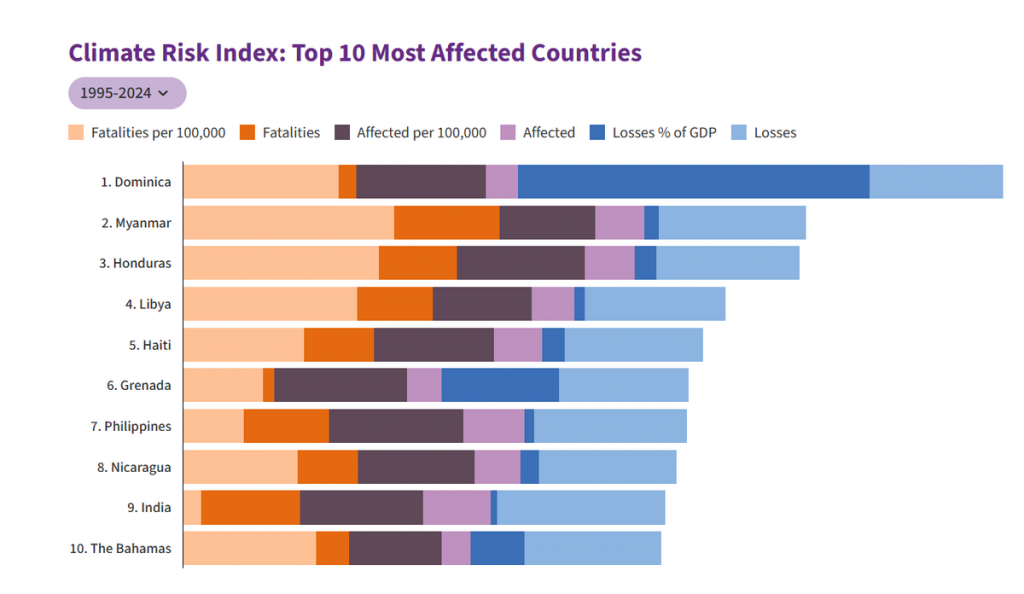
- India was ninth on the list of countries most affected by extreme weather events between 1995 and 2024.
- In the last three decades, India faced around 430 extreme weather events which resulted in inflation-adjusted losses of around $170 billion.
- Most People Affected: India ranked third behind Bangladesh and the Philippines.
- Continuous Threat Category: It has placed India, along with the Philippines, Nicaragua, and Haiti in the “continuous threats” category,
- This means that these countries are exposed to repeated and frequent extreme weather events.
Recommendations
- Global emissions have to be reduced immediately.
- Adaptation efforts must be accelerated.
- Effective solutions for loss and damage must be implemented, and adequate climate finance must be provided.
| – The CRI is calculated based on the economic and human effects of extreme weather events. 1. Higher the rank, the worse a country has been affected by extreme weather events. 2. The index, however, only analyses rapid onset events like storms, extreme temperatures, wildfires, glacial lake outbursts, and floods. 3. It does not include slow onset events like rising mean temperatures, sea level rise, ocean acidification, glacial retreat, etc. |
Source: TH
Previous article
India, Botswana Cheetah Translocation Pact
Next article
India, Nepal Ink Pact to Step Up Trade Ties
