
River Bank Erosion

Syllabus: GS1/Geography

Context

  • The Brahmaputra, Teesta, and Dharla rivers have become unpredictable, eroding land faster than ever before.

About Riverbank Erosion

  • Riverbank erosion is the wearing away of the banks of a river due to the continuous action of flowing water. 
  • It is a natural geomorphological process but can be accelerated by human activities or environmental changes.
  • When water flows along a river channel, it exerts shear stress on the riverbanks. 
    • Over time, this force removes soil, sand, and rock particles from the bank, leading to undercutting, collapse, and retreat of the riverbank.
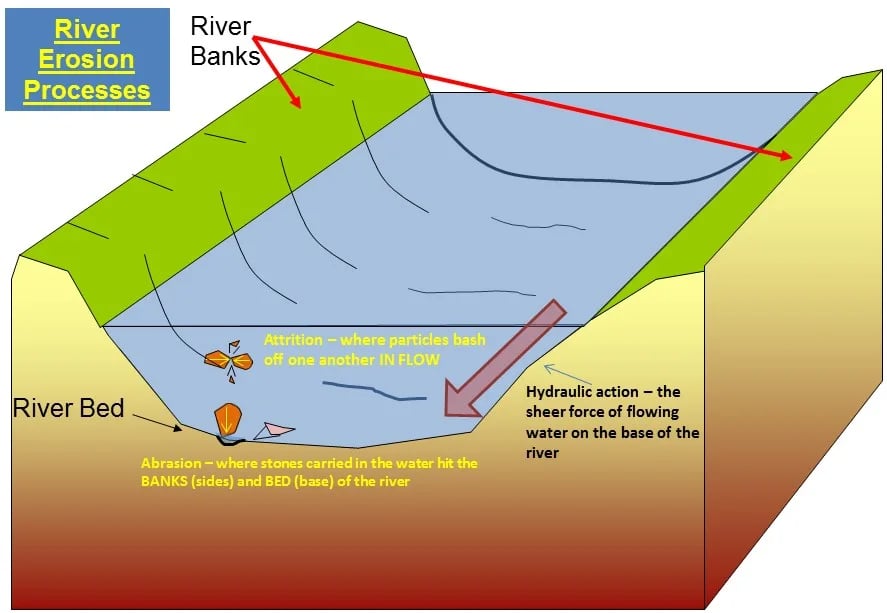
Causes of Riverbank Erosion

  • Natural Causes
    • Strong river currents: Fast-flowing water erodes the outer banks of bends (meanders).
    • Floods: High water volume and velocity during floods intensify erosion.
    • Soil composition: Loose or sandy soils erode more easily.
    • Lack of vegetation: Roots help bind the soil; their absence makes banks fragile.
    • River meandering: Continuous shifting of river channels causes lateral erosion.
  • Human-Induced Causes: 
    • Deforestation near riverbanks.
    • Sand mining and gravel extraction.
    • Construction of dams and embankments altering natural flow.
    • Overgrazing or cultivation close to the river edge.

Impacts

  • Loss of agricultural land and livelihoods.
  • Displacement of people, which is also a major problem in states like Assam and West Bengal.
  • Damage to infrastructure such as roads, bridges, and embankments.
  • Sedimentation downstream, affecting navigation and aquatic life.

Control and Mitigation Measures

  • Bioengineering methods: planting grasses, shrubs, and trees to stabilize banks.
  • Construction of revetments, spurs, and gabion walls.
  • River training and dredging to manage flow.
  • Community-based riverbank management and land-use planning.

Source: TH


Other News of the Day

Syllabus: GS2/International Relation Context Recently, India and Vietnam convened the 15th Defence Policy Dialogue in Hanoi, reaffirming their commitment to deepening defence cooperation across traditional and emerging domains. Key Agreements Signed– A Memorandum of Agreement on Mutual Submarine Search, Rescue Support and Cooperation, marking a new phase of operational coordination in maritime safety.– A Letter...
Read More

Syllabus: GS2/Health, GS3/ S&T In News The Union Ministry of Health and Family Welfare has amended the Transplantation of Human Organs and Tissues (Amendment) Rules, 2025 under the Transplantation of Human Organs and Tissues Act, 1994. Key Highlights The amendment strengthens the National Organ Transplant Programme (NOTP) and streamlines functioning of corneal transplantation centres, while...
Read More

Syllabus: GS2/ Governance, GS3/Infrastructure Context India has witnessed a worrying recurrence of train accidents caused by technical failures & human error in the recent. What are the Major Causes of Accidents? Staffing Shortages in Safety-Critical Roles: Out of the one million positions that are directly engaged in operations and maintenance, there are more than 1.5...
Read More

Syllabus: GS3/Science and Technology Context The discovery of altermagnetism has emerged as a new class of magnetic order. Magnetism and Types Magnetism is a force of attraction or repulsion that acts between certain materials — mainly those containing iron, nickel, cobalt, or their alloys — due to the motion of electric charges (like electrons). For...
Read More

Rift Valley Fever Syllabus: GS2/ Health In News The World Health Organization (WHO) confirmed an outbreak of Rift Valley Fever (RVF) affecting Mauritania and Senegal in Western Africa. About Rift Valley Fever (RVF) RVF derives its name from Kenya’s Rift Valley, where the disease was first recognised in the early 1930s. It is caused by...
Read More
scroll to top