

Syllabus: GS2/International Relations
Context
- The Prime Minister of India’s visit to Bhutan to honour the 70th birth anniversary of Jigme Singye Wangchuck, the Fourth King of Bhutan (K4), affectionately called the ‘Bodhisattva King’, highlighting the India’s commitment to its ‘Neighbourhood First’ policy and its deep and enduring friendship between the two nations.
About the India–Bhutan Relations
- Historical Overview: Key Milestones
- 1949: Treaty of Friendship and Cooperation signed.
- 1968: Bhutan established its first diplomatic mission in India.
- 1971: Bhutan joined the United Nations with India’s support.
- 2007: Treaty revised to enhance equality and mutual respect.
- High-Level Exchanges:
- Visits by Indian Leadership: India’s Prime Minister chose Bhutan for his first foreign visit in 2014, further in August 2019 and in March 2024, when he was conferred with the Order of the Druk Gyalpo, Bhutan’s highest civilian honour.
- Visits by Bhutanese Leadership: The King of Bhutan, has made several visits to India, including in September 2022, April 2023, November 2023, and December 2024, culminating in the issuance of the ‘Framework for Expanded India-Bhutan Partnership’ in 2023.
- Strategic Cooperation: Regular high-level visits reinforce diplomatic trust.
- Joint efforts on border management and security, particularly post-Doklam standoff (2017).
- India assists Bhutan’s Royal Bhutan Army through training and logistics.
About Bhutan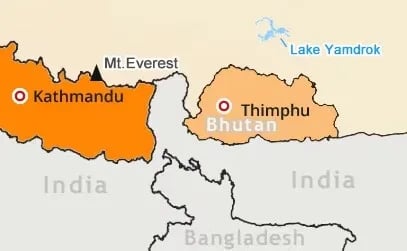 – It is a Himalayan kingdom and a landlocked country nestled between India and China, shares a unique and deeply rooted relationship with India. – It is a constitutional monarchy, currently led by King Jigme Khesar Namgyel Wangchuck. – It is known for its emphasis on Gross National Happiness (GNH) as a development philosophy. |
India-Bhutan: Developmental Partnership
- India remains Bhutan’s principal development partner since its First Five-Year Plan (1971). Development cooperation is guided through annual ‘Plan Talks’, focusing on Bhutan’s priorities.
- Major Commitments:
- During PM Modi’s March 2024 visit, India committed INR 10,000 crore for Bhutan’s 13th Five-Year Plan, and the first tranche of INR 5,000 crore was finalized in July 2024.
- Assistance spans infrastructure, health, education, agriculture, ICT, and digital connectivity.
- The High-Impact Community Development Projects (HICDPs) continue to improve rural infrastructure and livelihoods.
Trade and Commerce
- India is Bhutan’s largest trading partner, with trade rising from USD 484 million (2014–15) to USD 1.6 billion (2022–23).
- The India-Bhutan Trade, Commerce and Transit Agreement (2016) provides a free trade regime and duty-free transit for Bhutanese goods.
- Key outcomes of the Commerce Secretary Level Meeting (September 2024) included:
- New Land Customs Stations (LCS) at Hatisar and Darranga.
- Approval for border haats and new trade routes.
- Expansion of timber species for export and enhanced food imports.
- India remains Bhutan’s largest investor, contributing over 50% of total FDI across sectors like banking, power, IT, and education.
- Currency Swap Facility: USD 200 million (2022); extended under FCSA 2024–27 with INR 1,500 crore drawn.
- Standby Credit Facilities: Interest reduced from 5% to 2.5%; additional INR 300 crore extended in 2023.
Energy Cooperation
- Hydropower is the cornerstone of bilateral economic relations. India has helped construct four major hydroelectric projects (HEPs) like Chukha (336 MW), Kurichhu (60 MW), Tala (1,020 MW), Mangdechhu (720 MW) totaling 2,136 MW.
- Two more — Punatsangchhu-I and II (1,020 MW each) — are under construction, with Punatsangchhu-II expected to commission soon.
- Recent Initiatives: India allowed Basochhu HEP (64 MW) to trade electricity on the Indian Energy Exchange in 2023, later extending approval to Nikachhu HEP.
- The India-Bhutan Joint Vision on Energy Partnership (2024) envisions cooperation in hydro, solar, and green hydrogen.
- The Renewable Energy Roundtable (October 2024) in Thimphu expanded collaboration in sustainable energy.
Cooperation in Emerging Areas
- Space Cooperation: A milestone was achieved with the India-Bhutan SAT, launched on 26 November 2022, and the Joint Plan of Action (JPoA) on space signed in March 2024.
- The first Joint Working Group under JPoA met in September 2024.
- Environmental Collaboration: The first India-Bhutan JWG on Environment in October 2024 explored cooperation in biodiversity, waste management, and climate resilience.
- Digital and Fintech Integration: RuPay and BHIM UPI have made cross-border payments seamless since 2019–2021.
- Work is ongoing for full QR interoperability between Indian and Bhutanese systems.
- Integration of Bhutan’s Druk Research and Education Network with India’s National Knowledge Network (NKN) enhances academic and digital connectivity.
- Cross-Border Infrastructure: Both nations are working to enhance connectivity through:
- Rail links: Kokrajhar–Gelephu and Banarhat–Samtse.
- Immigration Check Post at Darranga (Assam): Opened in November 2024, improving tourism and trade.
- Gyalsung National Service Programme: India supports Bhutan’s Gyalsung Project, a national service and skill-building program, with INR 200 crore grant assistance, and INR 1,500 crore concessional loan;
- Education and Capacity Building: Education forms a strong bridge between the two nations:
- 1,000+ Bhutanese students benefit annually from Ambassador’s and ICCR scholarships.
- Bhutanese students pursue higher studies in IITs, Nalanda University, and other Indian institutions.
- 325 annual training slots under the ITEC programme support Bhutanese professionals.
- Cultural Ties: The India-Bhutan Foundation (IBF), established in 2003, fosters exchanges in education, science, and culture.
- Bhutanese pilgrims visit Buddhist sites across India, while construction of a Bhutanese Lhakhang at Bodh Gaya is underway, expected to open in 2025.
- Cultural cooperation also includes the exhibition of the Zhabdrung Statue from Kolkata’s Asiatic Society in Bhutan.
- Indian Community in Bhutan: Around 50,000 Indians work across Bhutan in infrastructure, hydropower, education, and commerce — symbolizing the people-to-people foundation of the bilateral partnership.
Concerns & Challenges Ahead of India–Bhutan Relations
- Border Negotiations with China: Bhutan’s ongoing talks with China over disputed border areas, including Doklam, raise concerns in India about potential strategic vulnerabilities.
- Infrastructure Diplomacy & Gaps: China’s Belt and Road Initiative (BRI) and its expanding footprint in South Asia could tempt Bhutan with economic incentives, challenging India’s traditional primacy in the region.
- While initiatives like the Kokrajhar–Gelephu rail link are promising, Bhutan’s rugged terrain and limited connectivity still hinder trade and mobility.
- Security Concerns: Cross-border movement and porous borders require enhanced coordination to prevent illicit activities and maintain peace.
- Sovereignty vs. Partnership: Bhutan’s desire for greater autonomy in foreign policy needs to be balanced with India’s strategic interests, especially in the sensitive Himalayan corridor.
- Multilateral Engagements: Bhutan’s increasing participation in global forums and its evolving stance on regional issues may occasionally diverge from India’s positions.
- Hydropower Dependency: Bhutan’s economy remains heavily reliant on hydropower exports to India.
- Delays in projects like Punatsangchhu-II and shifting energy demands pose risks to Bhutan’s fiscal stability.
- Youth Migration & Employment: Bhutanese youth increasingly seek opportunities abroad, including in India.
- Addressing employment and skill development is crucial to prevent brain drain and social discontent.
Road Ahead: Future Prospects
- As Bhutan transitions into a middle-income country, India’s cooperation will focus on technology, innovation, and youth empowerment. Emerging areas include:
- Digital partnerships: ICT, fintech, and startup collaboration.
- Tourism recovery and sustainable infrastructure.
- Regional integration through BIMSTEC and BBIN frameworks.
Conclusion
- India–Bhutan relations exemplify a unique model of friendship and trust, encompassing development, energy, technology, and culture.
- It continues to evolve—building a future of prosperity for both nations and setting a benchmark for regional cooperation, rooted in shared values and mutual respect.
| Daily Mains Practice Question [Q] Discuss the significance of cultural diplomacy and leadership symbolism in strengthening India–Bhutan relations. |
Previous article
COP30 in Belem: Climate Ambition and Reality
