


Syllabus: GS2/International Relation
Context
- The Western Indian Ocean (WIO) has emerged as a pivotal maritime region where security, trade, and diplomacy converge, once seen as a remote expanse, and a peripheral concern in global geopolitics.
About the Western Indian Ocean (WIO)
- It stretches from the eastern coast of Africa to the Arabian Sea, encompassing countries like Somalia, Kenya, Tanzania, Mozambique, South Africa, Comoros, Madagascar, Seychelles, Mauritius, and Réunion.
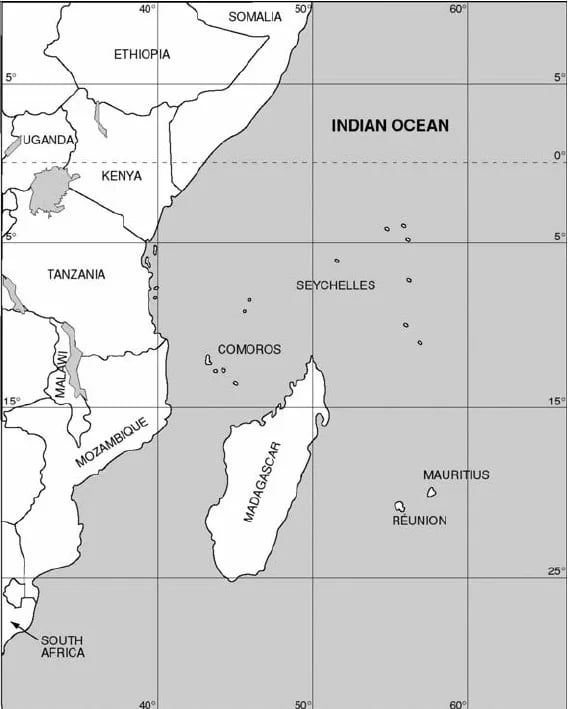
- It connects key maritime chokepoints like Bab el-Mandeb, the Mozambique Channel, and the Strait of Hormuz, making it a vital corridor for energy and trade.
- It is one of the busiest and most closely monitored maritime corridors in the world, stretching from the Horn of Africa to the Mozambique Channel, and dotted with island nations like Seychelles, Mauritius, and Madagascar.
- It is home to about 36 countries and almost 40% of the world’s coastline, making it a vital hub for commerce and connectivity that fuel economies across Africa, Asia, and the Middle East.
Maritime Security Challenges
- Piracy and Armed Robbery: The resurgence of piracy off Somalia and narcotics trafficking from Afghanistan pose persistent threats to maritime security.
- Recent disruptions in the Red Sea and Gulf of Aden have reignited concerns.
- Narcotics and Illicit Trafficking: Indian Navy operations, such as the seizure of 2,500 kg of narcotics by INS Tarkash, highlight the region’s vulnerability to transnational crime.
- Non-Traditional Threats: Climate change, illegal fishing, and maritime disasters require coordinated responses.
- There is a need for enhanced Maritime Domain Awareness (MDA) through real-time data sharing among regional stakeholders.
- China’s Naval Expansion: China’s growing presence, including naval activity and infrastructure investments, has added a layer of strategic competition in the region.
- Recently, China’s 48th Naval Escort Fleet, comprising the destroyer Tangshan and the frigate Daqing, embarked on anti-piracy mission to the Gulf of Aden.
- China’s Belt and Road Initiative (BRI) has driven massive investment in WIO port infrastructure — from Djibouti, where its first overseas military base is located, to Gwadar in Pakistan.
- China’s deployment of research and survey vessels in the eastern Indian Ocean further reveals dual objectives: mapping seabeds for scientific purposes while potentially enhancing submarine warfare capabilities.
- Climate-Induced Disasters: Rising sea levels, coral bleaching, and extreme weather events threaten coastal communities and marine ecosystems.
India’s Maritime Strategy and Regional Engagement
- India’s maritime approach emphasizes partnerships, trust, and a rules-based order, unlike China.
- While India never issued an explicit ‘Monroe Doctrine’ for the Indian Ocean, its influence has been widely acknowledged among littoral nations.
- Security and Growth for All in the Region (SAGAR Doctrine): It integrates defence cooperation, capacity building, humanitarian aid, and environmental protection.
- Combined Maritime Forces (CMF): India’s participation in CMF and its support for regional capacity-building through naval exercises and humanitarian missions reflect its growing influence.
- Environmental and Economic Projects: Projects like SOLSTICE-WIO, endorsed by INCOIS, aim to enhance ecosystem research and promote sustainable livelihoods in coastal communities.
- The region’s estimated natural resource value exceeds US$ 300 billion, underscoring the need for balanced development.
- Operational Strength: India strengthens interoperability with partners, through naval exercises like Konkan 2024.
- The Information Fusion Centre – Indian Ocean Region (IFC-IOR) in Gurugram acts as a regional intelligence hub, connecting India with African and Indo-Pacific nations for real-time maritime awareness, disaster response, and climate resilience.
- The Indo-Pacific Oceans Initiative (IPOI) and partnerships with France, the US, Japan, and Australia reflect India’s commitment to multilateral stability.
- Access to key facilities such as Duqm Port (Oman) and Réunion Island (France) enhances India’s operational reach and rapid response capability.
Africa’s Central Role
- The WIO region forms a critical bridge between Africa and Asia. India’s growing ties with these nations are both strategic and developmental.
- Partnership in Action:
- In Mauritius: India has invested over $680 million in infrastructure, healthcare, and maritime security, including Port Louis redevelopment.
- In Seychelles: Joint naval training enhances local defence capabilities.
- In Mozambique: India’s participation in the $20 billion LNG project with TotalEnergies boosts regional energy resilience and local employment.
- India’s engagement aligns with Africa’s Agenda 2063, emphasizing skills development, blue economy growth, and sustainable governance — positioning India as a partner of choice over debt-laden alternatives.
Way Forward
- Safeguarding Critical Chokepoints: The WIO hosts some of the world’s most vital maritime chokepoints — the Strait of Hormuz, Bab el-Mandeb, and the Mozambique Channel — through which much of India’s oil supply flows.
- India collaborates with regional and global partners, including France, the UAE, the US, and Saudi Arabia, conducting joint patrols, information-sharing missions, and maritime security exercises, to secure these arteries.
- Balancing Power with Responsibility: Smaller island states prioritize climate security, sustainability, and development — areas where India’s inclusive, capacity-building approach resonates strongly.
- By linking defence assistance with environmental and developmental initiatives, India distinguishes itself as a responsible maritime power rather than a hegemon.
- Shaping the Region’s Future: The Western Indian Ocean stands at the crossroads of security, trade, and diplomacy. As China expands its presence, India’s sustained engagement through partnership-driven policies ensures that the region remains open, stable, and secure.
- For India, the WIO is the strategic heart of its Indo-Pacific vision and its actions will define the regional balance of power, economic interdependence, and maritime governance for decades to come.
| Daily Mains Practice Question [Q] Discuss the factors contributing to the rising strategic significance of the Western Indian Ocean and evaluate how regional and extra-regional powers are reshaping its geopolitical landscape. |
Previous article
A Start for North-South Carbon Market Cooperation
Next article
An Amended Constitution Bill: Its Contentious Issues
