


Syllabus: GS3/Infrastructure
Context
- Post-harvest losses remain a significant challenge in India, particularly for perishable commodities and there is a need for integrated cold chain and value addition infrastructure.
Scale of Post Harvest Loss
- India ranks second in global agriculture production, but its share in global agricultural exports is only 2.4%, placing it eighth in the world.
- India’s post-harvest losses amount to approximately ₹1,52,790 crore annually, according to a Ministry of Food Processing Industries 2022 study.
- The biggest loss is from perishable commodities, which include livestock produce such as eggs, fish and meat (22%), fruits (19%) and vegetables (18%).
Reasons for the Post Harvest Loss
- Harvesting Inefficiencies: Premature or delayed harvesting leads to the quality & quantity loss.
- Mechanisation Gaps: Limited access to harvest machinery causes damage & spillage.
- Inadequate Market Access & Price Support: Small farmers often sell produce immediately after harvest due to liquidity constraints and lack of warehouse receipts.
- Leads to distress sales and discourages investment in proper storage or post-harvest handling.
- Pest & Disease Attacks: Inadequate pest control leads to crop spoilage.
- Inadequate Infrastructure: Shortage of cold chains, warehouses, moisture-proof silos leads to the rotting/decay of the food items.
- Transport Bottlenecks: The road infrastructure is not robust and there is a lack of refrigerated transport support.
Concerns
- Direct GDP Loss: In India, food loss is estimated at ₹1.5 trillion annually of GDP loss which can be avoided through more efficient and resilient food systems.
- Farmer Incomes: It leads to reduced profitability due to spoilage and wastage of produce.
- Green House Gas Emissions: Even modest percentage losses in cereals, particularly paddy, translate into more than 10 million tonnes of carbon dioxide (CO2)-equivalent emissions annually, owing to the high methane intensity of rice.
- Losses of livestock products are equally damaging because of their heavy resource footprint.
- Burden on government schemes: The food wastage also has a cascading impact on the government food security schemes such as Public Distribution System, nutrition missions.
- Loss of Resources: The production of these food crops is a cumulative result of proper water supply, energy, fertilizer, land and labour.
- The food lost is equivalent to the wasted water, energy, fertilizer, and land etc.
Government Initiatives
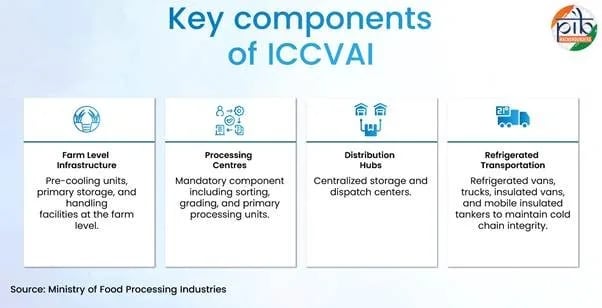
- Integrated Cold Chain and Value Addition Infrastructure Scheme (ICCVAI): The Ministry of Food Processing Industries (MoFPI) runs the ICCVAI Scheme, as part of the Pradhan Mantri Kisan Sampada Yojana (PMKSY).
- The scheme encompasses multiple sectors, including horticulture, dairy, meat, poultry, and marine or fish products, thereby addressing a broad spectrum of perishable commodities crucial to agriculture and allied industries.
- Mission for Integrated Development of Horticulture (MIDH): Under the MIDH, financial assistance is provided for a range of horticulture activities, including the construction, expansion, and modernization of cold storages with a capacity of up to 5,000 MT across the country.
- These projects are implemented based on Annual Action Plans submitted by States and Union Territories.
- Operation Greens Scheme: It is a central Sector Scheme being implemented by MoFPI under Pradhan Mantri Kisan SAMPADA Yojana from 2018-19, with the objective of enhancing the value realisation of farmers and minimizing post-harvest losses.
- Agriculture Infrastructure Funds (AIF): The Fund aims to facilitate the creation of post-harvest management and community farming assets, including cold storages, warehouses and processing units.
- All the eligible beneficiaries can avail collateral-free term loans of up to₹2 crore along with an interest subvention of 3% per annum on the term loan.
- Enhanced Budgetary Allocation under PMKSY (2025): The Union Cabinet in 2025 approved an additional outlay of₹1,920 crore for the PMKSY, raising the total allocation to ₹6,520 crore for the 15th Finance Commission cycle.
- This significant increase reflects the government’s strong commitment to expand the impact of cold chain infrastructure.
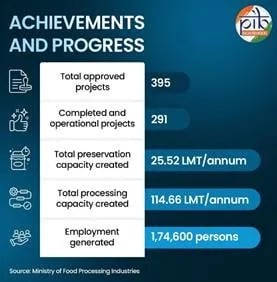
Achievements and Progress
Conclusion
- The evolution of the scheme demonstrates adaptive governance.
- The 2025 budget increase underscores the government’s focus on strengthening and expanding the impact of cold chain infrastructure.
- Strengthening linkages with agricultural marketing reforms can further amplify benefits for farmers including Doubling Farmer’s Income (DFI).
Source: PIB
Previous article
News in Short – 28 October, 2025
